Drauger OS 7.8 “Urgal” has been released as the latest stable version of this Linux distro aimed specifically at gamers, which builds on Ubuntu 26.04 LTS, pairs it with KDE Plasma desktop, and shapes the experience around gaming.
The distro describes itself as a “Desktop Linux Gaming Operating System,” designed to provide a platform where gamers can start playing quickly while keeping a secure and stable Ubuntu LTS foundation.
Strange, but at the same time, the developers do not present this distro as an everyday desktop OS. The project openly says Drauger OS is not for daily use, noting it does not include common desktop applications like an office suite or audio and video editing tools. Which is a little strange, considering that installing them takes just a single command.
Anyway. If you want a polished all-purpose Linux desktop, this probably is not it. But if you like gaming-focused distro experiments, Drauger OS clearly plays in that space.
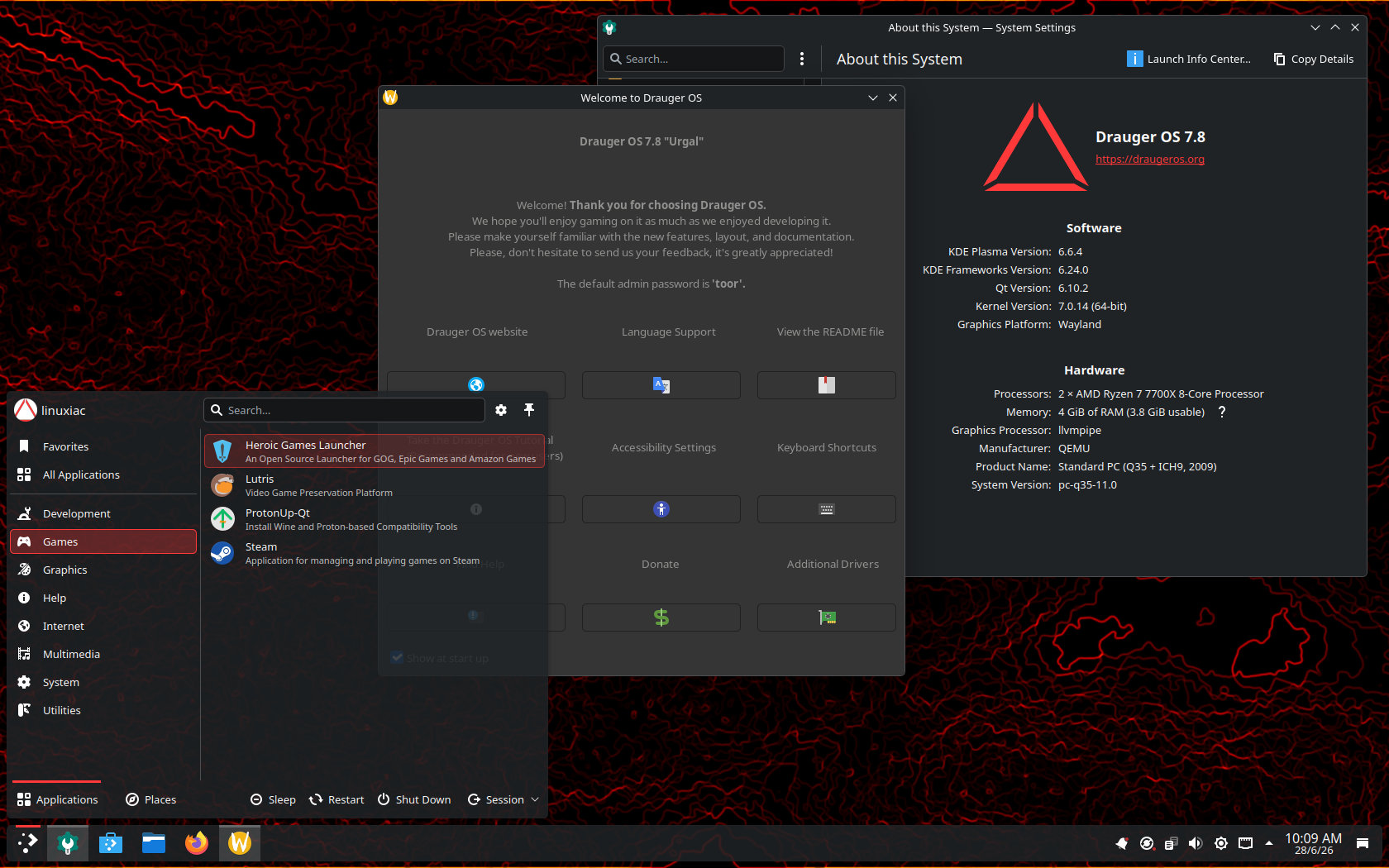
The new 7.8 release ships with Linux kernel 7.0, with developers highlighting day-one NTSYNC support as a key gaming-related benefit. Just to mention, NTSYNC aims to improve Windows game compatibility layers like Wine and Proton, where synchronization performance directly affects gaming behavior and responsiveness.
On the desktop side, the distro ships with KDE Plasma 6.6 (v6.6.4) and Wayland by default, along with KDE Frameworks 6.24, the KDE Gear 25.12.3 app collection, and Qt 6.10.
The gaming focus is clearly visible in the preinstalled applications: Heroic Games Launcher, Lutris, ProtonUp-Qt, and Steam. There are also several application-level changes in this release. Firefox is now shipped as a Flatpak, which developers present as a way to avoid Ubuntu’s Snap packaging while giving users a browser that updates through Flatpak.
Drauger OS 7.8 also switches to sudo-rs instead of the traditional C-based sudo implementation, although the sudo command remains available as a symlink to sudo-rs. The traditional sudo package remains in the repositories for users who need it.
The installer, called Edamame, has also been improved, with Quick Install now able to copy network settings using both NetworkManager and netplan. Netplan settings can be carried over from the live system to the installed one. Other application changes include replacing Elisa with Lollypop, adding VLC and Flatseal, and removing Synaptic.
One thing worth pointing out is the storage requirement. Drauger OS lists 32 GB as the minimum, with roughly half used after installation. That feels heavy for a niche gaming distro, especially when many users may only want to test it in a virtual machine or on spare hardware.
The recommended storage, however, is even higher: a 256 GB NVMe SSD. For the best results, the project lists a 500 GB NVMe 4.0 SSD.
Now, the important caveat: Drauger OS still feels like a niche project rather than a distribution with a strong, proven release track record. It has been around for several years, and the developers clearly understand the problem of gaming-focused Linux distros disappearing over time.
That is a fair point, but it does not make Drauger OS a mature or battle-tested choice. The release cadence appears slow and irregular, and the project warns users it is not meant for everyday desktop use. So, while Drauger OS 7.8 is interesting, it is best viewed as a niche gaming-focused Ubuntu/KDE experiment for enthusiasts, distro hoppers, and Linux gamers who enjoy testing alternatives.
For users who want a stable, predictable daily-driver gaming setup, a distro such as Arch-based CachyOS, Fedora-based Nobara, or the atomic Bazzite will likely remain the safer route. But for those who like specialized Linux distributions, Drauger OS 7.8 “Urgal” is worth a look. It brings an Ubuntu LTS base, KDE Plasma, plus gaming tools out of the box.
For additional details, see the project’s website. The announcement for the new version 7.8 is on Reddit.