
The Rhino Linux team has unveiled the latest 2026.1 (and the first of the year) release of its Ubuntu-based rolling-release distribution, featuring new Lomiri desktop images for generic x86_64 and ARM64 systems, as an additional offering alongside the company’s own Unicorn desktop.
If you’re wondering what Lomiri is, it’s the graphical shell best known from Ubuntu Touch, the mobile Linux OS maintained by UBports. Designed for convergence, allowing the same UI to adapt across phones, tablets, and desktop setups, it began as Canonical’s Unity 8 interface and was continued by UBports after Canonical ended development of Ubuntu Touch and Unity 8.
This release follows Rhino Linux’s ongoing work with UBports to bring Lomiri to more devices. With this snapshot, users installing Rhino Linux on standard x86_64 or ARM64 systems can choose Lomiri as the desktop environment via the new generic ISO images.
“While Lomiri support on generic systems is still considered an evolving experience, we are excited by the progress made so far and are excited to continue working closely with the UBports team to provide improvements for Lomiri users on desktop and mobile.”
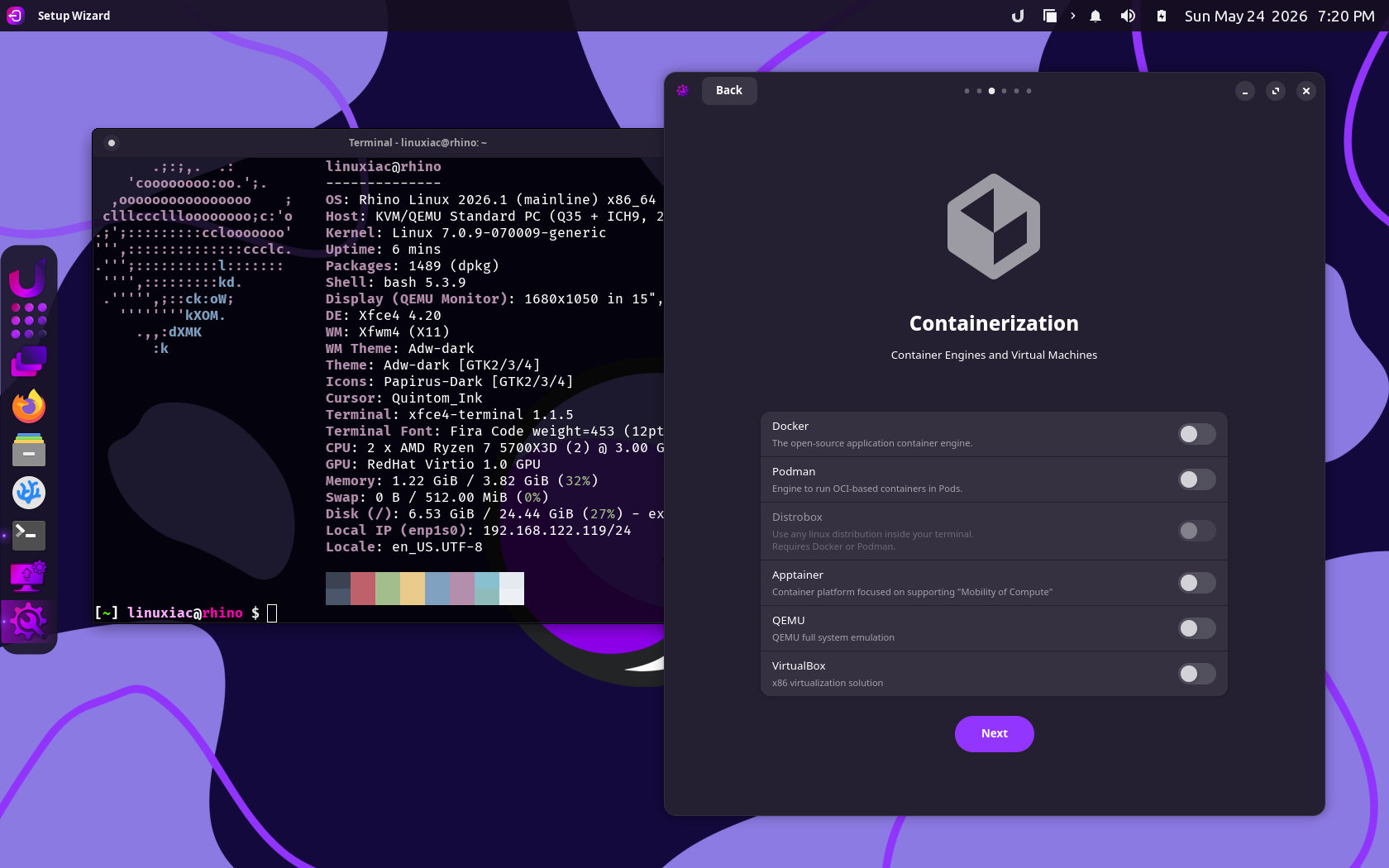
The release also updates Pacstall, Rhino Linux’s AUR-inspired package manager used to build and install user-contributed packages on top of Ubuntu’s base, to the 6.4.x series. This snapshot adds new DNUM and CDNUM internal variables, PACSTALL_XTRACEFD and PACSTALL_XTRACEFDLOG environment variables, and exported KVER support for pre/post scripts.
On top of that, according to devs, Pacstall 6.4.x also includes bug fixes, internal cleanups, and translation updates, while the full changelog is available through the Pacstall release page.
Additionally, Rhino Linux 2026.1 updates the default kernels across its images. Generic ISO disk images now ship with Linux kernel 7.0.9-generic, while PinePhone and PineTab images use 6.18.32-sunxi. PinePhone Pro images ship with 6.18.32-rockchip, PineTab2 images use 6.9.0-okpine, and Raspberry Pi images now include 7.0.0-raspi by default.
For additional details, see the announcement. The Rhino Linux 2026.1 snapshot images are now available on the project’s website.



Very nice.
Lomiri is starting to look usable.
with the issues this distro has had in the past there is no way i’m using it as a long term os on my machine.
What issues did it have? I think them only offering XFCE as a DE is an issue as it doesn’t support Wayland fully yet and not having something like KDE or Gnome as an alternative is not a good way. Mint and Xubuntu already have XFCE so this is pointless to me.