
KaOS 2026.09 is now available as the second stable ISO of the independently developed, Qt-focused Linux distribution, fully based on Dinit, and marks another step away from systemd and KDE Plasma.
The new release uses a startup stack built around Dinit, Turnstile, and seatd for system startup, sessions, and services. Systemd components are now used mainly for udev and tmpfiles. Elogind remains only to provide Polkit integration.
For logins, KaOS has switched to greetd with the console-based Tuigreet as the default display manager. A new Noctalia-based graphical greeter is also available in the repositories, although the developers say it is not yet as complete as Tuigreet.
On the desktop side, KaOS continues its move toward a Niri and Noctalia-based environment. The ISO ships with Niri 26.04 and Noctalia 5.1. Noctalia brings a new screenshot region editor with annotation tools, ModemManager support for mobile data, and collapsible groups in the settings interface.
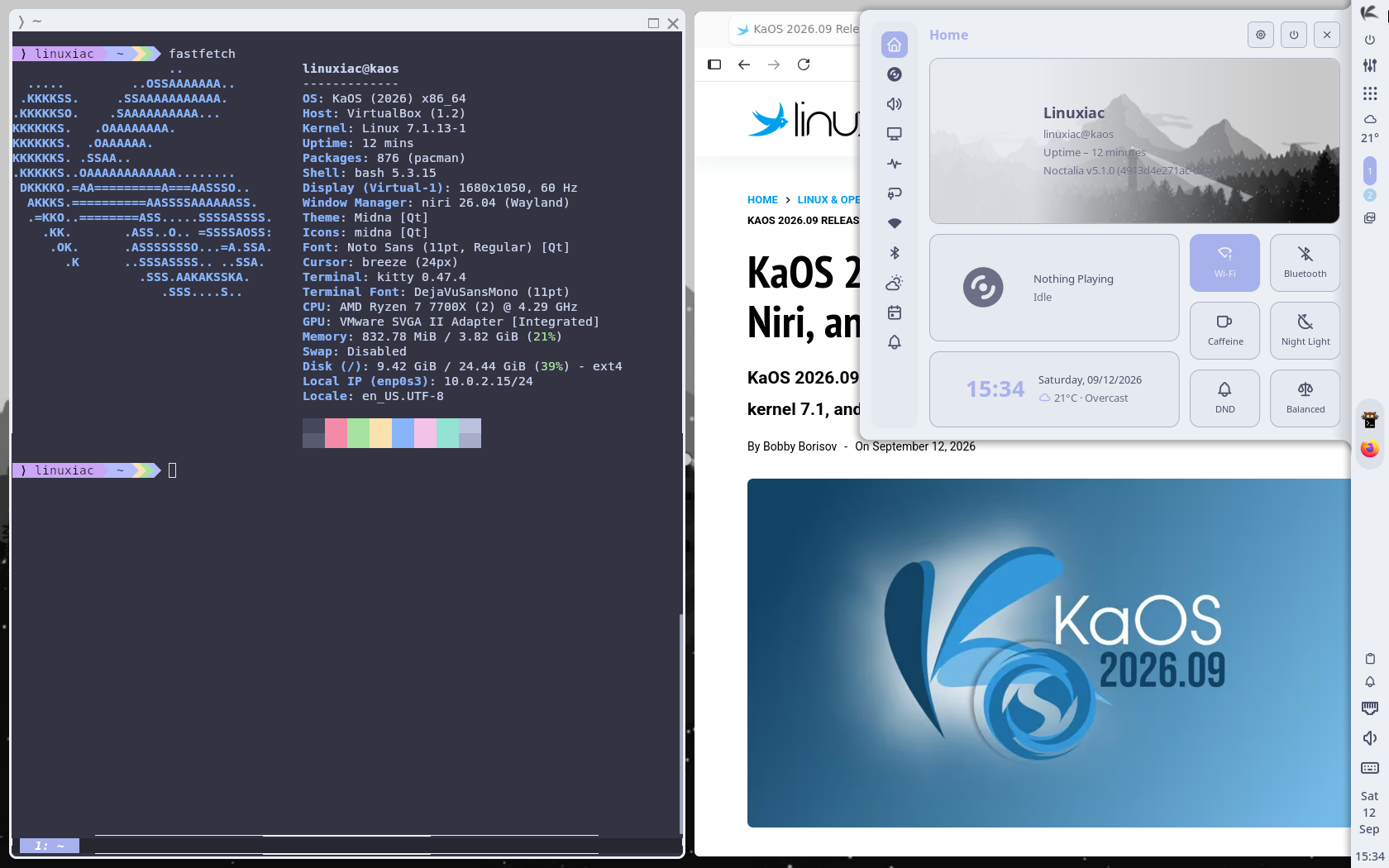
The distribution remains firmly focused on Qt applications and, according to the project, the new ISO is still GTK-free.
One of the biggest changes, however, concerns KDE Plasma. Plasma 6.7 remains fully available in the repositories, but KaOS has confirmed that it will be the final Plasma series offered by the distribution.
Once KDE Plasma moves to version 6.8, Plasma packages will be removed from the KaOS repositories. The project says this decision is tied to the broader move away from systemd and its preference for the Niri/Noctalia setup going forward.
KaOS 2026.09 also includes a substantial refresh of the underlying system. According to the developers, roughly 70% of the distribution was rebuilt during the past two months because several major updates were held back until the Dinit transition was completed.
Among the updated components are Linux kernel 7.1, GCC 15.3, glibc 2.43, Binutils 2.46, Mesa 26.2, PipeWire 1.6.8, GStreamer 1.28, OpenSSH 10.5, Rust 1.98, CMake 4.4, ZFS 2.4.4, MariaDB 12.3.3, and Poppler 26.09.
Another notable change is the bootloader. Limine is now the default, while systemd-boot has been removed as an installation option. Other UEFI bootloader choices remain available through the Calamares installer.
Speaking of Calamares, it has also been updated so that it can now operate fully under a pure Wayland session, including fixes needed to restore text input in QML-based installer modules such as user creation.
Among the newly added packages are noctalia-greeter, umbriel, xdg-desktop-portal-umbriel, wlroots, and openrc-settingsd. Audacity 4 has also returned to the repositories now that it is Qt 6-based, replacing Tenacity.
For storage, automated partitioning in Calamares continues to support XFS, EXT4, Btrfs, and ZFS. XFS remains the default filesystem for the ISO.
Users planning to test KaOS 2026.09 in VirtualBox should note that 3D acceleration and the VMSVGA graphics controller are required due to the distribution’s Wayland-based desktop. The developers warn that the system will not boot in VirtualBox without this configuration.
There are also a few known limitations. RAID installations are currently unavailable, XFS cannot be used for BIOS installs because of a GRUB compatibility issue, and some privilege escalation actions may not work because Polkit has not yet been fully adapted to the Turnstile/seatd stack.
Lastly, KaOS warns that its installation images do not support Ventoy, Rufus, or UNetbootin for creating bootable media, so users should follow the project’s official installation-media instructions instead.
For more details, see the official KaOS 2026.09 release announcement.

Noctalia is becoming a standard… 😉
Using it makes me forget the originality of each window manager.