Artix Linux, an Arch-based rolling-release distribution replacing systemd with alternative init systems like OpenRC, runit, s6, and dinit, has announced its November 2026 ISO release.
This is the project’s second (following the April release) and final official release of the year, featuring Linux kernel 7.2.14, updated software packages, and several changes to desktop and service management.
The most notable one is the transition of KDE Plasma to Wayland. The distribution has updated the necessary configurations for both its Plasma and Community-Qt editions to accommodate the switch.
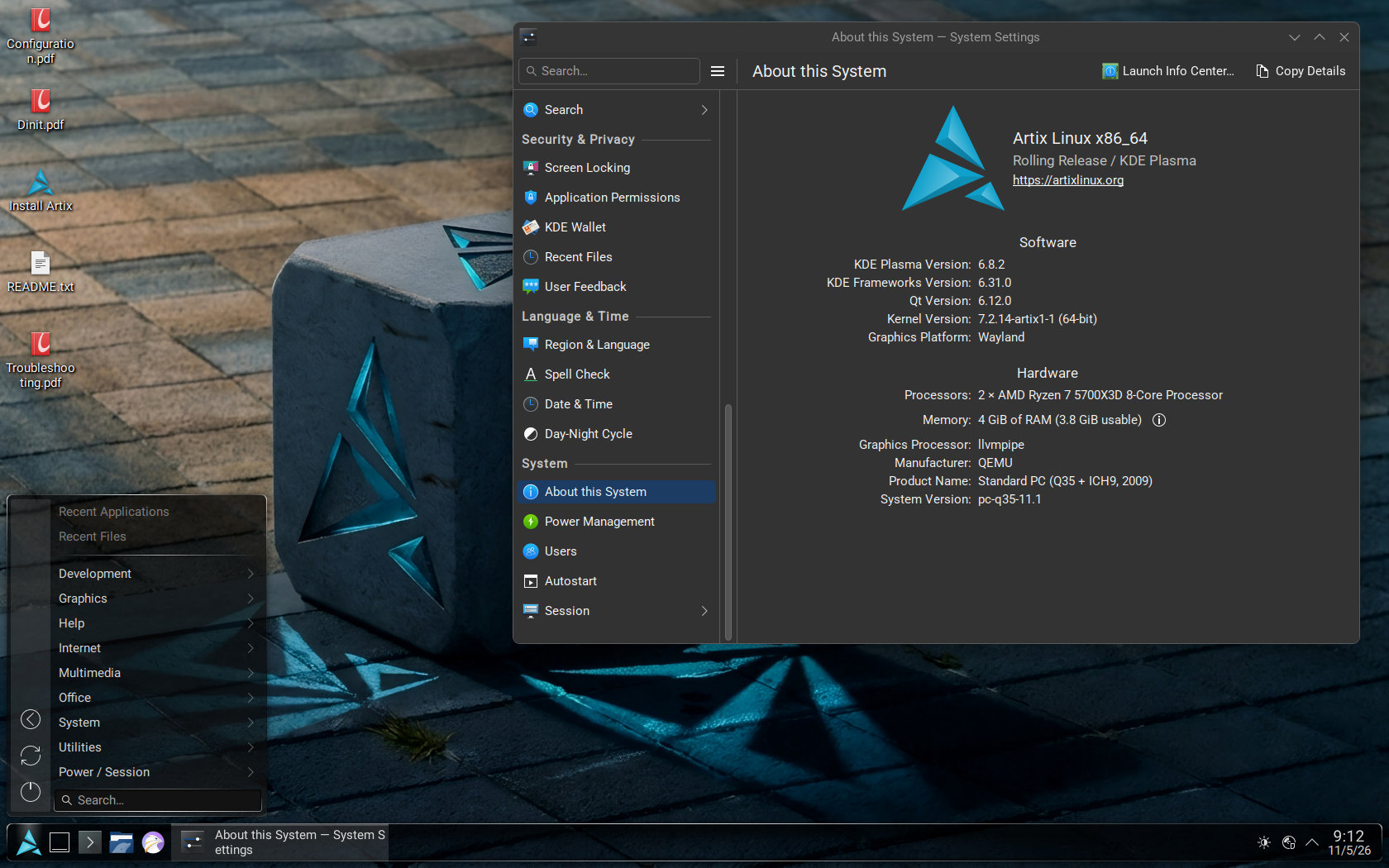
However, Wayland support remains limited to Plasma for now. Developers say other desktop environments are at various stages of Wayland implementation and are not yet suitable for daily use. As a result, users may encounter Wayland session options in their login managers that do not work correctly or at all.
Another important improvement concerns user services. Artix Linux 2026.11 introduces fully implemented user service management for OpenRC and dinit, letting users run and manage services within their own sessions instead of relying only on system-wide services.
Similar functionality is possible with runit and s6 through userspawn, though enabling it currently requires manual user configuration.
The release also reduces the number of desktop environment and init system combinations offered through official installation images. Developers say this decision aims to simplify testing and enable faster release cycles while maintaining installation options for users with different experience levels.
Moreover, the Plasma and Xfce gaming editions remain in beta. These images will continue to be distributed through the project’s weekly downloads section for additional testing rather than being included among the official release images.
As usual, Artix Linux continues to follow Arch Linux’s rolling-release model, meaning existing users can obtain the latest package updates through the distribution’s regular update mechanism without reinstalling their systems.
For more information, see the announcement. The installation images are available from the project’s download page, where users can choose between KDE Plasma, Xfce, Cinnamon, LXQt, LXDE, and MATE desktop environments, as well as OpenRC, runit, s6, and dinit init systems.