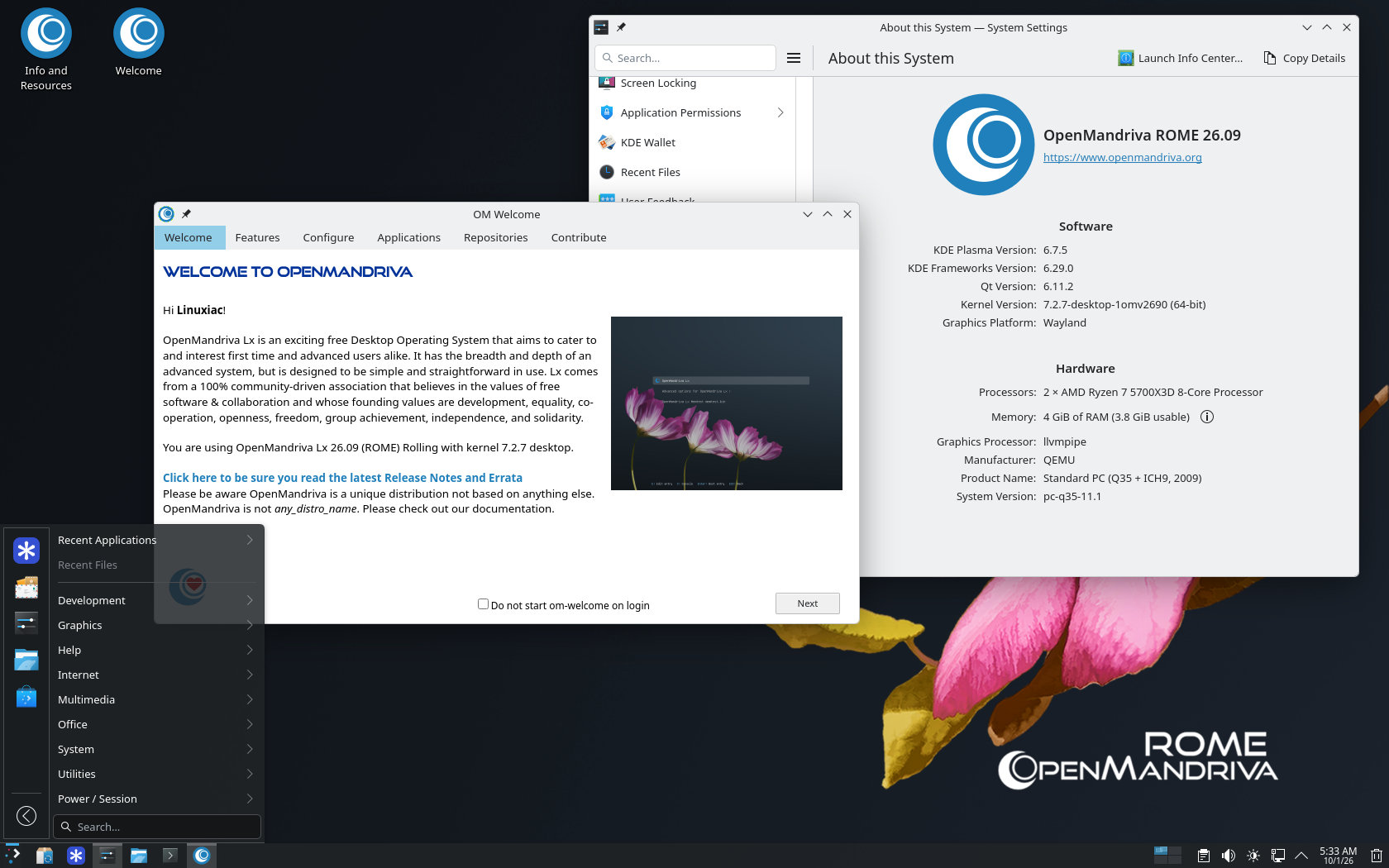
OpenMandriva has published refreshed installation images for ROME, its rolling-release edition, combining the distro’s current software stack in the new 26.09 snapshot.
OpenMandriva ROME 26.09 ships with Linux kernel 7.2 by default, while kernel 7.3-rc4 is also available for users who want to test the upcoming series. The distro also provides kernels in both Clang-compiled and GCC-compiled variants.
On the desktop side, KDE Plasma has been updated to 6.7.5, accompanied by KDE Gear 26.08.1 and KDE Frameworks 6.29. GNOME users get version 50.3, while LXQt moves to 2.4. Xfce remains on the 4.20 series, and MATE 1.28 now includes an experimental Wayland session.
The repositories also contain newer releases of Hyprland, COSMIC Desktop, Niri, Sway, i3, IceWM, Qtile, and several other window managers and desktop environments.
Under the hood, a significant change is the move to RPM 6.1. OpenMandriva has extended it with an optional %pgo section for spec files to simplify Profile-Guided Optimization when building packages. Several packages already use this feature alongside broader Link-Time Optimization.
The development toolchain has also moved forward. LLVM/Clang 23.1.2 is now the default compiler, GCC has been updated to 16.2, and the distribution ships glibc 2.44.
Graphics support comes with Mesa 26.2.3 and ROCm 10.0, including patches aimed at extending ROCm support to older Radeon GPUs. For NVIDIA hardware, the open NVIDIA kernel module has been moved directly into the kernel, avoiding situations where it becomes out of sync after kernel updates. The proprietary driver has meanwhile been updated to version 610.57.
Interestingly, another notable addition is Snap support. OpenMandriva already supports Flatpak with Flathub enabled and AppImage, but users can now install snapd from the repositories. The project stresses that native RPM packages remain its preferred format due to tighter system integration and reduced duplication.
The Plasma and LXQt editions have a new default browser. Helium 0.17.2 replaces ungoogled-chromium and is based on that project, restoring selected Chromium functionality without reintroducing Google services. OpenMandriva has adapted Chromium Embedded Framework to use Helium, allowing OBS Studio to use a CEF plugin based on the browser.
For gaming, ROME 26.09 includes Wine 11.18 with WoW64 support, Proton 11, DXVK 3.0.2, vkd3d 2.0, and vkd3d-proton. The Steam installer available through the non-free repository has also been updated to version 1.0.0.86.
Moreover, the release brings Qt 6.11.2, GTK 4.22.5, PipeWire 1.6.9, FFmpeg 9.0, GStreamer 1.28.6, Firefox 156, Thunderbird 155, LibreOffice 26.8, GIMP 3.2.4, Blender 5.2.2, and Krita 6.0.4, which has now moved to Qt 6.
OpenMandriva has also expanded the selection of local AI software available from its repositories, including Ollama, llama.cpp, Whisper.cpp, Stable Diffusion.cpp, ComfyUI, KoboldCpp, Aider, and several other tools. Many use the system-wide GGML library with GPU acceleration through ROCm, Vulkan, or OpenCL.
For additional details, see the announcement.
The refreshed ROME 26.09 images are available in Plasma X11, Plasma Wayland, and GNOME Wayland editions, with community-maintained LXQt, MATE, and Xfce spins also offered. Plasma and LXQt images are available for regular x86_64 systems as well as optimized znver builds for AMD Ryzen processors. An AArch64 server image is available too.
One exception is COSMIC Desktop: a ROME 26.09 COSMIC installation image was held back because of an issue with the login manager. Existing COSMIC users can continue updating normally, while new users can install it from the repositories.