CachyOS, the performance-focused Arch-based distribution, has released its November 2026 update, the sixth of the year. The headline addition is support for Easy Anti-Cheat Linux v2 through a dedicated linux-cachyos-eac kernel. This kernel works with Secure Boot, TPM 2.0, IOMMU, and kernel lockdown to meet EAC’s system verification requirements.
The EAC kernel gets its own boot entry, letting users switch to it when needed while keeping their regular kernel. CachyOS also introduces eac-setup and eac-status utilities for configuring and verifying the setup. It supports systemd-boot, Limine, and rEFInd, plus experimental GRUB compatibility. However, this does not guarantee compatibility with every EAC-protected game.
Another change is CachyOS Package Installer 2.0, featuring a redesigned interface and optional integration with the AUR, Flatpak, and AppImage. For AUR packages, the installer displays PKGBUILD files and installation scripts for review, using static analysis to flag suspicious code before building packages.
It also supports reviewing changes between installed and updated AUR packages. AppImages can be installed from local files or GitHub projects, with support for tracking newer releases and importing applications previously managed through Shelly or Gear Lever.
The release also introduces cachyos-recovery, a standalone recovery environment launched directly from the bootloader or UEFI, removing the need for external recovery media. Users can boot into Btrfs snapshots to test them before permanently rolling back their systems.
The recovery tool supports LUKS-encrypted installations, works independently of Snapper, and regenerates kernel, initramfs, and bootloader files when restoring a snapshot. On UEFI systems, it uses about 70 MB on the EFI System Partition.
On the graphics side, the new cachyos-drm-awaiter replaces early kernel mode setting and the previous NVIDIA module loader. It makes sure GPU drivers load before the display manager starts, supports different graphics drivers, and displays a QR code when driver initialization fails.
The installation process also changes. Calamares now uses shared CachyOS installer libraries for several backend operations. The command-line installer has received substantial refactoring, including improvements to LUKS and LVM handling. Plymouth is now optional during installation.
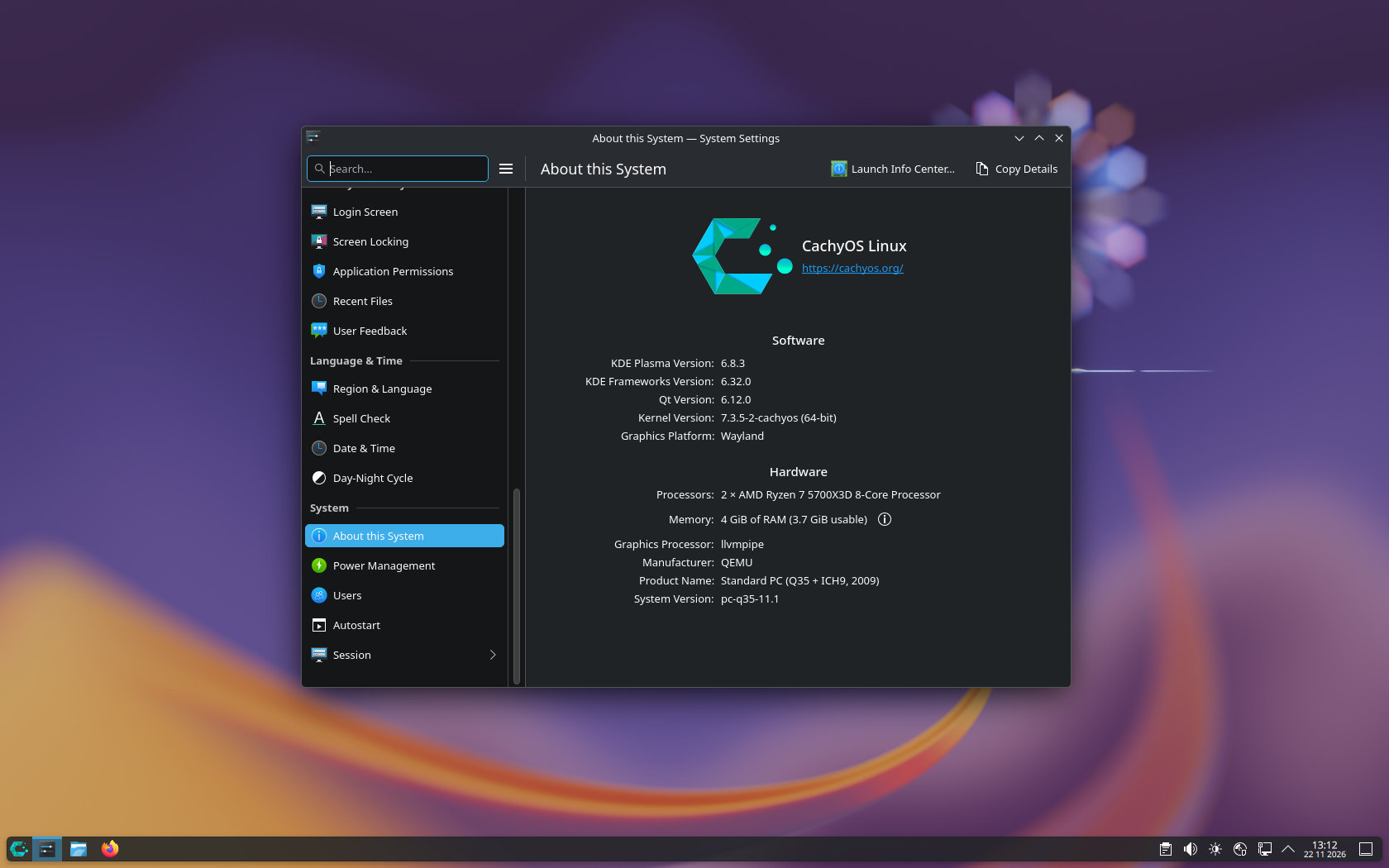
Under the hood, the new installation media ships with Linux kernel 7.3.5, NVIDIA 620.73.04 drivers, Mesa 26.3.1, and Limine 12.10. Additional changes include prebuilt NVIDIA 580xx kernel modules, support for compiling the kernel with Rust and ThinLTO, and updated Proton-CachyOS packages.
Other improvements include updated hardware detection for Intel hybrid processors, tablet mode support for the Framework Laptop 12, and the return of systemd-oomd configuration enabled by default. CachyOS now provides a dedicated image for WSL.
Finally, existing CachyOS users should know that the transition to cachyos-drm-awaiter requires reinstalling their driver profiles after updating. The developers recommend running sudo pacman -Syu, followed by sudo chwd -a -f.
For more information, see the announcement. The new installation images are available through the project’s download mirrors.