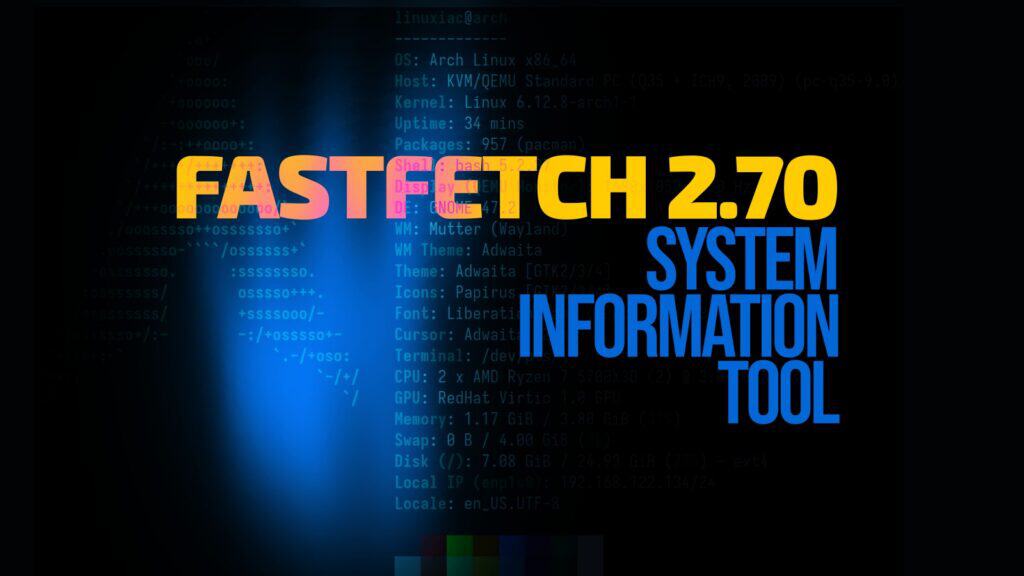
Fastfetch, the popular open-source system information tool that displays hardware and software details in the terminal, has released version 2.70, introducing improved Android hardware detection, Linux audio enhancements, fewer dependencies, and several bug fixes.
A notable change for Linux users is the removal of the libpulse and libddcutil dependencies. Developers say package maintainers can now remove both libraries from their Fastfetch packages.
The Sound module now has an ALSA fallback. Linux systems without a sound server can display information about their audio output devices and volume levels instead of returning an error.
On Android, Fastfetch 2.70 introduces several hardware reporting improvements. The tool can now detect sound devices, and display detection uses Android’s Binder interface without needing extra permissions or launching a separate process.
Battery reporting now includes temperature, estimated remaining time, and charging method, distinguishing between AC, USB, and wireless charging.
Moreover, media detection is now available when Fastfetch runs under an Android application user ID, although this functionality requires notification access permission. The tool can also identify applications by their displayed names rather than package identifiers.
On the configuration changes side, QuickJS-based format scripting, deprecated in version 2.69, has been removed entirely. Users relying on it will need to migrate their scripts to Lua.
The Command module also replaces the useStdErr option with useOutput, allowing users to capture standard output, standard error, or both. The default is now both streams.
Another change concerns shell detection. Fastfetch now obtains the user’s login shell from /etc/passwd rather than relying on the $SHELL environment variable, which may contain outdated information after a shell change.
Disk reporting has also been adjusted. The {size-available} custom format placeholder was removed, while {size-free} now follows the disk.useAvailable setting. Plus, the JSON output no longer includes the bytes.available and bytes.used fields.
As for bug fixes, Fastfetch 2.70 addresses an issue where external monitors detected through DDC/CI could incorrectly appear as built-in displays on Linux. It also improves Snapdragon X1 and X2 processor identification and fixes font-size detection in the foot terminal.
Other corrections include properly identifying Vulkan drivers on multi-GPU systems, fixing display detection on Android 17, resolving incorrect disk capacity reporting for quota-limited Windows volumes, and correcting MAC address reporting on macOS 27.
Finally, the release adds Finnish language support, pkgsrc package detection on macOS, a filled Artix Linux logo, and several internal performance improvements.
For more information, see the official Fastfetch 2.70 release notes.