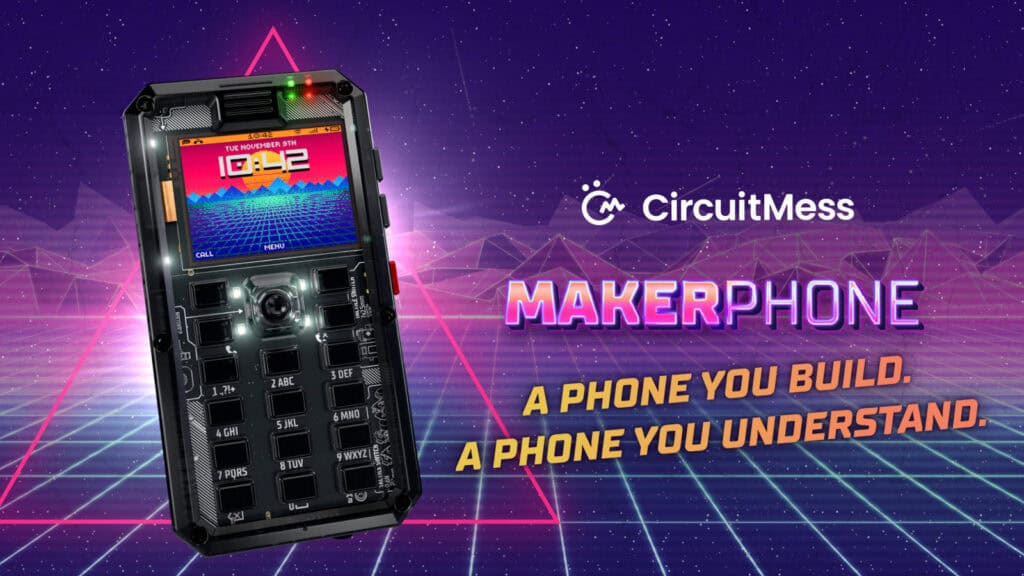
CircuitMess has launched MAKERphone 2.0, a build-it-yourself 4G mobile phone based on the ESP32-S3, combining open, hackable hardware with real cellular connectivity, MicroPython and C++ programming, and a modular expansion system.
The project has attracted significant attention on Kickstarter. With five days remaining, MAKERphone 2.0 has raised $385,335 from 1,937 backers against a $30,000 goal, putting the campaign at more than 1,280% funded. Kickstarter has also selected it as a “Project We Love.”
MAKERphone 2.0 follows the original 2018 model, but the assembly process is substantially simpler. The first version required about seven hours of soldering. The new phone can be assembled in about two hours without a soldering iron or prior electronics experience. Components click, screw, or plug into place, with illustrated instructions and video guides provided.
Once assembled, it functions as a real mobile phone rather than just an electronics kit. Insert a nano-SIM and the device can make voice calls and send SMS messages over 4G LTE Cat-1 networks, with 2G as a fallback.
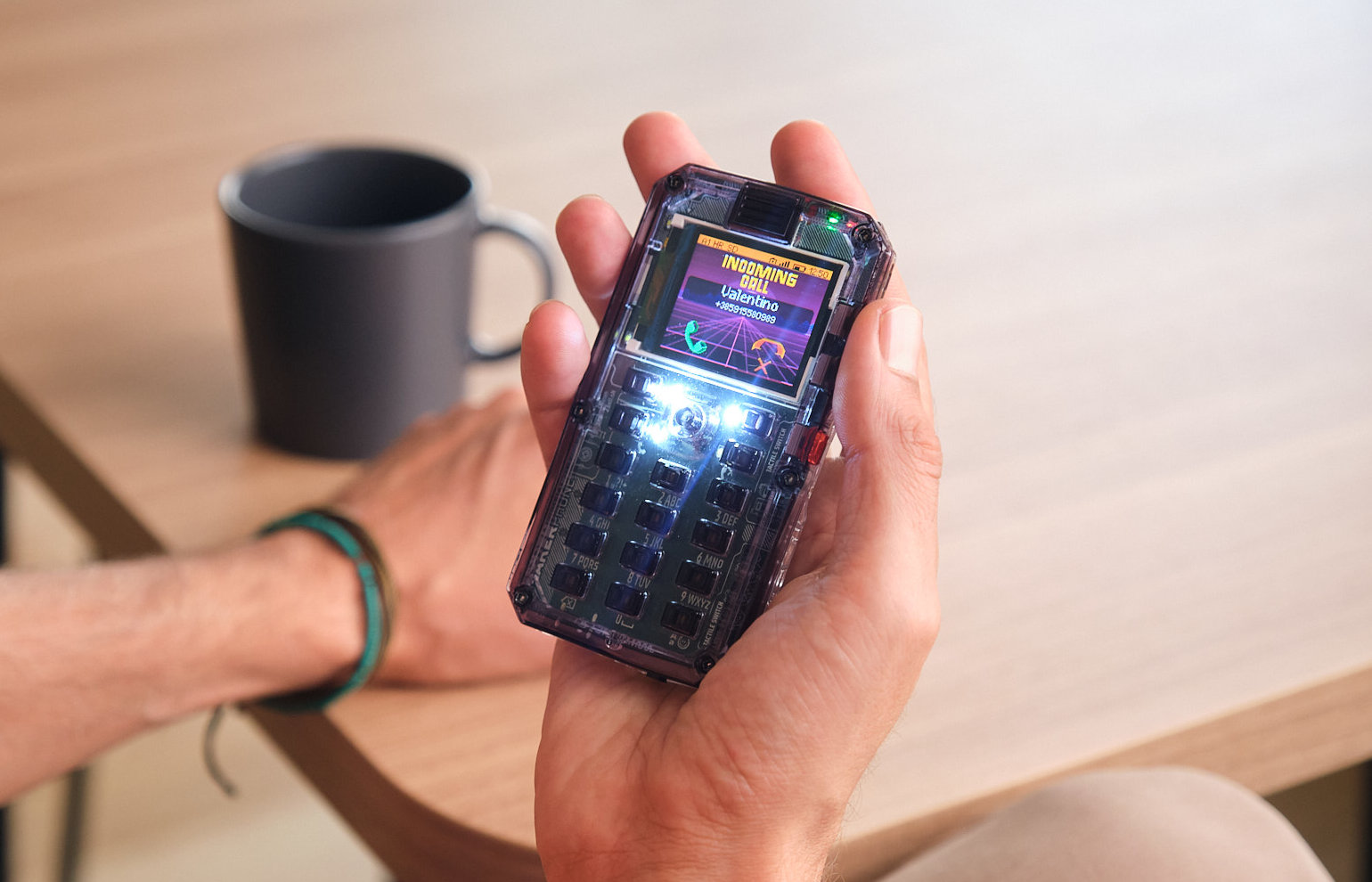
At its core is a dual-core ESP32-S3 with 4 MB of flash storage and 4 MB of PSRAM. The device includes a 1.77-inch 160×128 color display, traditional 12-key phone keypad, navigation joystick, four function buttons, dedicated power control, and volume buttons.
Other hardware includes Wi-Fi, Bluetooth, a microSD slot, USB-C for charging and programming, a 3.5 mm headphone jack, a speaker, a microphone, a real-time clock, decorative RGB LEDs, and a 1,000 mAh battery. The assembled phone measures 11.5 × 6 × 1.8 cm and weighs 104 grams.
CircuitMess describes the device as fully open and hackable, built on an Arduino-compatible platform without the usual restrictions of consumer smartphones. Owners can program it directly using MicroPython or C++ and create their own applications, games, and automations.
For beginners, the company provides VibeBoy, an AI-assisted coding environment that lets users describe what they want to build in plain English. Users can transfer the generated code to the phone, inspect it, modify it, and eventually replace it with code written directly in Python or C++.
The phone ships with more than 10 retro-style games alongside familiar phone functions such as contacts, call history, alarms, notes, a calendar, music playback, file management, and photo and video viewing.
Hardware expansion is handled through CircuitMess’ UMAX connector. Six optional modules are planned, including a camera, larger speaker, flashlight, temperature and humidity sensor, infrared module, and a DIY perf board for building custom circuits. Connected modules are automatically detected, with their corresponding applications appearing in the phone’s menu.
CircuitMess is also offering an optional MAKERband companion smartwatch built around the ESP32-C3 RISC-V chip. It can pair with MAKERphone 2.0 as well as Android and iOS devices and provides notifications, music controls, camera shutter functionality, programmable watch faces, and several mini-games.
According to CircuitMess, MAKERphone 2.0 is beyond the prototype stage. The hardware design is complete, final production hardware exists, and the software is feature-complete and undergoing final testing. The Kickstarter campaign aims to fund manufacturing at scale rather than further R&D.
For more information, visit the MAKERphone 2.0 Kickstarter campaign page.
Image credits: CircuitMess