
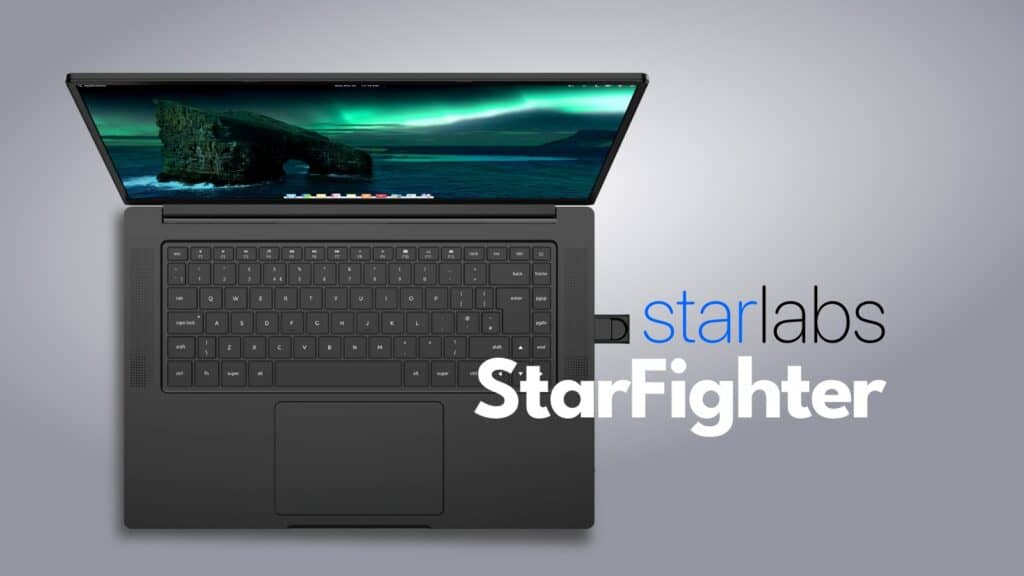
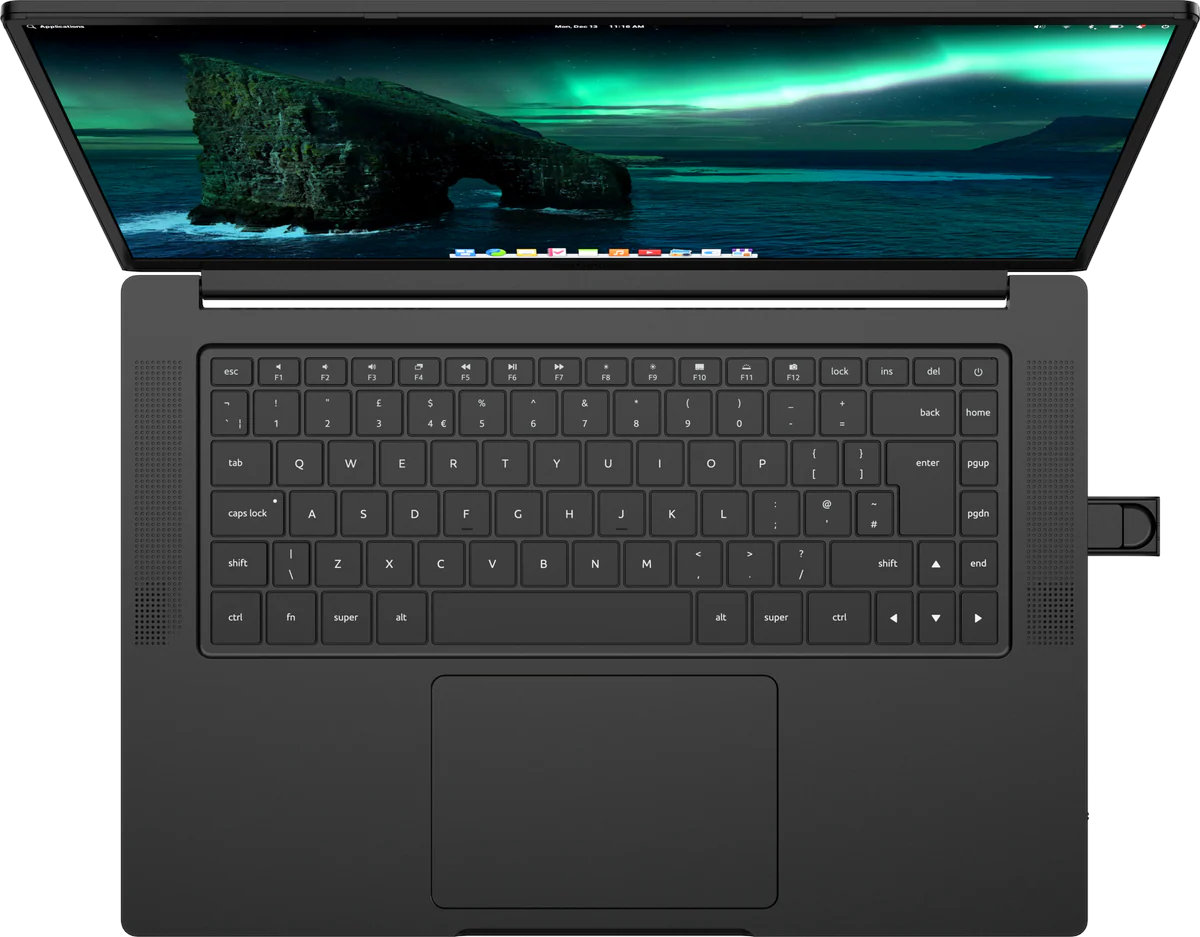
Star Labs has opened sales for the StarFighter, its most expensive Linux laptop line to date. The 16-inch system is positioned as a premium machine with open-source firmware, high-resolution matte display options, and several preinstalled Linux distributions.
The StarFighter is available in three main configurations. The Standard model starts at $1,878 before taxes and includes a QHD 165Hz matte display, an Intel Core Ultra 5 125H 14-core processor, and 32GB of LPDDR5X memory. The Ultra model upgrades to a 4K 120Hz matte display, an Intel Core Ultra 9 285H 16-core processor, and 64GB of LPDDR5X memory, starting at $2,843 before taxes.
The AMD model uses the same 4K 120Hz matte display and 64GB memory but switches to an AMD Ryzen 7 8845HS 8-core processor, with pricing starting at $3,573 before taxes.
That pricing places the StarFighter well above Star Labs’ smaller systems and makes it the company’s flagship laptop rather than an entry-level Linux notebook. For comparison, the StarLite starts at $1,042 before taxes, while the StarFighter starts at $1,878 and rises to $3,573 for the AMD configuration.
Strange, the AMD configuration is notably more expensive than the Intel Ultra model, despite both sharing the same display and memory class. Star Labs does not explain the difference on the product page, so the gap should be treated as a configuration and pricing detail rather than a performance claim.
The laptop features a 16-inch 16:10 IPS display. Star Labs lists the higher-end panel with a 3840×2400 resolution, 120Hz refresh rate, 625 cd/m² brightness, 178-degree viewing angles, and a true matte coating. The Standard model uses a QHD 165Hz matte panel.
The laptop uses open-source firmware powered by coreboot and edk II, with updates delivered through the Linux Vendor Firmware Service. LVFS updates cover the BIOS, Embedded Controller, and SSD, while the firmware supports measured boot and advanced configuration options.
Privacy hardware is also part of the design. The StarFighter includes a removable webcam that connects magnetically and can be stored inside the chassis when not in use. Additionally, it has a physical wireless kill switch to disable wireless connectivity.
Connectivity includes Wi-Fi 6E, Bluetooth 5.3, USB-C, HDMI, USB-A, a combo audio jack, and microSD. Star Labs’ overview page describes Thunderbolt 4/USB4 support, but the specification page indicates Thunderbolt availability depends on the Intel models.
Storage starts at 1TB by default, with upgrade options up to 4TB on the main drive. Star Labs also lists additional storage options, including PCIe Gen 3×4 and Gen 4×4 SSD choices. The SSD can be upgraded or replaced with a small Phillips screwdriver. The LPDDR5X memory is part of the selected configuration and is not user-upgradable.
The operating system is entirely Linux-focused. Star Labs currently lists Ubuntu 26.04 LTS, elementary OS 8.1, Fedora 44, Linux Mint 22.3, Manjaro 26, Zorin OS 18, Qubes 4.2.4, and MX Linux 25.1 among its recommended options. Additional choices include Windows 11 Home, Windows 11 Professional, and Zorin OS 18 Pro.
Star Labs also offers anti-interdiction options for the StarFighter. The standard level includes a tamper-evident seal on the outer packaging, while paid Enhanced and Maximum levels add serialized seals, pre-dispatch verification photos, and physical tamper-evident varnish markings on the system itself.
For more details and orders, visit the manufacturer’s website.


They’re double the price of a MacBook Pro M5 and half the performance.
COME ON! You deleted my comment quoting The Last Starfighter movie? SERIOUSLY?
Lame.
I loved the last star fighter movie. I heard they were bringing it back, but apparently as a comic book.
Regarding Numpad I even asked them if is considered as a near future option some years ago but it wasn’t
I would bought it with very high probability if so/numpad at that time (and it was normal price) as also feel very uncomfortable without.
Also interesting that they finally have CoreBoot working on (older) AMD CPU
https://earth.starlabs.systems/blogs/news/coreboot-on-the-amd-starbook-finally
There are rumors that next gen AMD CPU will be supported by CoreBoot (with openSIL) and correspondingly this news is really nice unexpected surprise/hope that this may happen sooner, maybe because of that its “price is included” in AMD model (just a guess)
Some business decisions are really hard to understand.
Do they realize that Linux users have a known affinity for AMD CPUs? If I see Intel, I skip entirely, and I know I represent a large majority of Linux users on this. So why make the AMD variant so expensive? People will skip either for having Intel or for the AMD option being too expensive. It makes little business sense if you know the Linux market.
Then at 16″ the absence of a numpad is unforgivable. It means this is destined to developers, as normal people doing any kind of family budget work or utilities calculcations or solar panel in and out balance, or even the wife with recipes quantities, or any other of the 1000 reasons to want a numpad, will skip any laptop without numpad.
The absence of a numpad means it is intended for developers, but developers tend to prefer lightweight ultra laptop around 13-14″ (where the absence of numpad is understandable).
Tuxedo or Slimbook and even Framework have a lot more keyboard layouts available too.
In my opinion, there is very little appeal to this laptop for the intended market. It does everything against the grain of the market, and not in a good/different way.
The Linux market isn’t big and already has a few actors (System76 in addition to the above-mentioned), so if you are not aligned with its demand and don’t know your market, it’s like shooting yourself in the foot.
I hope they won’t come crying about the Linux market when it doesn’t sell, because the demand is there, just need offers that have some logic.
Look at Tuxedo offering, it’s much more refined and will cover what the starfighter does with 2 or 3 options while having more versatility and customization options.
I’m using Linux and I don’t have an affinity for AMD CPUs – Intel is working absolutely fine, that are making commits to kernel etc. Actually on my laptopa i rsync my arch from Intel to AMD and have no problems. Why would anybody have such affinity – please elaborate using specific arguments.
Maybe considering the performance results (vulkan support, frames per second) one would prefer AMD GPU for gaming over Nvidia, but that’s it. I’ve used Nvidia and desktop usage is fine.
What makes you have/think other users have an affinity towards AMD devices?
If it’s because of the ME, Starlab already disables it. Also AMD has a similar thing.
If it’s because of price-to-performance, then there’s really no reason to have brand hate here.
I’d really like to hear what reasons you have to prefer Intel over AMD. IMHO these two brands are too similar to hate one over another
No it’s just amd always has good open source drivers and tends to run a bit better than Intel for that reason.