Parrot OS, the Debian-based Linux distro for cybersecurity professionals, penetration testers, and privacy-conscious users, has released version 7.4, with the biggest change being AnonSurf 6.0, Parrot’s tool for routing system traffic through the Tor network, which now uses systemd for starting, stopping, restarting, boot handling, and requesting new Tor identities.
The new architecture makes changes to DNS, firewall rules, IPv6, and Tor configuration more reliable. Interrupted sessions can recover automatically during boot. The command-line interface has gained public IP and Tor status checks, DNS tools, JSON output, and Nyx monitoring support.
Another notable addition is Parrot Discovery, a new first-run setup application. Instead of serving only as a welcome screen, it helps users install browsers, editors, chat applications, container tools, gaming software, and privacy utilities through curated APT and Flatpak commands.
Parrot 7.4 also introduces official optimized ISO images targeting newer processors. These builds use the amd64v3 and arm64v8.2 architecture levels, letting compatible systems take advantage of newer CPU instructions. Parrot says compute-heavy workloads such as compression, cryptography, FFmpeg, NumPy, and OpenBLAS benefit the most, while standard images remain available for older hardware.
ARM support has received attention as well. New arm64 ISO images are available, and Parrot is preparing its first Orange Pi beta, initially targeting the Orange Pi 5 Ultra. Raspberry Pi and other ARM images also receive fixes for package dependencies, SSH host keys, and Home and Security edition menu handling.
Moreover, Rocket 2.0, Parrot’s tool for managing containerized security applications, now has a redesigned PySide6 interface, combining a searchable tool catalog, container status, image availability, and Dockerfile management.
Users can generate Dockerfiles, build images, and start containers directly from the application. Rootless Podman remains the preferred runtime, with Docker available as a fallback after user approval.
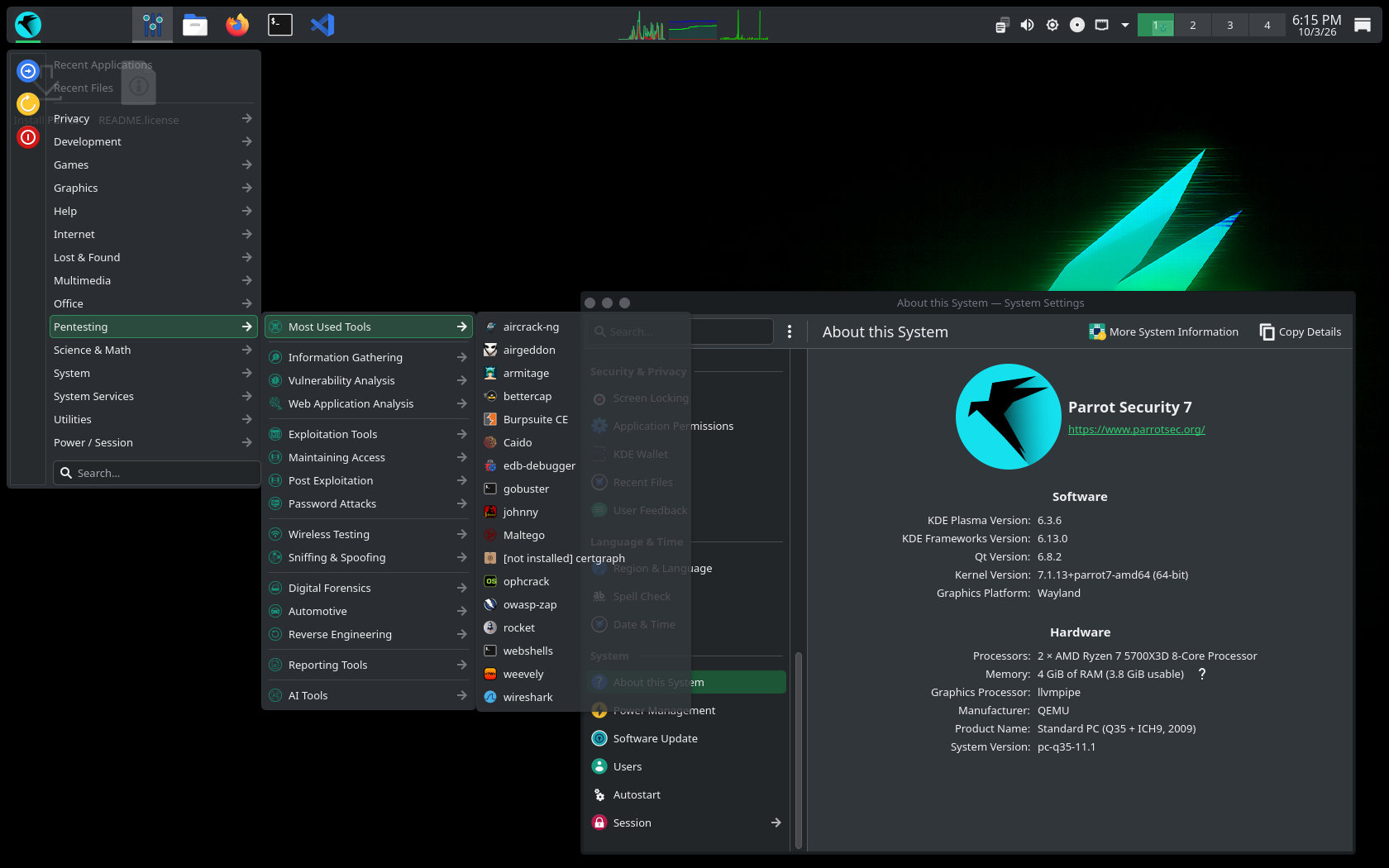
On the desktop side, Parrot Core 7.4.1 improves KDE configuration by moving appearance and daemon defaults under /etc/xdg. Baloo indexing is disabled by default, fewer KDE background modules load automatically, and Parrot wallpapers appear directly in the wallpaper selector.
Last but not least, the release refreshes a long list of security tools, including Metasploit Framework 6.5.4, Bettercap 2.41.7, Kismet 2025.09.R1, Certipy-AD 5.1.0, Ligolo-ng 0.9.1, ffuf 2.2.1, dnsx 1.3, and TheHarvester 4.10.1. Driver packages for Realtek RTL8188EUS and Broadcom STA have also been updated.
For more details, see the announcement. Existing Parrot OS users can upgrade to version 7.4 with sudo parrot-upgrade.
Parrot OS is available in several editions, including Security for penetration testing and cybersecurity work, Home for everyday use, and Core for more minimal setups.