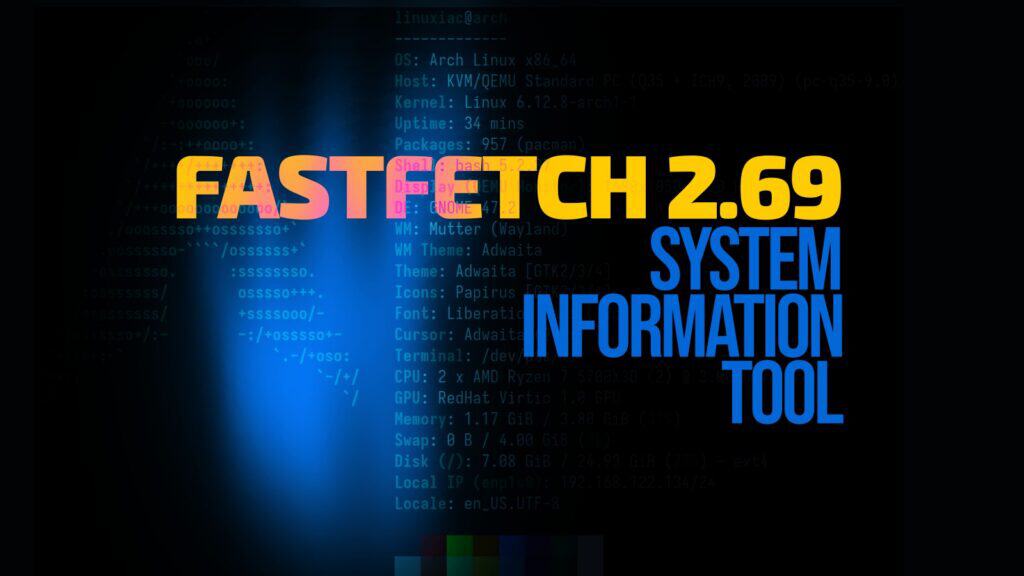
Fastfetch, the popular command-line system information tool that displays hardware and software details alongside a distribution logo, has released version 2.69.
One of the most visible changes is better image logo support. Fastfetch can now display animated GIF and APNG images when using the Kitty graphics protocol. Users can either play the animation or select a specific frame, while terminals without Kitty graphics support will fall back to the built-in logo.
Image handling has been simplified on Windows, macOS, and Android. Fastfetch now uses native image-processing libraries on these platforms instead of ImageMagick, so package maintainers can drop the ImageMagick dependency. ImageMagick 6 has been deprecated and will be removed in a future release.
Another useful addition is the new logo.position: "auto" option. When enabled, Fastfetch automatically moves wide logos above the module output if there is not enough horizontal terminal space. The existing left-side placement remains the default.
For Linux users, Fastfetch 2.69 adds CRUX package detection and support for counting RakuOS rum overlay packages. It can now detect CPU names and frequencies on SPARC systems, improves COSMIC Desktop version detection, and adds Umbriel version detection. Snapdragon X2 CPU identification has also been fixed.
Bluetooth reporting has received a notable upgrade as well. Fastfetch can now detect Bluetooth Low Energy devices on Windows and macOS, distinguish between LE and classic devices, display signal quality when available, and report Bluetooth Core versions up to 6.3.
On the Android side, ROM detection now covers platforms such as HarmonyOS, Flyme, One UI, and LineageOS. Fastfetch can also report more camera, battery, display, Wi-Fi, wallpaper, and media information, although some details require newer Android versions, root access, or ADB.
Moreover, the default sampling delay for DiskIO, NetIO, and Top has been reduced from 500 ms to 250 ms, making those modules respond faster. The built-in HTTP client used by PublicIP and Weather now supports custom ports and chunked responses. Lua format scripting is now stable.
Finally, the release also includes a broad set of fixes covering GPU reporting, GNOME Classic and Trinity version detection, package counting, JSON output, gamepad battery reporting, Windows Terminal font detection, ANSI-aware truncation, Base64 handling, and several architecture-specific issues.
For additional details, see the changelog. Fastfetch 2.69 is available now from the project’s GitHub releases page for Linux and other supported platforms.