Ardour 9.5 has been released today as the latest version of the open-source digital audio workstation, introducing enhanced MIDI editing, new pianoroll tools, usability improvements, plugin fixes, and updated control surface support.
The main update is the expanded pianoroll workflow. Ardour 9.5 adds a left sidebar for chord editing and quantization, allowing users to draw three-, four-, or five-note chords directly in the pianoroll. Users can also modify, invert, or adjust existing chords by dropping notes.
In addition, MIDI quantization is now integrated into the same sidebar. Users can select notes, choose a quantization grid, and apply changes directly from the pianoroll, streamlining grid-based MIDI correction.
Reference notes, also known as ghost notes in other DAWs, are now supported. Ardour 9.5 allows multiple MIDI regions to be opened in the same pianoroll view, enabling users to edit one region while referencing notes from others.
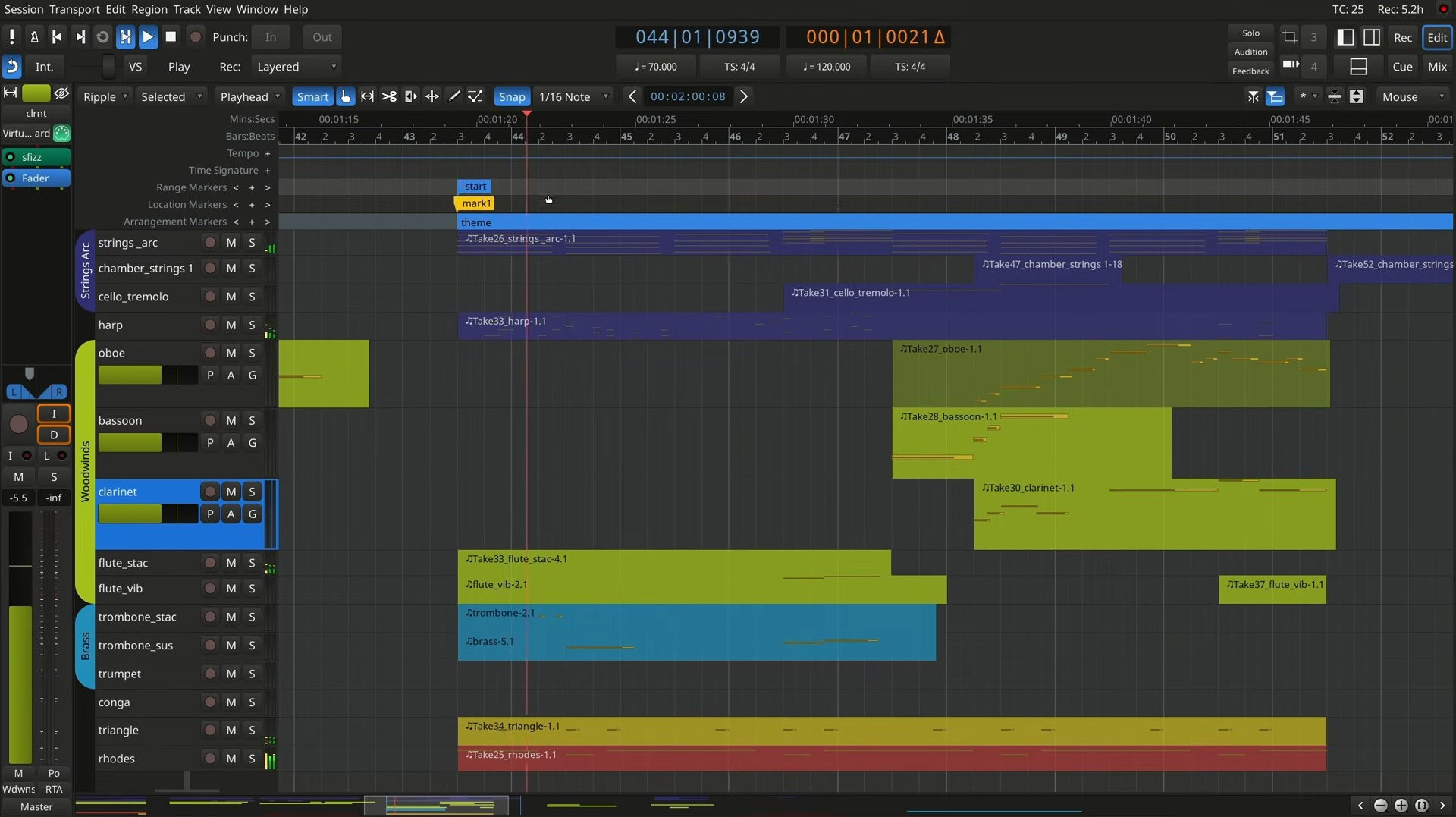
The release also adds support for editing multiple MIDI regions simultaneously, with a drop-down control to switch between the active region and all regions. A new Cubase-style cross cursor improves orientation when drawing notes or automation.
It’s worth also noting that Ardour 9.5 introduces new note coloring schemes in the pianoroll, including velocity, channel, track, and configurable pitch themes. Plus, MIDI automation lanes have been redesigned to stack vertically, allowing users to select, edit, or clear any lane with one click.
Beyond MIDI editing, Ardour 9.5 improves the main interface. Region automation control points appear when hovering over a region. The summary pane is now thinner by default, themable, sharper, and features zoom controls on the right.
Plugin views in the editor’s bottom pane can now be collapsed for quicker access to frequently used plugins. Collapsed views include a bypass toggle, enabling plugins to be disabled without expanding the full view.
Track template handling has been improved as on the Mixer page, users can access local and global track templates and apply them to existing tracks to replace processing. The release also includes two new color themes: Arc and OneDark.
Regarding AI, Ardour 9.5 introduces an experimental, community-contributed MCP server for controlling Ardour via a locally running LLM. It’s an opt-in feature and can be enabled in Edit > Preferences > Control Surfaces by selecting the experimental MCP HTTP Server option. The project clarifies that this feature does not generate audio with LLMs.
Additional improvements include enhanced metronome click resampling, corrected export overwrite detection, saved default MIDI draw channel and velocity, improved session dialog resizing, restored JPEG image support, OSC enhancements, Mackie control updates, MIDI chase improvements, and various internal refactoring and cleanup.
For plugins, Ardour 9.5 resolves scanning issues with certain VST3 plugins, supports loading VSTs with names outside the current user locale, prevents plugin changes during recording, and fixes crashes with LV2 plugins using non-URI extensions.
Bug fixes address latency compensation with side-chain sends, audible artifacts from muted aux sends, MIDI timestretching, MIDI chase behavior, relative snapping in the bottom pianoroll, pitch-bend automation display, archive error reporting, and various crash conditions.
For additional details, see the announcement. Ardour 9.5 is now available on the project’s official website.
Image credits: Ardour Project