
Windows’ long-standing dominance of the desktop operating system market has taken a noticeable hit, according to StatCounter’s latest worldwide desktop OS market-share data.
In June 2026, StatCounter reported that Windows made up 56.55% of global desktop OS usage, dropping Microsoft’s share below 60%. This is a big change for an operating system that has shaped desktop computing for decades and usually led its competitors by a wide margin.
Linux, meanwhile, continues its gradual rise. StatCounter’s June 2026 data puts Linux at 4.39% worldwide, one of its strongest recent showings in the company’s desktop OS statistics. While still far behind Windows, the figure keeps Linux firmly above the symbolic 4% line, which only a few years ago would have looked highly optimistic for the desktop.
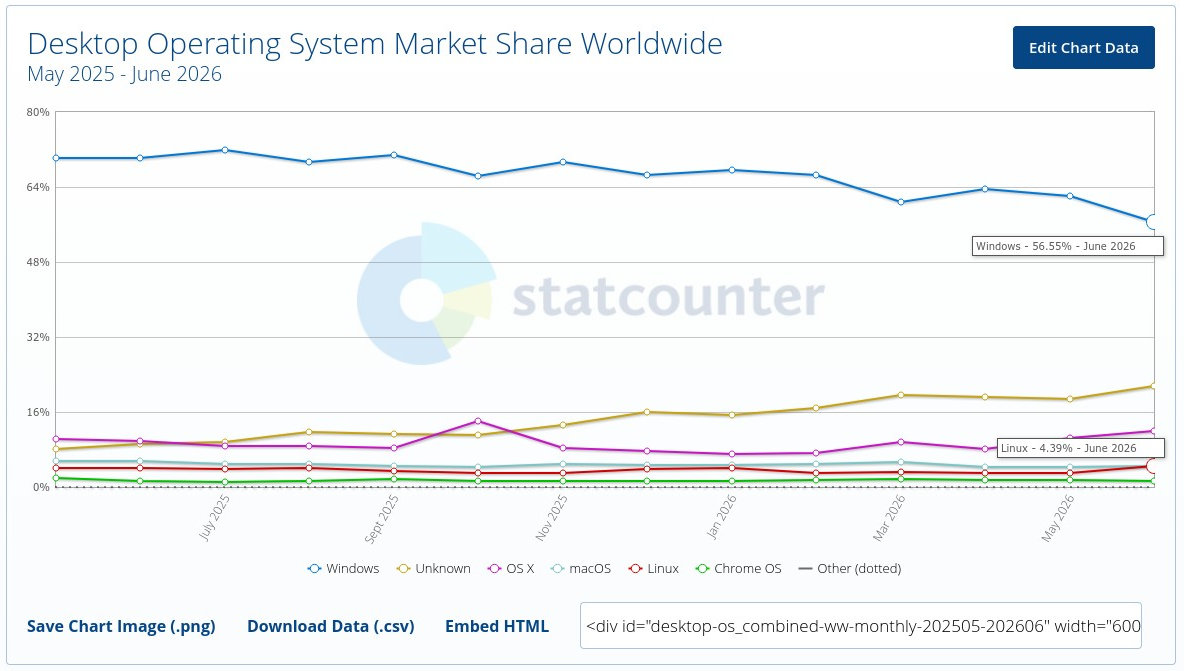
Apple’s desktop platforms also remain a major part of the picture. StatCounter lists OS X at 11.89% and macOS at 4.48% for June 2026, meaning Apple’s combined desktop presence remains comfortably ahead of Linux in the global chart. Chrome OS follows with 1.21%.
Of course, StatCounter’s numbers should be read for what they are: web usage statistics, not a direct count of installed operating systems.
The company calculates its Global Stats from page views across websites using its tracking code, analyzing details such as browser, operating system, and screen resolution. In other words, the figures reflect measured web activity rather than the number of machines actually installed worldwide.
Still, this trend is worth noting. Windows is still the world’s most popular desktop operating system by a large margin, but dropping below 60% is a significant milestone. At the same time, Linux staying above 4% shows that open-source desktops are now a real part of the global market, not just a tiny fraction.
A few things may be helping Linux keep growing. The Steam Deck and better support for gaming on Linux have made it more visible to everyday users. Yes, it is still tough to compete on the desktop with Microsoft and Apple, but things are moving in a positive direction.
Distributions like Ubuntu, Arch, Fedora, Linux Mint, openSUSE, and others are also offering smoother desktop experiences. Plus, some people are frustrated with Windows 11’s hardware requirements, privacy concerns, and Microsoft’s push for more online services, which may be leading them to try other options.
So, what conclusion can we draw from all of this? The most accurate way to put it is that StatCounter data shows one clear thing: now, the market is less one-sided than before. And that is a good thing.





Why when I go to statcounter the graph does not match the numbers at the top? The top number says Windows is at 56.61% but the graph when I hover over the Windows line for June says 72%.
I noticed that statcounter is not showing the “Unknown” category for some reason, this favors Windows percentages.
Seems like they’ve corrected it
“OS X at 11.89% and macOS at 4.48% for June 2026”, you mean OS X, a version of macOS that had its End of Life in 2016, ten years ago? I highly doubt that nearly 12 of desktop computers in the world use a 10 year old version of an auto-updating operating system.
This statistic is total nonsense, on many levels.
Since these stats are compiled from User-Agent strings on web requests, theyre limited to whatever info is included by the web browser. Apple made the intentional decision to cap the os version in User-Agents to OSX 10.15.7. So the user agent for Safari on macOs 26 looks like “Mozilla/5.0 (Macintosh; Intel Mac OS X 15_7_7)”
This was done to reduce the ability of malicious websites to learn exact details about the users OS.
More info and the original thread on this decision below:
https://nielsleenheer.com/articles/2025/the-user-agent-string-of-safari-on-ios-26-and-macos-26/
https://groups.google.com/a/chromium.org/g/blink-dev/c/hAI4QoX6rEo/m/qQNPThr0AAAJ?pli=1
“21.45% unknown” <— what is meant by "unknown" in this context – unable to determine (what would cause this?) or unknown operating system?
If the later, who is creating these OS? Would it be countries like Russia and China?
The article states that they are counting OS distribution based on users visiting websites, meaning that they are almost certainly using the User-Agent. User-Agent is a required header sent on all web requests that tells the server who or what is making the request. As an example, the the User-Agent sent by Chrome on Windows starts with “Mozilla/5.0 (Windows NT 10.0; Win64; x64)”, which includes info on the operating system. Thus its possible to tell if a user is on desktop/mobile and which OS theyre using.
There are lots of programs that make web requests that arent web browsers, like web crawlers that visit/scrape web sites. Those programs still have to include a User-Agent, but it is not required to include operating system or platform details.
So essentially 21.5% of all tracked web requests are made with a User-Agent that does not include the operating system. Bots, non-browser apps, etc.
Some web browsers (for example FireFox) will let users change the User-Agent to whatever you want.
This is also what happen when you request the “desktop mode” of a site from a mobile browser. The browser simply re-requests the webpage, but changes the user agent to pretend like its a full desktop browser.
Thank you for your explanation. FINALLY, it’s clear what this “Unknown” means!!!
Others and I have wondered for years what this could be!
Many, even Steven J. Vaughan-Nichols, suggested that this “Unknown” must be Linux.
Well, he’s getting old …
Problem its a lot peoples started using vpns and other adblockes who spoof agent and can change agetn to decent most popualr like windows/chrome
and he can sit on linxu with firefox but browser will thinh its chrome on windows.
Windows will continue to dominate the desktop for a long time to come, but windows users need Win12 to bring some order to the chaos of Win11.
On the contrary. If you follow the global political news, you’d know that whole continents are changing to Linux because of sovereignty and security reasons.
China, Europe, India, Russia, Canada, Brazil, and many, many others are replacing MS Windows with a Linux distro. This attack on Windows is in different markets: the government, companies, gaming, and other personal use. The first two are because of sovereignty and security; the latter because the gaming experience is generally better on Linux than on Windows, and Valve has now made SteamOS with the upcoming Steam Machine proper for personal computer use. More and more people work with Linux at work and experience the much easier way of working and the choice of Desktops on a Linux Desktop compared with the horrible Windows.
I dare to declare this June 2026 the beginning of the Year of the Linux Desktop, but we’ll only know in hindsight, of course. And yeah, it’s been declared many times, but this time you can see the underlying push that’s undeniable and factual.
Funny though, there’s ONE person who made this happen: Donald Trump!
Because of his extortionate behaviour towards countries, politicians globally took note and understood the liability of using proprietary software, be it American or otherwise.
It’s fascinating that this has not been written about extensively, because this will have humongous implications in the software industry!
What guarantee you have that Windows 12 will be better or any good at all?
Last good Windows version was 7, even Vista wasn’t so bad, the three consecutive ones – XP, Vista, 7 were all good, Vista just gets bad reputation due to Microsoft marketing it wrong that it will work on XP PCs, which wasn’t the case.
But since Windows 8, every subsequent Windows version is worse. It’s true that 10 fixed some GUI problems with 8, but it eventually became worse and with 3rd party mods, 8 is still superior to 10 and 11, because it’s closer to 7 than they are.
10 got bloated with AI and other crap in the last few years before it went out of support. 11 also launched somewhat clean, but is now severely bloated with AI and other crap to the point where it just doesn’t run good even on good computers.
Windows is doomed to get worse, it will continue to be popular, but it will never be as good as it once was, I have no hope that 12 will be any better than 11. I also use Linux for the last 2 years.
so basically windows still dominates and the percentage is most likely higher then 60% since these stats are counting unknown os data against what they could figure out. So how do I make websites not know what os I am using.
Actually the unknowns is more likely Linux machines as a lot of the users will block their data being shared
Last year I buy a Lenovo laptop for a gift to my Mother (72), I remove W11 and installed ubuntu, she seems to be cool using ubuntu. lol.
Same here, except I put Zorin 18 Core on my mother’s new laptop since its UI is more “windows-like” out of the box. Chromium browser (I would’ve preferred Firefox, but Chrome was what she was used to on her old Windows box), LibreOffice, copy all of her browser bookmarks from the old PC to the new one, and so far no complaints — and so far, no more panicked calls in the evenings because “the computer is doing something strange, what does this message mean”? 😀
(And if it ever *does* do something unexpected, I can SSH in as superuser and administrate it remotely.)
20% of the desktop market share is Unknown?
That seems a bit sus to me.
nope its blocking the read of user agent in a browser
ergo privacy that comes with a non windows os like linux or a bsd unix
Makes sense to an extent. But how do they qualify those as desktop users and not something automated, etc.
What percent is hidden linux in the unknown. I am sure that that needs looking into deeper.