openSUSE Tumbleweed now sets systemd-boot as the default bootloader for new installations, replacing GRUB2-BLS. And let me clarify right away: this change affects only new installations. Existing Tumbleweed systems will continue using GRUB unless users choose to switch manually.
As a result, new installations will display a different bootloader than previous versions. So, instead:
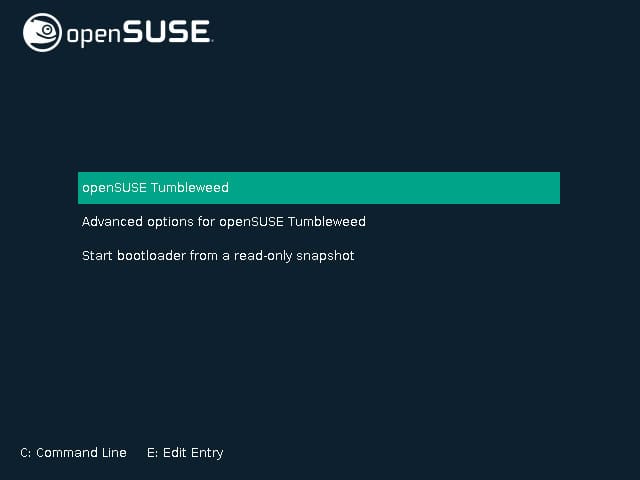
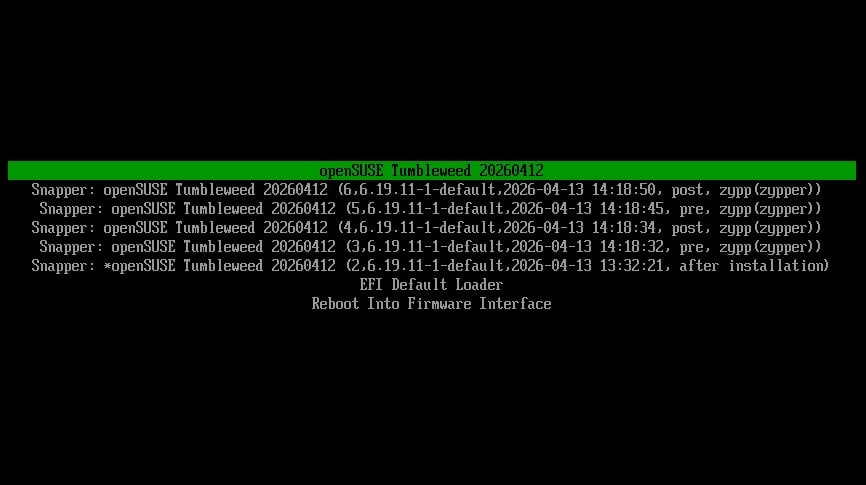
After a fresh Tumbleweed installation, systemd-boot will appear as the default bootloader, and you’ll get this:
Actually, the transition to the new bootloader occurred in two phases. In November 2025, openSUSE changed the installer default from classic GRUB2 to GRUB2-BLS, which remained a GRUB2-based solution.
The primary change involved handling boot entries. Instead of the traditional GRUB configuration, BLS (Boot Loader Specification) entries were stored as separate files. openSUSE stated this shift was intended to better support modern boot and encryption workflows, including systemd-based full-disk encryption, TPM2, and FIDO2.
But now, Tumbleweed has even advanced further by making systemd-boot the default for new installations. What do users gain from this? First, openSUSE cites simplified integration of new features as a key advantage of adopting BLS-compatible boot setups.
Second, is improved compatibility with modern full-disk encryption workflows. openSUSE links this approach to systemd-based disk encryption, including TPM2 and FIDO2 token-based unlocking. Traditional bootloaders like GRUB require embedding decryption logic and key-derivation handling in the bootloader, which increases complexity.
Additionally, systemd-boot aligns more closely with the BLS model, handling boot entries as separate files rather than generating a single large configuration file, as with GRUB.
That doesn’t mean that systemd-boot is universally superior to GRUB. GRUB offers broader legacy compatibility and advanced multi-boot flexibility, particularly outside standard UEFI setups. While systemd-boot is simpler, it is limited to UEFI environments.
Anyway. In my view, this change by openSUSE is a positive development. Managing systemd boot entries involves editing simple (just a few lines) text files, which offers greater simplicity and transparency.
And finally, I’d like to say that migrating existing Tumbleweed installations between GRUB and systemd-boot (and vice versa) is possible but requires manual intervention and technical expertise. So my personal advice is: unless it’s absolutely critical for you, just keep using your current bootloader.