Haiku’s ARM64 development has reached a new milestone, as developer Sam Roberts reports that the port is now “mostly stable” in QEMU for this open-source operating system that continues the BeOS legacy
“I’ve been spending some time improving the arm64 port of Haiku with the goal of some day running Haiku on my M1 MacBook Air.”
In a Haiku community forum update, Roberts stated that the current build supports standard QEMU devices, including virtio SCSI, virtio networking, xHCI USB, and up to eight CPU cores via SMP. However, the port is not complete, with at least one kernel crash and several double-free bugs remaining.
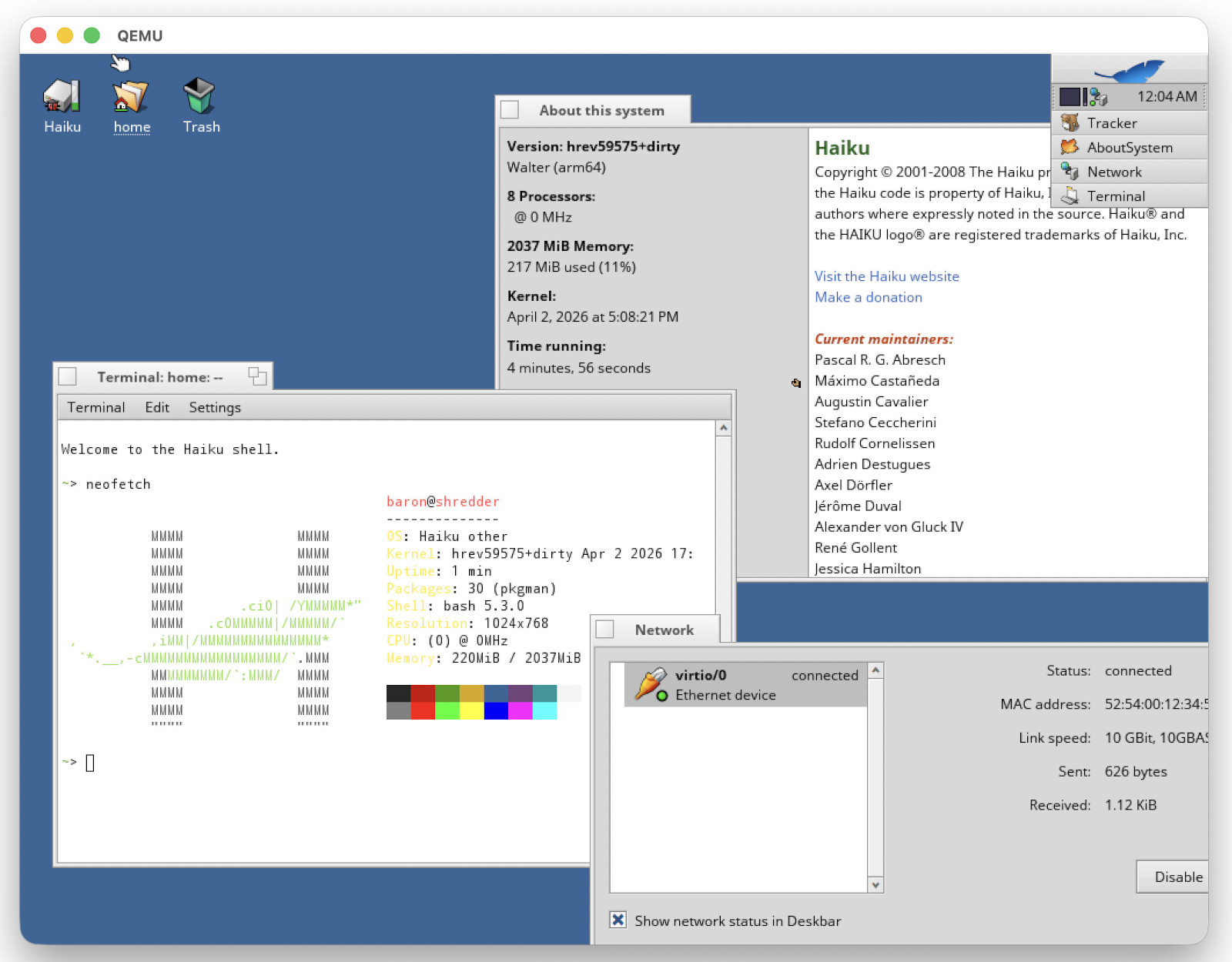
As is clear from the announcement, the long-term goal is to run Haiku on an M1 MacBook Air, but current efforts focus on virtualization, with a mostly stable ARM64 port operating under QEMU. In other words, native Apple Silicon support is not yet available for daily use.
Importantly, this work is not maintained as a separate private branch. The developer confirmed it is based on Haiku upstream, though some features, such as the ACPI add-on and the zstd package, may need to be enabled in the bootstrap image. Users interested in testing must bootstrap Haiku themselves, as some binary packages still require rebuilding.
The following discussion indicates that broader testing is approaching. The developer noted they are using command-line QEMU and do not plan to create a UTM-specific image. The expectation is that the standard Haiku install image will eventually work on UTM, as it does on other operating systems.
Finally, Roberts also stated that ARM64 nightly images are available, though they are not yet functional. Usable images are expected within the next few weeks after additional package rebuilds.
For more details, see the announcement.
Image credits: Sam Roberts