
Garuda Linux has announced Garuda Nix, a new project that brings the distribution’s familiar desktop configurations, styling, and opinionated defaults to NixOS.
Importantly, Garuda Nix is not Arch-based. While the regular Garuda Linux distribution is built on Arch, Garuda Nix uses NixOS as its foundation, offering a separate way to get the Garuda experience on NixOS.
The project evolved from the previously available Garuda Nix Subsystem, originally designed as an add-on for Garuda Linux that let users install NixOS alongside Garuda Linux on the same partition using separate subvolumes.
However, the project expanded beyond that original use case and has since been rebranded as the standalone Garuda Nix project, offering two desktop configurations: Dr460nized and Mokka. Both use the same dotfiles found on the corresponding Garuda Linux editions, adapted to work with NixOS.
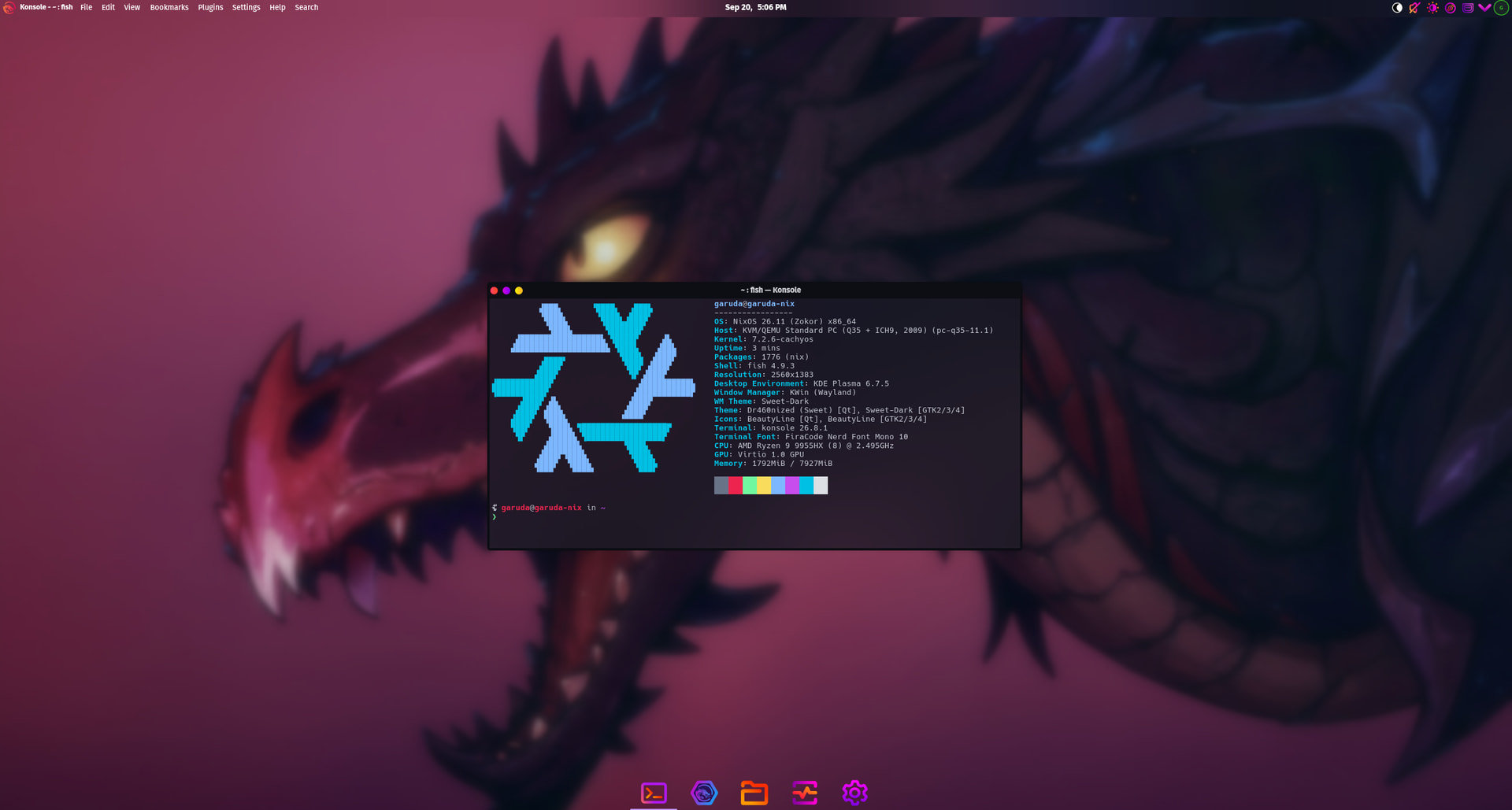
For those unfamiliar with NixOS, it is a Linux distro built around the Nix package manager and a declarative approach to system configuration. Instead of configuring the system manually through separate files and commands, users describe the machine’s desired state in configuration files and apply those changes.
Garuda Nix essentially combines that NixOS foundation with the desktop experience and defaults Garuda users already know.
Installation can be done through the graphical Calamares installer or from the command line using the install-garuda-nix utility. Separate Dr460nized and Mokka ISO images are available, but either installer can deploy either desktop configuration because the NixOS installation is network-based.
Once installed, users get Garuda’s preconfigured settings together with a ready-to-use Nix flake configuration under /etc/nixos. Several presets from Garuda’s garuda-* module settings are included as well.
Another notable part of the project is Chaotic Nyx, which serves as the Nix counterpart to Garuda’s well-known Chaotic-AUR repository. It is included as part of the Garuda Nix setup and provides access to additional prebuilt packages within the Nix ecosystem.
The command-line installer also provides several additional options, including support for configuring NixOS Impermanence.
Impermanence allows selected system data to be discarded automatically after a reboot, while configured files and directories remain persistent. Garuda Nix implements this using Btrfs rollbacks on Btrfs systems or by placing the root filesystem in tmpfs when using ext4.
The project currently provides separate Dr460nized and Mokka installation images, with daily ISO builds generated through Garuda’s CI infrastructure.
For existing Garuda Linux users interested in trying NixOS, that makes Garuda Nix a much more familiar entry point than starting with a standard NixOS installation.
For additional details, see the announcement.
Image credits: Garuda Linux




Have to test it.