
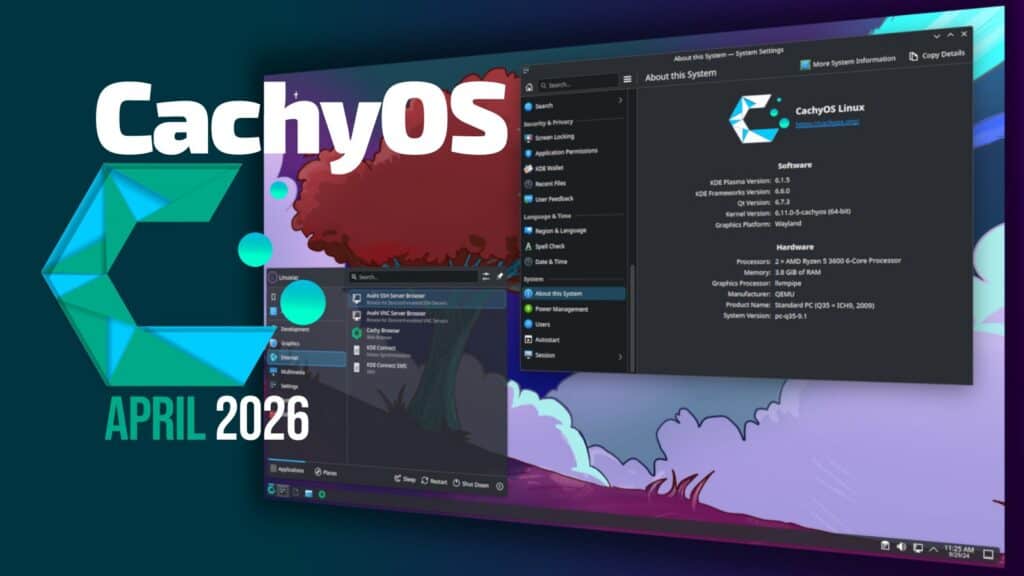
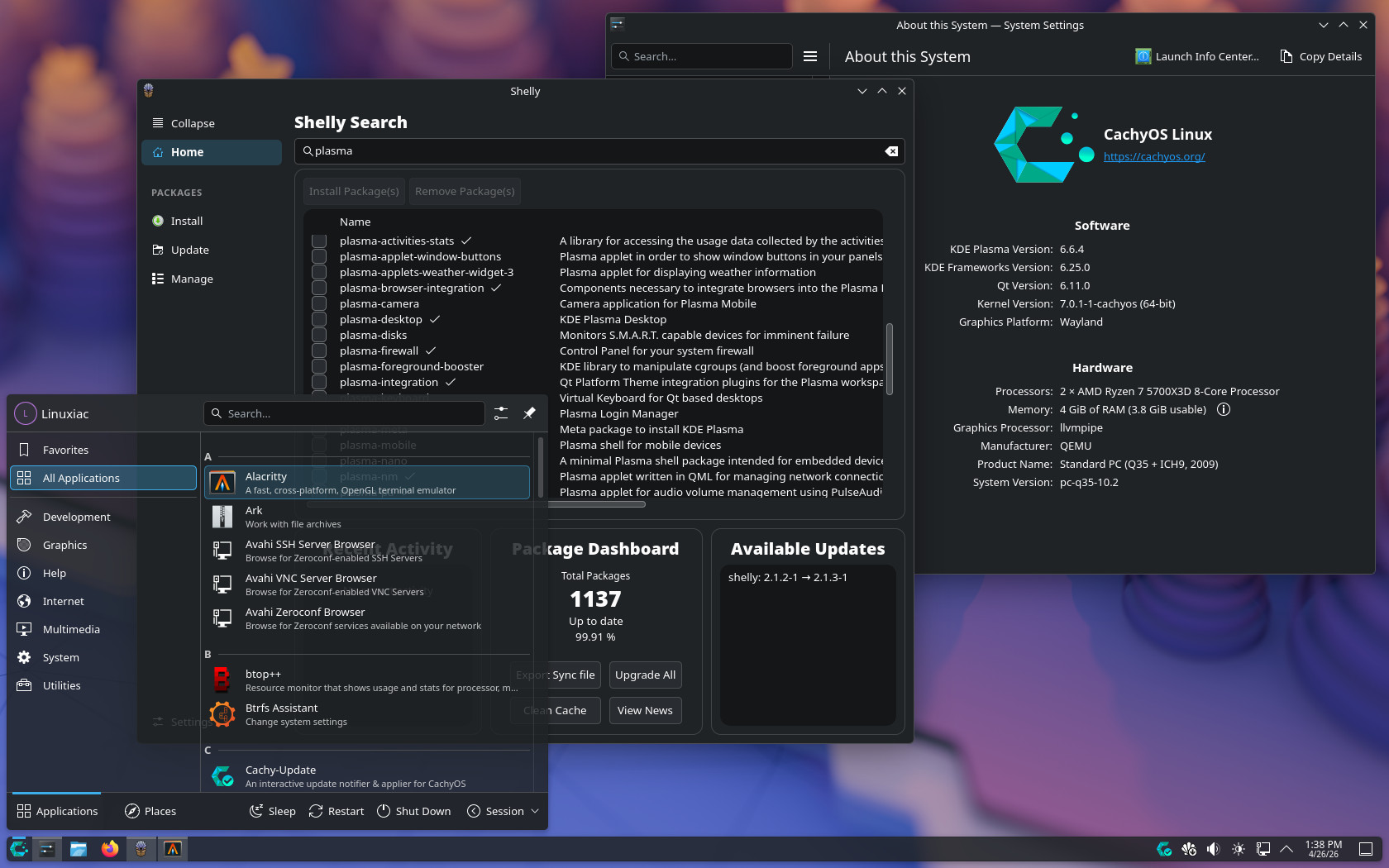
Arch-based CachyOS has released its April 2026 ISO powered by Linux kernel 6.18 LTS, the third update this year, with a key change being that the installer now uses Shelly as the default GUI package manager, replacing Octopi.
New installations automatically create a permanent system snapshot after setup, serving as a baseline restore point. Additionally, GRUB os-prober is enabled by default, allowing the bootloader to detect other operating systems on the device.
On top of that, the installer no longer offers the UKUI desktop, and the GNOME package set has been updated and streamlined. MangoWM is now available as a desktop option with dotfiles and can also be installed using the DMS shell. And for AMD GPU systems, CachyOS uses a new Plymouth theme to resolve previous rendering issues on laptops with secondary monitors.
The Welcome app introduces several enhancements, including DNS-over-HTTPS support via blocky. The updated DNS page can test connection speeds, automatically select the fastest server, display server metadata such as region and filtering type, and allow custom DNS server entries. A DHCP indicator and reset option have also been added.
In addition, it also now features a VRAM management toggle for AMD and Intel GPUs using dmemcg-booster. On KDE systems, this also installs plasma-foreground-booster. Additional interface improvements include full keyboard navigation, enhanced SVG social icons for HiDPI and dark themes, and wezterm support in the terminal helper.
Hardware detection has been enhanced with chwd, CachyOS’s hardware detection and configuration tool. It now supports native USB device detection via libusb and sysfs, chassis type detection, fingerprint reader integration for sudo prompts, and CPU family and model detection for intel-lpmd.
NVIDIA support has been updated, with CachyOS now providing separate NVIDIA profiles for laptops and desktops, improving installed-kernel detection in these profiles, removing the kms hook from mkinitcpio.conf on non-portable desktops to prevent driver conflicts, and eliminating the forced Xorg session from NVIDIA 470xx profiles to improve compatibility with Plasma Login Manager.
Another system-level update in cachyos-settings changes the default NVMe I/O scheduler from none to kyber, which is expected to improve responsiveness under mixed workloads. The component also removes S01x power management due to issues with the NVIDIA 595 driver and disables AggressiveVblank to address VR-related NVIDIA problems.
Finally, this release addresses several issues:
- Virtual machine profiles now remove the outdated
WaylandEnable=falsesetting for GDM. - The installer now logs the selected partitioning method and correctly removes outdated microcode packages when reusing an existing boot partition.
- CachyOS-Welcome resolves connectivity issues, fixes dark theme link icons, prevents duplicate app launches, and improves desktop window matching.
For additional details, see the announcement.
Existing CachyOS users do not need any manual migration steps. A standard system upgrade with a simple sudo pacman -Syu command is sufficient to receive all improvements.



Replacing the CLI is already painful, but doing so in a GTK4 GUI becomes a real heartbreak. Thanks, but no.
Same, seems like it has a hard dependency on Gtk4 (therefore probably built on it), so I’ll have to pass.
Although at least, it doesn’t seem to be plagued by libadwaita.