The aerynOS team has released a major update to its unstable stream, featuring Linux kernel 7.3.4, systemd 262, NVIDIA 620 graphics drivers, and a refreshed KDE desktop stack.
Starting with the kernel, the distro now ships Linux 7.3.4 for both its stable and gaming kernel variants, while the extended-term support option has been updated to Linux 6.18.63. The GNU C Library has also been upgraded to 2.44, with its minimum supported Linux kernel baseline raised to 6.6.
Another major change is the transition from systemd 261.5 to 262.2. Due to this upgrade, developers recommend that users log out of their desktop sessions before updating. Otherwise, the graphical environment may appear frozen after the update. The recommended procedure is to switch to a Linux console with Ctrl+Alt+F3, log in, run sudo moss sync -u, then sudo reboot once it finishes.
On the graphics side, the distribution has adopted NVIDIA driver 620.70.06, including open kernel modules and NGX DLSS components. Mesa has also been updated to version 26.2.7, while the OpenCV computer vision library advances to its 5.1 series.
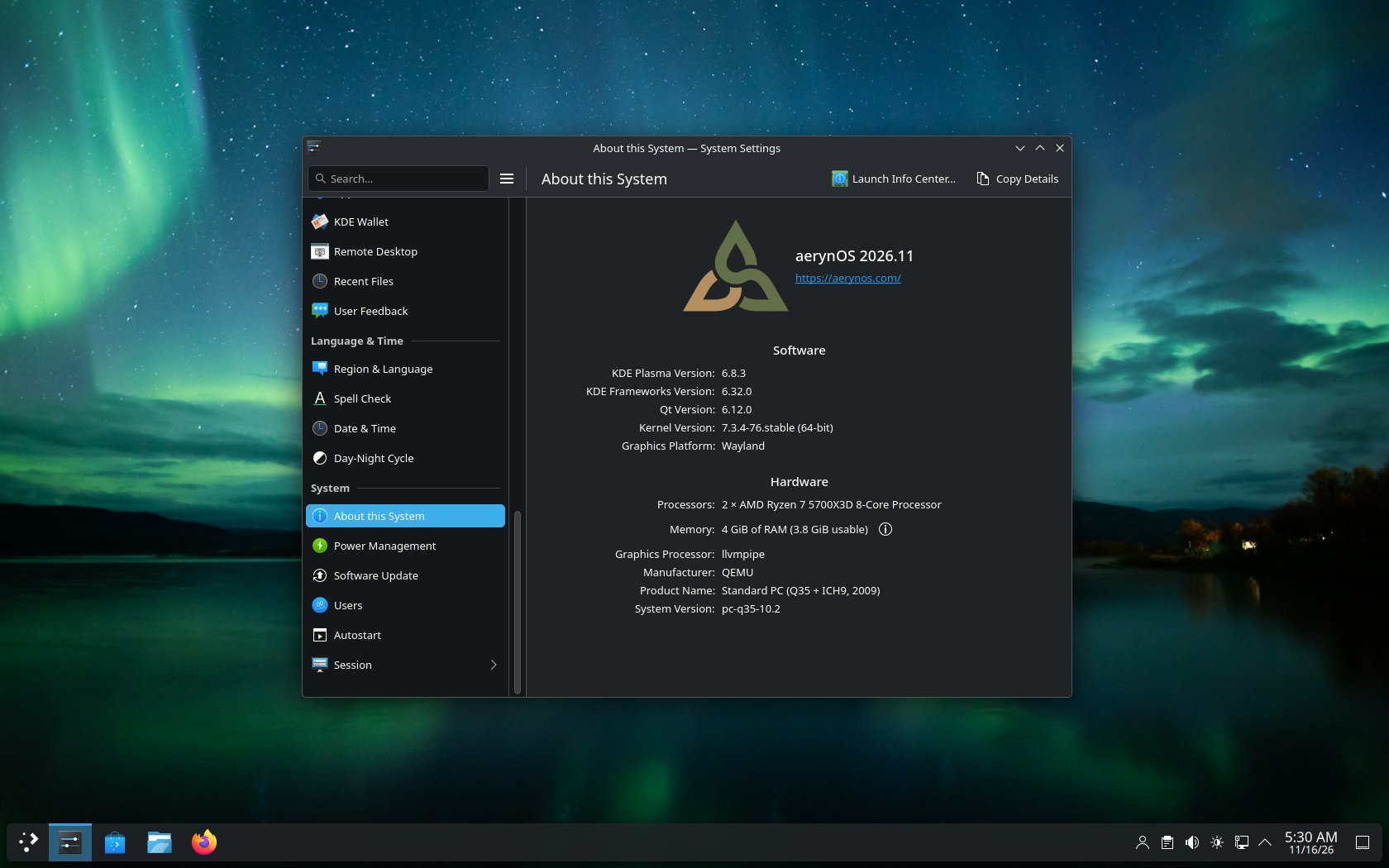
Desktop users receive KDE Plasma 6.8.3 and KDE Frameworks 6.32, both containing bug fixes and improvements. Other application updates include Firefox 160, Thunderbird 160, LibreOffice 26.8.3, Hyprland 0.57.2, Wine 11.22, and Podman 6.2.
For developers, the Rust toolchain has been upgraded to version 1.100, which introduces support for the never type, among other changes. Go 1.27.4, updated Node.js 22 and 24 packages with security fixes, and Zed 1.28.1 are also included.
On top of that, the update improves aerynOS’s native package management and build tools. Moss now directs users from older info and list commands to the newer pkg info and pkg list commands. Boulder can continue recording build logs when encountering non-UTF-8 output, fixing an issue that caused builds like qt6-webengine to abort.
Several smaller usability improvements are included. Nano now enables syntax highlighting, automatic indentation, and soft wrapping by default. The default Bash configuration adds ~/.local/bin to the PATH environment variable.
Finally, the update delivers a security-related change to the initramfs environment. The root account is now explicitly kept locked by default through the SYSTEMD_SULOGIN_FORCE=0 kernel command-line setting. Users who need root access for troubleshooting can override this behavior when necessary.
For more information, see the announcement.