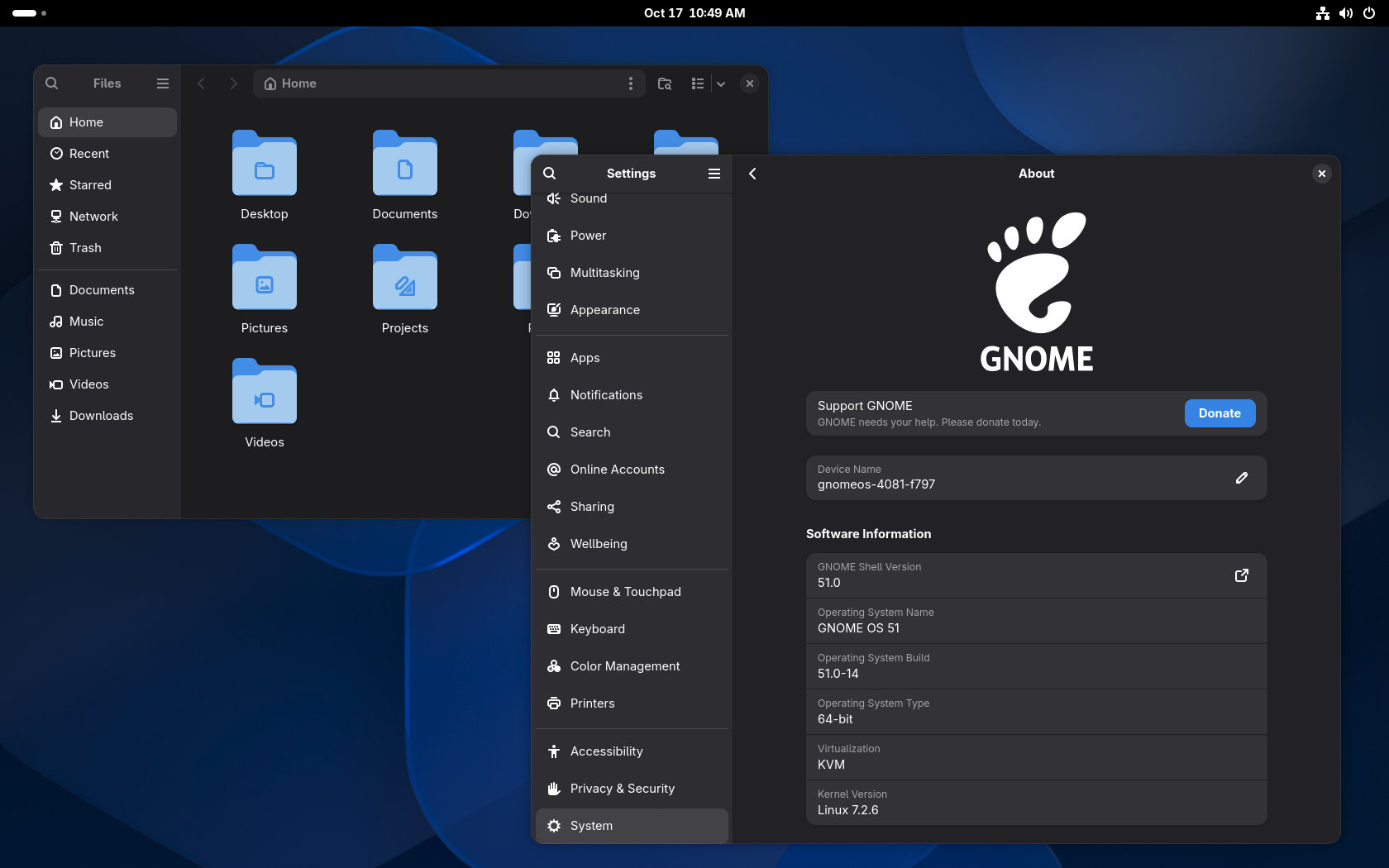
Nearly two years after the first plans emerged to turn GNOME OS into a general-purpose Linux distro, Adrian Vovk, one of the developers behind the initiative, announced the availability of GNOME OS Preview.
As you probably know, the distro has traditionally served as a testing platform for GNOME developers, offering nightly builds with the latest changes from the project’s Git repositories. While useful for testing upcoming features, this approach made it less suitable for everyday users.
The new Preview edition changes that. Instead of pulling constantly changing development code, it is built using the latest stable GNOME release, GNOME 51, powered by Linux kernel 7.2.6.
GNOME OS Nightly will continue serving developers and testers who need access to the latest changes, while Preview offers a more reliable alternative for early adopters.
Apart from the new edition, Vovk highlighted several improvements to GNOME OS over the past year. Among them is better memory management through zswap, which helps systems with limited RAM avoid running out of memory. Developers also implemented a mechanism that dynamically expands usable disk-based swap space when needed.
Another addition is Test Center, an application we covered earlier this year. It allows users to install experimental Flatpak builds directly from merge requests, making it easier to test software changes before merging. On GNOME OS Nightly, it can also test system components through temporary system extensions.
Moreover, Toolpak is a new project designed to make command-line development tools easier to install and distribute across Linux distributions, much like Flatpak does for desktop apps.
The developers are currently still working on several features before the system is ready for a broader audience. These include deeper integration with systemd-homed for stronger per-user encryption, a redesigned installer, improved TPM support, and better compatibility with ARM hardware, including certain smartphones.
Another important task is adding delta updates to systemd-sysupdate, the technology GNOME OS adopted in 2024 for system updates. Currently, updates can require downloading an entire system image of about 2 GB. Delta support would significantly reduce that by transferring only the changes.
The team also plans to ship preinstalled applications as Flatpaks and improve application compatibility, including support for software such as VPN clients.
However, users should be aware that GNOME OS Preview is still experimental, and the developers explicitly warn that it may not offer a seamless upgrade path to the eventual stable edition. In other words, users might need to reinstall the operating system later.
According to Vovk, the team doesn’t intend to declare GNOME OS stable until it can guarantee a clear, long-term upgrade path. For now, Preview is expected to remain available for several years while development continues.
Those interested can download GNOME OS Preview from the project’s official website, where the Nightly edition is also available.