

AlmaLinux OS 10.2 “Lavender Lion” is now available as the latest stable update to the project’s Enterprise Linux 10 branch. It brings i686 userspace packages, Btrfs boot support, GNOME 49, updated development stacks, and expanded support for older hardware.
The release includes Linux kernel 6.12 and adds Python 3.14, PostgreSQL 18, MariaDB 11.8, Ruby 4.0, and PHP 8.4 as new packages. It also includes SDL3, libkrun, trustee, and FIDO Device Onboard tooling. Container and virtualization components such as Podman, Buildah, libvirt, QEMU-KVM, and skopeo have been updated.
On the desktop side, AlmaLinux 10.2 moves to GNOME 49. Security-related components have also been refreshed, including OpenSSL, OpenSSH, SSSD, SELinux policies, crypto-policies, and Keylime.
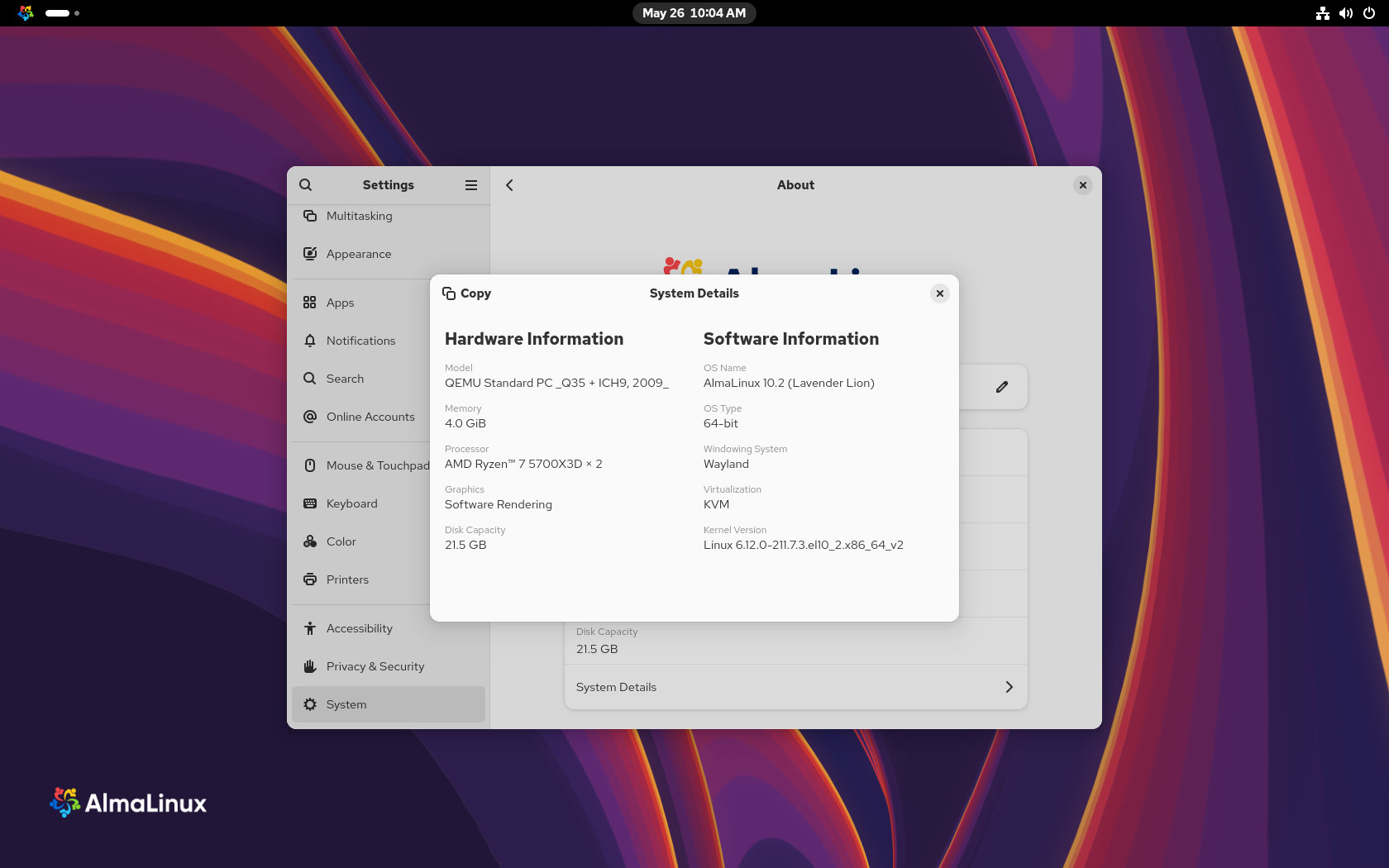
One notable change is the arrival of i686 userspace packages in the stable AlmaLinux 10 series. The project first introduced i686 support in AlmaLinux Kitten 10 in April. AlmaLinux 10.2 now brings that work into a stable release. This enables legacy 32-bit software, CI pipelines, and containerized workloads on AlmaLinux 10.
AlmaLinux 10.2 also continues several project-specific differences from upstream Enterprise Linux. These include Btrfs support with the ability to boot from a Btrfs volume, the CRB repository enabled by default, and parallel x86_64_v2 builds with matching EPEL coverage for older systems.
On top of that, the release restores SPICE support for both server and client applications, re-enables frame pointers by default for system-wide profiling, and ships Firefox and Thunderbird as regular RPM packages in the system repositories.
Hardware support has expanded through the return of several older storage and networking drivers that upstream disabled. The list covers hardware families from Adaptec, Dell PERC, HP, Mellanox, QLogic, Emulex, LSI, and Broadcom.
KVM for IBM POWER is now fully enabled in the virtualization stack, following its earlier technology preview status in AlmaLinux 9.6.
Installation images for AlmaLinux 10.2 are available for x86_64, x86_64_v2, aarch64, ppc64le, and s390x. Torrents are also available for the same architectures.
Alongside AlmaLinux 10.2, the project also released AlmaLinux OS 9.8 “Olive Jaguar,” marking the first time AlmaLinux has shipped two stable releases on the same day. AlmaLinux 9.8 is based on the 5.14 kernel and includes new compiler toolsets, updated module streams, Python 3.14 as a new package, updated container and virtualization tools, and security updates.
AlmaLinux 9.8 also includes an ALESCo-approved kernel backport that fixes excessive CPU consumption by systemd and ps during task cleanup. According to AlmaLinux, the fix was submitted to CentOS Stream 9 but was deferred upstream, so the project included it in AlmaLinux 9.8.
Both AlmaLinux 9.8 and 10.2 include patches for several recent CVEs covered by the project over the past month, including Copy Fail, Dirty Frag, Fragnesia, nginx Rift, and SSH Keysign Pwn.
For additional details, refer to the announcement or visit the release notes.
Cloud, container, live media, LXC/LXD, Vagrant, Raspberry Pi, WSL, and public cloud images are expected to follow after the public repositories are ready. If you are currently running AlmaLinux 9 or 10, run sudo dnf upgrade -y to upgrade to the respective latest release.



sudo dnf upgrade –refresh