
The Fedora Project has announced Fedora Linux 45, the latest stable version of the Red Hat-sponsored Linux distro, after two postponements from the original October 20 target.
Powered by the Linux 7.2 kernel series, it ships with GNOME 51 for Workstation users, KDE Plasma 6.8 for the KDE edition, security enhancements, installer improvements, and updated development tools.
Starting with the desktop, Fedora Workstation 45 ships with GNOME 51, which introduces smoother animations through improved frame scheduling, faster screen capture, and better display management.
The Settings application now supports automatic screen rotation on compatible devices, remembers monitor brightness levels, and offers an option to disable the touchpad when an external mouse is connected.
GNOME Software also receives improvements, including warnings for applications no longer maintained, more detailed Flatpak permission information, and faster application browsing. Other additions include offline map downloads in GNOME Maps, a redesigned file previewer based on GTK 4 and libadwaita, and improved file management responsiveness.
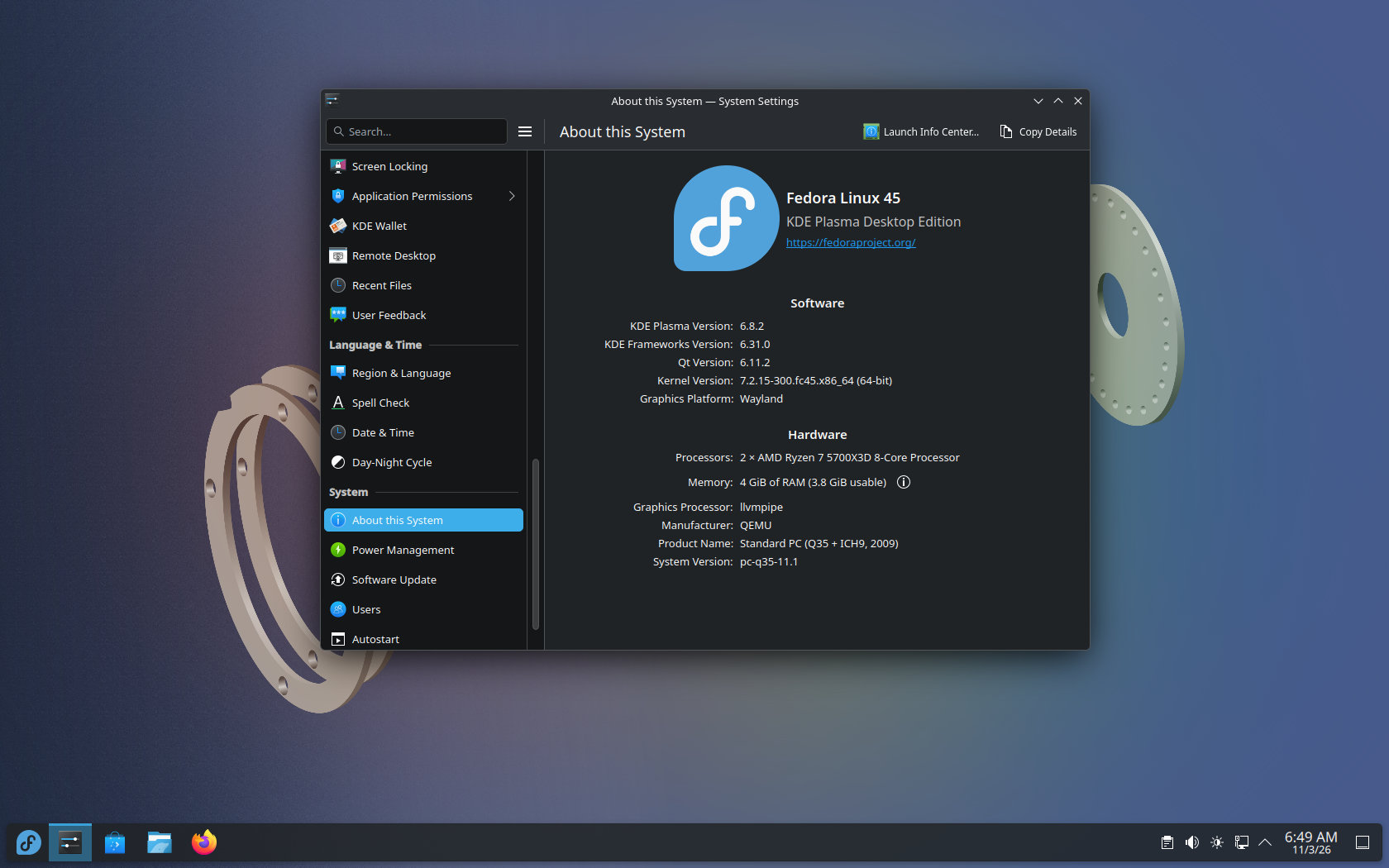
Fedora KDE Plasma Desktop 45 features KDE Plasma 6.8.2, which introduces per-screen virtual desktops, allowing users to manage virtual workspaces independently on each monitor.
Other additions include a system tray toggle for switching between light and dark themes, microphone testing, and improved handling of background applications. Remote desktop performance has also been improved, with bidirectional clipboard synchronization and virtual display support.
Plasma 6.8 also retires support for launching native X11 desktop sessions, completing its transition to Wayland. However, X11 applications remain supported through XWayland.
Under the hood, one of Fedora 45’s most notable changes is replacing the traditional in-kernel virtual console, fbcon, with kmscon, a userspace implementation. The new console provides improved Unicode and font rendering, better keyboard layout handling, and less console functionality running directly inside the kernel.
On the security side, Fedora 45 now enforces RPM package signature verification by default, requiring packages to have valid signatures and digests before installation unless verification is overridden.
Additionally, the distribution restricts ptrace permissions for unprivileged users by default, helping prevent malicious applications from inspecting other processes belonging to the same user. Full debugging functionality can still be enabled when appropriate development tools are installed.
Desktop secret management also changes with the adoption of oo7, a modern Secrets Service implementation written in Rust that replaces older secret-storage backends in supported configurations.
Fedora 45 also introduces several installation improvements. Anaconda installer now supports installing the distribution on Stratis-managed storage, including manual configuration via its WebUI and automated installations using Kickstart.
Users can also launch Cockpit Storage directly from the installer to create and configure Stratis storage pools, while automated deployments gain dedicated Kickstart commands for managing Stratis filesystems.
Moreover, Fedora Atomic Desktop variants, including Silverblue and Kinoite, transition from the legacy GTK-based Anaconda installer to the newer WebUI interface. These variants also gain support for secure remote installation via a browser, using HTTPS and PIN-based authentication.
Fedora 45 also updates how Atomic Desktop installation images are produced, switching to image-builder and enabling additional disk image formats for applicable variants. In addition, Fedora CoreOS enables systemd-oomd and zram swap by default to improve memory management.
On the software side, Fedora 45 includes RPM 6.1, Python 3.15, GCC 16.2, glibc 2.44, LLVM 23, Go 1.27, and Perl 5.44. Other updates include Podman 6, Pandas 3, and Lua 5.5, providing developers with newer compilers, programming environments, and container management capabilities.
Finally, one important change for existing users is the removal of two legacy NetworkManager VPN plugins, NetworkManager-vpnc and NetworkManager-fortisslvpn. Both are automatically removed during upgrades to Fedora 45, with affected users advised to migrate their VPN connections to supported alternatives such as OpenConnect or Libreswan.
For more details, visit the release announcement. Fedora Linux 45 is available now from Fedora’s official website in Workstation, KDE Plasma Desktop, Server, IoT, Cloud, CoreOS, Atomic desktop variants, and Fedora Spins.