Rune, a native keyboard-driven development environment for Linux and macOS, is now open source under the GPLv3 license, with developer Unstable Build publishing the source code on GitHub. The IDE is written mainly in Go and uses a GPU-accelerated native interface.
Importantly, unlike terminal editors such as Vim or Neovim, Rune is a native GUI app whose interface is heavily inspired by terminal multiplexers, with a character-grid layout built around terminals, panes, commands, and keyboard-driven workflows.
The terminal is a first-class part of the environment rather than an addition to the editor. Rune also includes a persistent console that acts as a REPL for managing packages, configuring models, controlling extensions and processes, and working with the debugger.
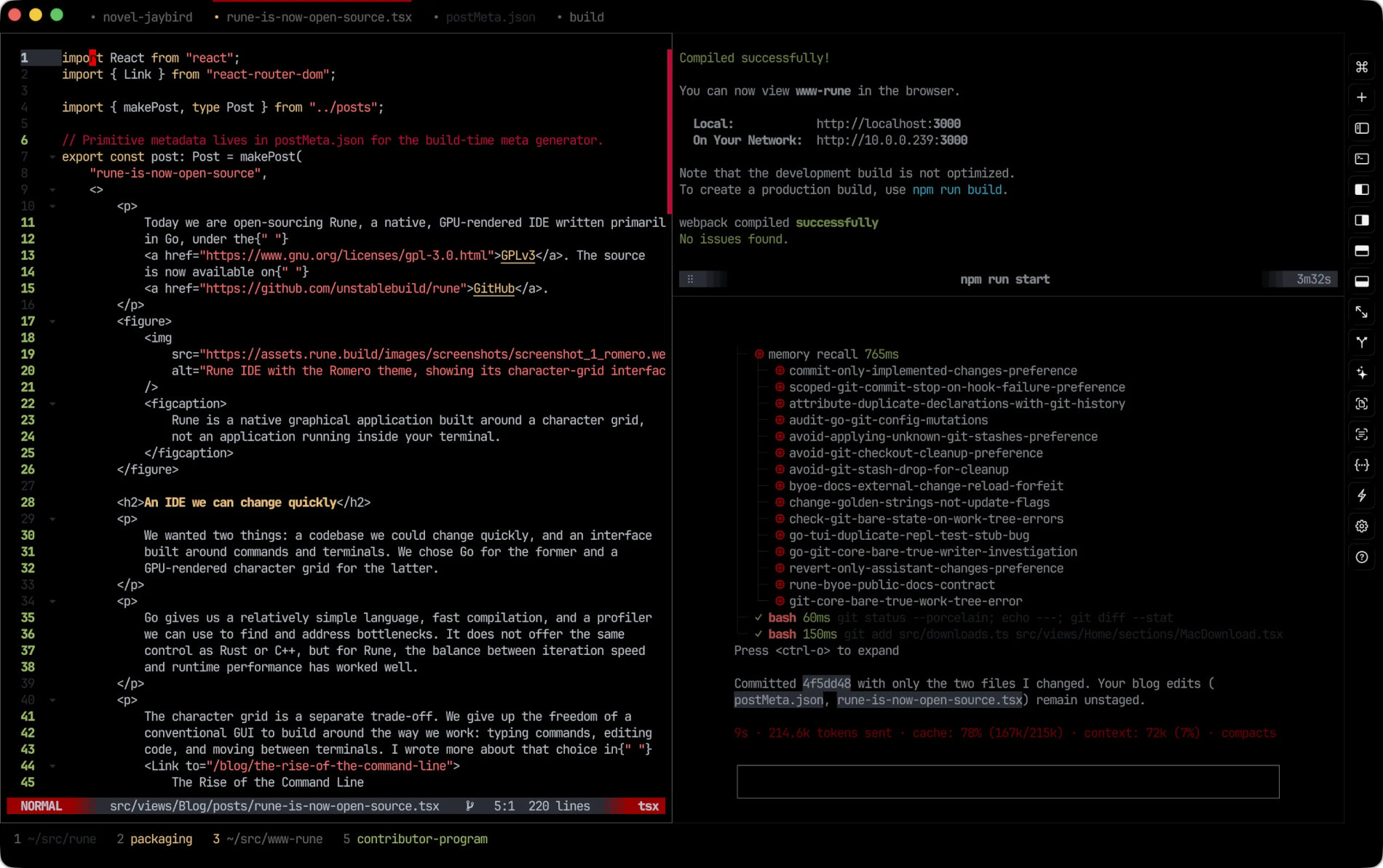
Another central part of the interface is Rune’s command prompt. Editor operations, window management, language tooling, and AI agent workflows are accessed through a single fuzzy-searchable command system. Commands can be chained into aliases or assigned to keyboard shortcuts.
Language support currently focuses on Go and Python, which Rune considers its first-class supported environments. Rust and Zig integrations are already available in beta in the project’s main development branch.
The project is currently looking for contributors interested in adding similarly deep integrations for languages such as TypeScript, Java, C#, Elixir, OCaml, and Clojure. SDKs are already available for developing Rune extensions in Go and Python.
AI tooling is also part of Rune’s broader development model, although the editor is not built solely around AI-assisted programming. Agent workflows share the same command environment as traditional editor and language operations, allowing AI tools to run alongside terminals and other development processes.
The move to open source also comes with an unusual approach to project governance. Rune is licensed under GPLv3, and contributors retain copyright over the code they submit.
Unstable Build says it will not require contributors to give special relicensing rights that could let the company make community-developed code proprietary. Instead, the company is preparing an optional contributor revenue-sharing program.
Accepted contributions will receive credits, and a defined portion of revenue from eligible Rune-related services will be placed into a contributor pool. Payments will be distributed based on the number of active credits each participant holds.
More details, including the source code and contribution instructions, are available through Rune’s official announcement and GitHub organization.
Image credits: Rune