
RefreshOS 3.0, developed and maintained by eXybit Technologies, has been released as the latest major version of the Debian-based desktop distribution, moving the project to Debian 13 (Trixie) and KDE Plasma 6.
Codenamed “Colorful Cosmos,” the release brings the distro to a newer desktop stack with KDE Plasma 6, Qt 6, and the Linux kernel 6.12. That makes it a major update over the old RefreshOS 2.x series, which was based on Debian 12 (Bookworm) and the previous Plasma 5 generation.
The distro offers an interesting approach, targeting users who want Debian’s stable foundation with a more modern desktop setup. Instead of starting from a standard Debian installation and manually adding firmware, codecs, desktop applications, and usability tweaks, RefreshOS includes and configures these parts by default.
The project bets on a traditional APT-based approach. It uses Debian repos for packages and updates and ships without Snap or Flatpak by default. The 3.0 release brings updated visuals, custom icons, cursors, window styling, and a new Reload Menu.
As you can see from the screenshot below, the result is a polished desktop presentation while the base remains Debian Stable (v13.5) with Plasma 6 (v6.3.6) as the main graphical environment.
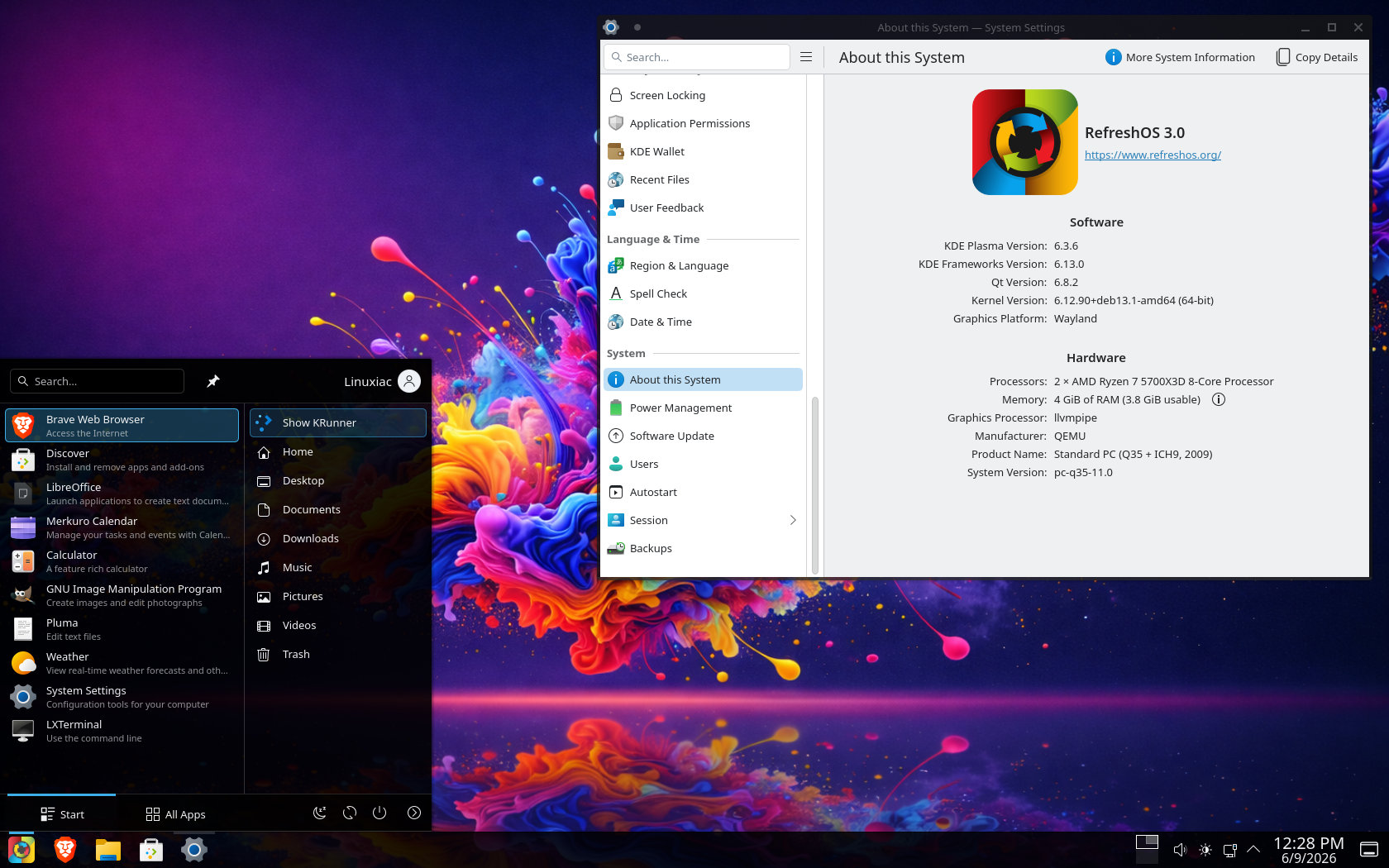
And let me make an important clarification right away: the distro should not be mistaken for a pure KDE application stack. Yes, Plasma 6 is the desktop environment, but interestingly, the system includes applications from other desktop projects such as Nemo as the file manager and LXTerminal as the terminal emulator.
So, one could say that, in practice, RefreshOS is a customized Debian desktop remix built around Plasma, not a strict KDE-only distribution. Now, a little more about the preinstalled apps that ship with the default install.
Brave is included as the default web browser. LibreOffice is preinstalled for office documents, spreadsheets, and presentations, while Thunderbird handles email. For multimedia use, VLC is included for video playback, and Elisa is available as the music player.
The distro also ships GIMP for image editing and Kdenlive for video editing. PhotoQt, KWave, and KolourPaint are also included, rounding out the default software set with image viewing, audio editing, and simple painting tools. Installation is handled through a live ISO with the Calamares graphical installer.
Hardware and multimedia support are part of the default setup. RefreshOS includes drivers, firmware, media support, power settings, and application defaults out of the box, lessening manual post-install configuration usually needed on a fresh Debian system.
For additional details, see the announcement.
With the arrival of the 3.0 release, the older 2.x line has been retired. In light of this, RefreshOS 2.0 and 2.5 will no longer receive support from eXybit Technologies, although existing systems will continue receiving Debian 12 LTS security updates through June 30, 2028.



The whole point of Debian is having a stable Linux that just works. “Debian fans” don’t tend to distro hop.
This distro sounds a bit redundant and therefore ridiculous. Debian Trixie already has KDE Plasma 6 in the repos and you can install it through the official Debian KDE live ISO file, therefore no need to install another desktop environment and then install KDE separately. The removal of some KDE apps to replace them with the likes of Nemo is actually a turnoff for me. I’d much rather have a pure Debian install with a KDE stack. I stopped reading at that point.
I’m amazed that you wrote this article with no apparent awareness of the redundancy and frankly uselessness of this distro. The developer’s time would’ve been better used contributing to Debian itself or another large distribution — unless a mainline responsible distro like Debian wouldn’t LET this dev have access to contribute for some reason. If that’s the case, that would be a red flag to stay away from his software!
Yeah, when I clicked on the article I thought it was going to be Debian Stable but with rolling KDE, which is a viable niche I would like to try. But as you pointed out, Debian already has Plasma 6 and using Nemo on a KDE distro sounds crazy to me lol.
I tried the live version, your review is very interesting. The system has a Wayland graphics server, a peculiarity considering that the system is based on Debian Trixie.
Considering wayland is the default in plasma 6, and plasma 6 is what’s in trixie, not sure why you would consider that peculiar. It’s also default for gnome, and that was the case even back on bookworm.
And to the author, you apparently have never installed debian, as suggesting the live iso as the way to install plasma is unnecessary. The standard netiso installer offers plasma along with several other desktop environments.
Very similar to MX linux.