MuseScore Studio 4.7 has been released as the latest version of the open-source, cross-platform music notation and composition software.
This release provides several engraving updates for greater control over score layout and notation. Arrowheads can now be added to text lines via the Lines palette or configured in the Properties panel. Chord brackets are available for keyboard music, guitar barré notation, and other sections requiring visual grouping.
Additionally, chord parentheses are now managed through the existing parenthesis controls in Properties. Lyric extension and dashed lines can be selected directly for precise positioning. System dividers now offer new scale and position options in Styles and can be selected and edited directly in the score.
Text handling has been refined as well, with MuseScore Studio 4.7 now providing formatting properties for all text lines, including staff and system text lines, volta brackets, and gradual tempo changes.
Text justification and alignment are now separate, offering more control over text positioning. Curly quotation marks are inserted automatically, with the option to undo and revert to straight quotation marks immediately after input.
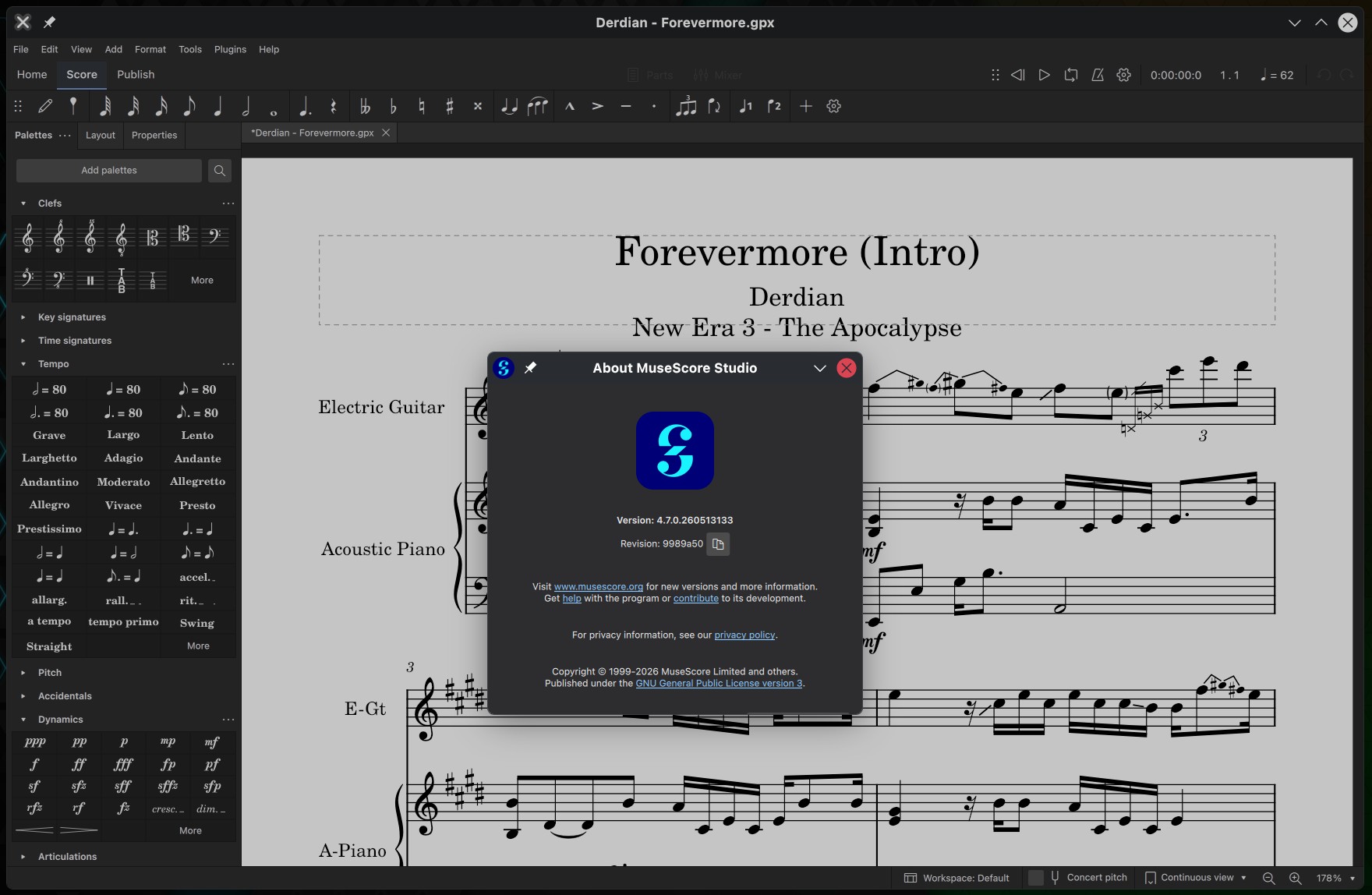
Guitar notation receives significant updates in this release. MuseScore Studio 4.7 introduces a new system for displaying guitar dives on tablature, above the tablature staff, and on the standard staff, with playback support.
On top of that, mew capo transposition modes allow users to view both sounding and played pitches on the standard staff. Plus, a non-transposing tablature option is also available for situations where the capo is used solely to simplify fingering.
Guitar options are complemented by fretboard diagrams and chord symbols now included in score transposition, ensuring consistency when changing keys or working with transposed material.
Workflow improvements address common editing tasks. Double-clicking a single note in a chord now selects the entire chord, and the “R” shortcut repeats the selection on the next beat. The mixer now features a search field for quickly locating sounds and effects, and some long dropdown menus support initial-letter navigation.
MuseScore Studio 4.7 also introduces new enharmonic spelling controls in the Tools menu. When entering notes via a MIDI keyboard, selecting an accidental in the note input toolbar now determines how notes and chords are spelled. The “Q” and “W” shortcuts can halve or double the duration of selected notes or ranges, and Find/Go to can now select a range of measures.
A new Appearance preference enables invert score mode to automatically follow the application’s dark mode setting.
Playback has been improved with a refactored audio engine, resulting in better performance and reduced lag across operating systems. On Windows, MuseScore Studio 4.7 adds ASIO support and a lower-latency 256-sample buffer option.
MP4 video export for scrolling score view, including audio playback, is now available from Publish > Export. MuseScore Studio 4.7 also adds MIDI machine control support, enabling compatible VST plugins to control the in-score playhead position.
For more details, see the announcement. Downloads are available via the project’s downloads section or GitHub release page.
Linux users can download MuseScore Studio directly. Users requiring MuseSounds support should install MuseSounds Manager separately. On Windows and macOS, update notifications will appear in MuseScore Studio or MuseHub, though manual installation remains available for those who prefer not to wait.