
Ageless Linux is a new project with an unconventional goal even by open-source standards. Instead of offering technical innovations, it serves as a platform for protest against emerging age-verification regulations that may affect operating systems and software distribution.
Right off the bat, one thing needs to be clear: Ageless Linux, based on Debian, is not a traditional distribution. It is just a minor modification applied to an existing Debian installation.
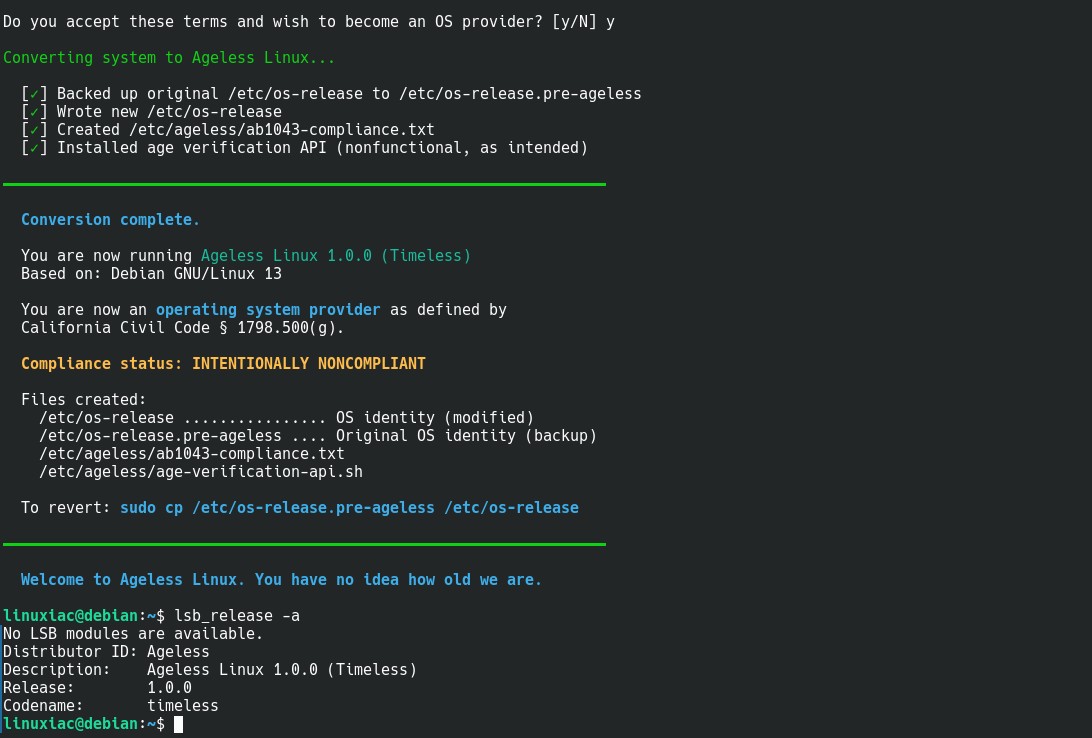
Users install Debian, then run a script from the project that rebrands the system as Ageless Linux and applies a few changes reflecting the project’s legal position. That’s it.
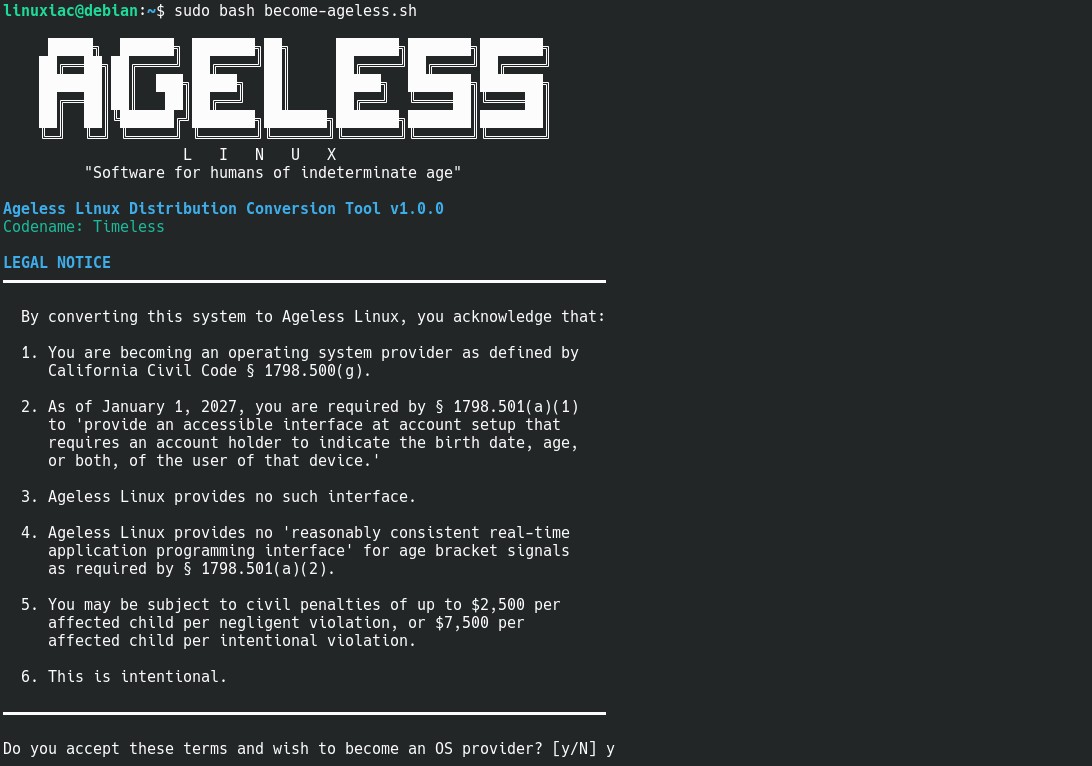
The initiative is focused on the implications of new legislation, such as California’s Digital Age Assurance Act. According to the project’s creators, the definitions used in such laws could be interpreted broadly enough to apply not only to major commercial operating systems but also to open-source platforms and software repositories.
Under some interpretations, Linux distributions, package repositories, or even individual software download sites could theoretically fall within the scope of an “application store” or an “operating system provider.”
As you know, most of the Linux distributions are maintained by decentralized communities and distributed globally through various channels. Applying regulations intended for centralized commercial platforms could create significant legal uncertainty for open-source projects.
Ageless Linux challenges these regulations by deliberately omitting any form of age verification. The system provides a minimal interface that returns no user age information and serves only as a placeholder. The creators describe this as intentional non-compliance to demonstrate the challenges of applying such requirements to open-source systems.
The project is technically lightweight. The script primarily updates system metadata, installs documentation on the project’s purpose, and adds the age-verification stub. Otherwise, the system remains a standard Debian 13 installation with its usual repositories and software ecosystem.
The project also suggests using a small hardware device, such as the Milk-V Duo single-board computer, to demonstrate its concept. This minimal Linux system can be distributed without age verification. The goal is to test how regulators might respond if minors use such a device.
According to the project’s roadmap, the creators plan to expand Ageless Linux later this year. A Debian-based Netinstall ISO, a prebuilt device image for the Milk-V Duo S single-board computer, and a Flatpak-based application repository called the Ageless Store are all expected in the third quarter of 2026.
The project also plans to distribute installer images via BitTorrent, noting that if age-verification laws are interpreted broadly, even torrent seeders sharing a Linux ISO could be classified as operating system providers.
For more details, visit the project’s website.

so everyone in usa will be marked 18 and over if you put 18 or above and it will not share your actual age but this could be just a 1st step to get us use to this before it becomes even more invasive in future and easier to track us?
Will there be any countries that are not going to pass anything like this? I will just vpn to another country if possible but it feels like many nations are headed towards this with some a lot worse then others.
Basically the law is so vague that anybody carrying a USB stick containing an OS is considered an OS provider. Moreover, anybody operating it is also in charge, so even if you don’t know for sure if an update is altering certain features you are still liable. There is no clear definition what an OS is either, and thus any appliance firmware can be considered OS. Your IoT devices can be illegal, and so on.
Sorry, but I don’t get the basic issue. Do you become an operating system “provider” and theoretically subject to California’s law by merely using Ageless Linux yourself or by letting others use it on your computer (in either case, even if not actually in California nor a citizen of California), or does Ageless Linux actually make you a “provider” by somehow exposing your system so that others can download Ageless Linux?