
MinIO, the widely used high-performance, S3-compatible object storage system for cloud-native applications with millions of deployments worldwide, is about to reach the end of its life cycle. But the way this shift has unfolded has left many in the open-source community raising their eyebrows. Here’s the background.
At the start of the summer, MinIO suddenly stripped nearly all useful features from its admin console, leaving them available only through the command line. As expected, the change triggered a wave of frustrated user reactions. What no one realized at the time, however, was that this first step was likely just one part of a larger, pre-planned cycle, as later events would suggest.
In mid-October, a second surprise followed—again with no prior notice to users. MinIO announced it would stop publishing Docker images, the primary method most people relied on to deploy it. That left users with a fait accompli: if you want to run MinIO, you now have to build it yourself from source, using the so-called source-only distribution.
This brings us to a few days ago, when the story reached its logical conclusion. MinIO has placed its open-source object storage project into maintenance-only mode, ending all active development and feature work. The company has stopped accepting new pull requests, enhancements, or contributions and will evaluate only critical security fixes on a case-by-case basis. Existing issues and pending pull requests will no longer receive active review.
On the project’s GitHub page, maintainers emphasize that community support will continue only on a best-effort basis through Slack. This shift effectively marks the conclusion of forward development for the free MinIO distribution.
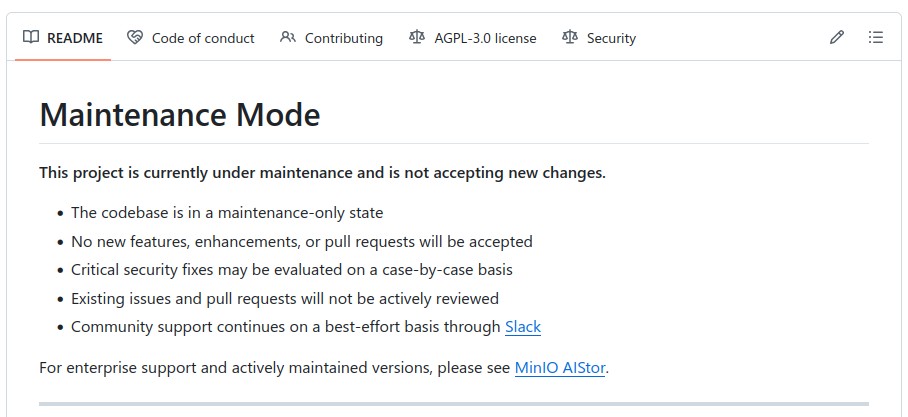
Or to put it plainly, MinIO is effectively done. Once again, the announcement came with no advance notice, no transition period, or any chance for users to react.
For anyone who wants to stay with the company, there’s a brand-new paid solution, MinIO AIStor, which is no longer tied to open source and now serves as the company’s actively maintained, fully supported offering. It includes the ongoing feature development, enterprise support options, and long-term maintenance that are no longer available in the open-source edition.
So, if MinIO is part of your infrastructure, the priority now is clear: begin planning an urgent migration to an alternative and move away from MinIO. With active support discontinued, continuing to rely on it poses a real risk, especially as attackers will be quick to exploit any vulnerabilities.
The good news is that there are great, fully open-source alternatives, like Garage, SeaweedFS, and RustFS, worth considering as MinIO replacements.
In conclusion, there’s nothing inherently wrong with MinIO deciding to step away from its open-source roots (which, ironically, is what made it so popular) and shift its focus entirely to commercial products. Yes, companies often make choices that align with their financial goals. But the way the transition was handled raises ethical questions, and the open-source community, for better or worse, tends to remember such moments for a very long time.


Thank you for the article and the ‘breaking’ news. I discovered this MinIO change earlier this week by encountering broken links in the documentation. Maybe the 404 errors were unrelated, but it caused me to search and find your article. Not the best way to learn of this.