
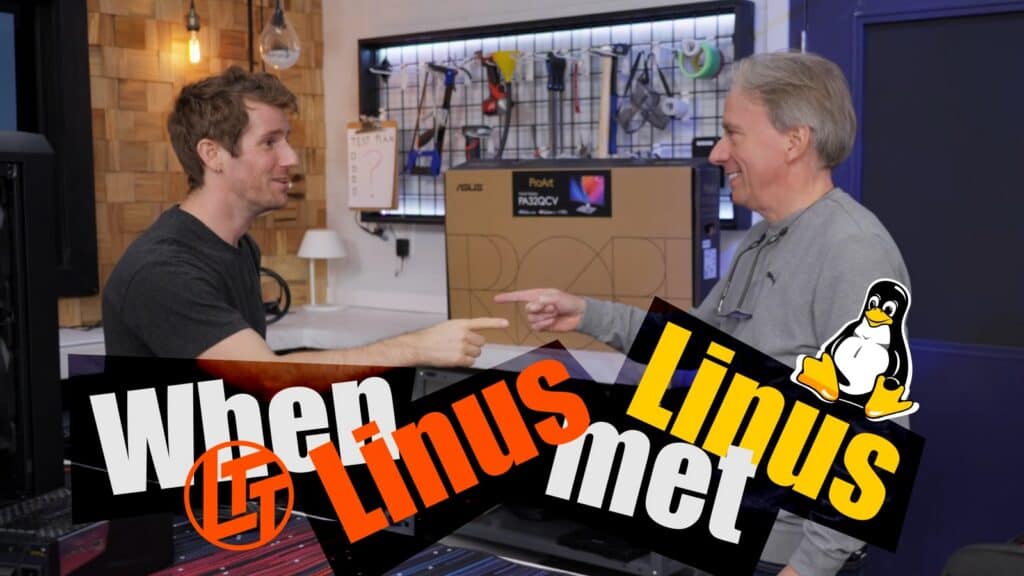
Linus Torvalds doesn’t usually seek the spotlight, so it was a pleasant surprise to see him appear a few days ago as a guest on another well-known Linus’s show—Canadian YouTube star Linus Sebastian from the Linus Tech Tips (LTT) channel.
Depending on who you ask, the two have very different kinds of fame. One is the creator of the operating system that reshaped modern computing. The other has more than 16 million followers, and it’s hard to find a tech enthusiast who hasn’t seen his videos. But as Torvalds joked at the start of the video, when signing a book about himself, “To fake Linus from the real one.”
The premise of the video—building the “perfect” Linux PC, as the title “Building the PERFECT Linux PC with Linus Torvalds” suggests—is mostly just a vehicle for the conversation. The focus isn’t really on assembling the machine but on the dialogue between the two and Torvalds’ answers to questions that many Linux users have long been curious about.
Below, I’ve pulled together the points I think will be most interesting to readers from the 53-minute video. So, let’s get started.
What Linux Distro Does Torvalds Actually Run?
Torvalds uses Fedora. In fact, this isn’t new—he’s said it many times over the years. And before you jump in with, “Well, if he uses it, it must be the best distribution,” let’s slow down a bit.
The fact that they’re installing the older Fedora 42 in the video, rather than the current Fedora 43, right after he says, “So, this is probably a newer version than the one I installed last time,” makes it clear he isn’t interested in version numbers, releases, names, features, or any of the usual release details.
For him, everything ultimately comes down to the one thing he actually cares about: the Linux kernel. So when the question comes up, “Why Fedora?” the answer is:
“They are very closely aligned with kernel developers. They made things easier, like Ubuntu very much wanted to be consumer-oriented. And in the process, when I tried it many, many years ago, they literally made it hard for me to upgrade the kernel because that was not their target audience. So I said, yeah, this is not for me, clearly by design. And again, that was not geared for me because I don’t care about anything other than the kernel. So the only thing I want to compile is my own kernel. I want a distro that just installs and just works.”
So, Torvalds couldn’t care less about desktop environments, flashy apps, or whatever else you can think of on the desktop side. As he’s openly admitted, he’s a walking disaster when it comes to maintaining a desktop setup—because none of that interests him. What matters to him is the Linux kernel, and everything else is secondary.
And as a small aside, if you’re wondering what the first thing he does after installing a system is, it’s not some elaborate kernel tuning ritual. He just changes the wallpaper to the one he’s used for many years. That’s it.
Finally, I would just like to share that I was struck by the fact that two places in the video indirectly referenced Arch (BTW), and based on Torvalds’ reaction, it’s hard for me to tell whether it was simply a light-hearted joke or if there was something more behind it.
Hardware Preferences
When it comes to his hardware preferences, Torvalds has said that he prefers using AMD processors. So it’s no surprise that the video showcases the assembly of a PC with an AMD Ryzen Threadripper 9960X CPU. If I recall correctly, in an interview a few years back, he explained that, compared to Intel chips in the same class, AMD hardware simply gives him better performance—something that matters a lot for the CPU-intensive kernel builds he runs constantly.
But what’s more interesting is that Torvalds spends a considerable amount of time in the video talking about another component he considers critical in any system: memory. Specifically, ECC memory. As he puts it, he “wouldn’t touch a system that didn’t have ECC memory.” For readers unfamiliar with the term, this is a type of RAM typically used in server-class systems that (unlike widely used desktop-class memory) can detect and correct small data errors on its own, helping keep a system stable and reliable.
Of course, there’s a reason behind this. It goes back to a bad experience he had many years ago, when he spent days chasing a bug that kept the kernel from compiling properly, only to discover that the real cause was a hardware issue with the standard desktop memory he was using at the time.
Beyond that, Torvalds made it clear he’s not a hardware enthusiast in any way. “I’ve done things close to hardware, but I’m not a hardware person. I love exploring the interface between software and hardware.” He said the last time he built a computer was five years ago, and he has no interest in keeping up with the latest gear. He just wants his machine to do the work he needs it to do. Quite a pragmatic approach.
Torvalds Reflects on Git
Another question Torvalds often gets asked is about his other famous creation, Git. He explains that this, too, came at a very specific moment and took him about six (boring) months for a clear reason: when he began working on the Linux kernel, no source control management system met his needs, so he decided to write his own.
He designed and wrote the initial implementation, then handed the project over to Junio Hamano and went back to what he enjoys most—writing code for the Linux kernel.
Today, Git is… well, the software behind all software. Virtually everything is developed with Git as its version control system. I’ll put it this way: if anyone ever tried to rank the most fundamental software in computing history, I’m not sure which would come out on top: the Linux kernel or Git.
How Much Kernel Code Does Torvalds Still Write?
The short version: almost none. The first version of the Linux kernel was about 10,000 lines of code, most of which Torvalds wrote himself. By 2006, his code accounted for only about 2% of the total. For context, by the end of 2024, the Linux kernel had grown to more than 40 million lines of code contributed by thousands of developers, making Torvalds’ direct programming role effectively negligible.
As he often notes, he doesn’t really write code anymore. His work is almost entirely organizational—reading and replying to hundreds of emails a day while overseeing development and preparing new kernel releases. These days, his most-used tool is his email client.
Online Presence
Torvalds is a clear example of someone who avoids having an online presence as much as possible. You won’t find him on any social network, and that’s entirely intentional. He simply doesn’t like that kind of publicity.
The video also makes it obvious that he strongly dislikes voice messages. But what he truly avoids are online meetings—yes, the typical video calls most people rely on for collaboration. As he puts it, the only app he uses for that sort of communication is his email client, and nothing more. So if you’re hoping for a quick online call with Torvalds, you can safely rule it out.
Bottom Line
Linus Torvalds—the creator of the Linux kernel and a figure often treated with near-mythic status, especially by younger Linux users—is, in reality, remarkably down-to-earth. He has no interest in glorifying his role or embracing any grand narrative about his place in the tech world. Actually, come to think of it, this is a trait you see in many people in the open-source world.
In fact, everything he says suggests that he has little desire to live in the spotlight. What he truly wants is what most people want: to spend as much time as possible with his family (instead of on airplane seats), and to focus on his favorite “hobby” — developing the Linux kernel.
The conversation with Linus Sebastian from LTT captures this perfectly. Torvalds is completely candid, though far more diplomatic today than in his early years, and the video offers a clear, human look at the person behind one of the most important technological achievements of our era — Linux. Of course, he also shares many other interesting insights in this video, so if you’re a Linux fan, it’s absolutely worth watching.

So, what email client does LT use ?
LOL, that also was my question after reading this article.
alpine of course
Torvalds use Fedora LX.