VitruvianOS 0.3 has been released as the project’s first publicly available version, described by its developers as a pilot build. It is based on the Linux kernel and adopts a design inspired by Haiku OS and BeOS.
For reference, VitruvianOS’s development began in 2019, and now, in 2026, this version serves more as a functional foundation rather than a complete system. But before we go further, a few words about the project itself, since the name is probably unfamiliar to the general public.
VitruvianOS is not a Linux distribution in the usual sense. It uses the Linux kernel only for hardware support, while replacing the standard Linux userland and desktop stack with its own components. Its goal is to combine Linux compatibility with a BeOS-style architecture.
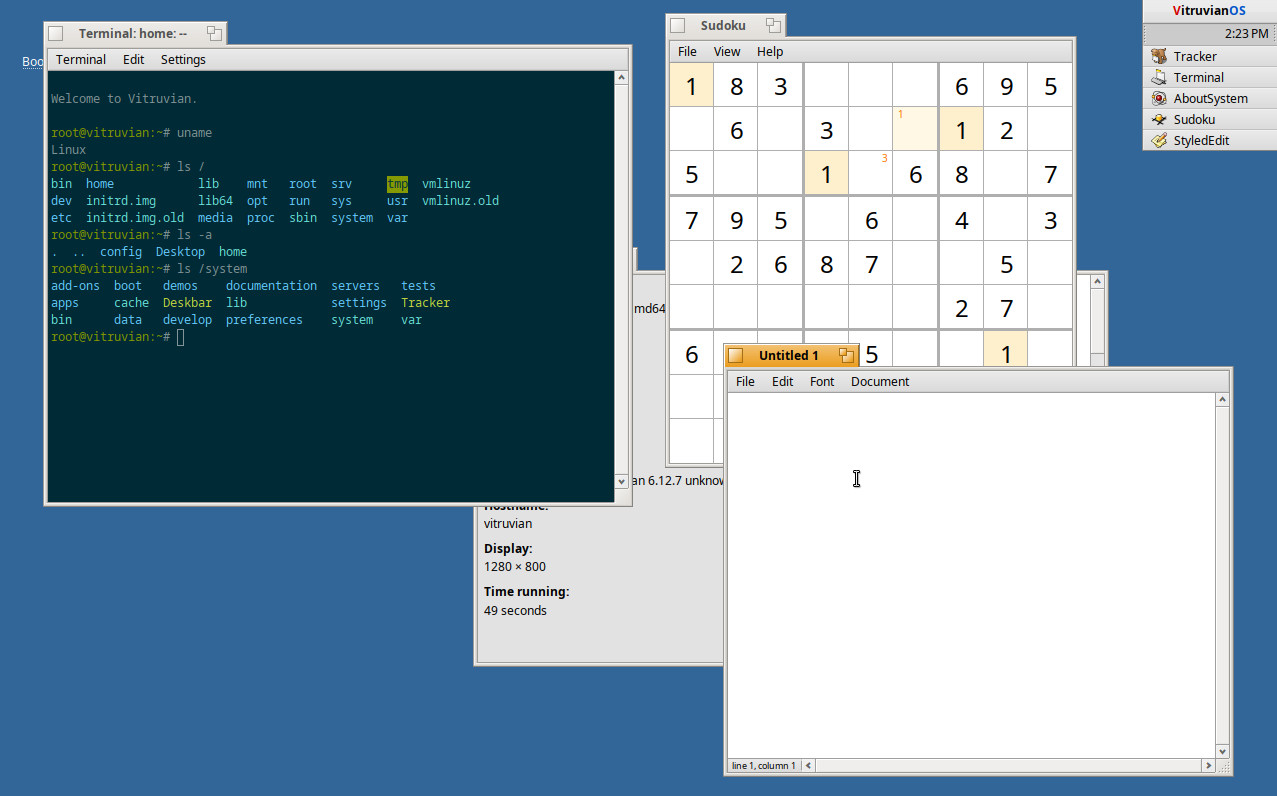
Let me explain. In a typical Linux desktop system, applications run on top of libraries and a display server such as X11 or Wayland. However, VitruvianOS removes this entire layer. It does not use X11 nor Wayland. Instead, it implements its own graphics system, input handling, and application runtime.
A key feature is Nexus, an internal communication layer that manages messaging between system components.
The system features native desktop elements modeled after BeOS, including a Deskbar and a Tracker-style file manager. It also offers a compatibility layer to support applications built for Haiku and BeOS APIs.
Moreover, the system uses a Linux kernel with real-time patches. Regarding filesystems, VitruvianOS 0.3 supports XFS and SquashFS, as well as extended attributes.
In the announcement, the developers have also outlined a short-term roadmap. Version 0.3.1 will add missing components and bug fixes based on initial testing. Version 0.3.2 aims to move the system toward self-hosting, enabling VitruvianOS to build itself.
Next, the upcoming 0.4 release will focus on stability and broader hardware support, including ongoing ARM port development. Planned improvements also include enhanced input handling, a complete keymap system, and further user interface refinements.
For more details, see the announcement.
Finally, once again: keep in mind that VitruvianOS 0.3 is an experimental release intended mainly for testing and development.
Image credits: VitruvianOS