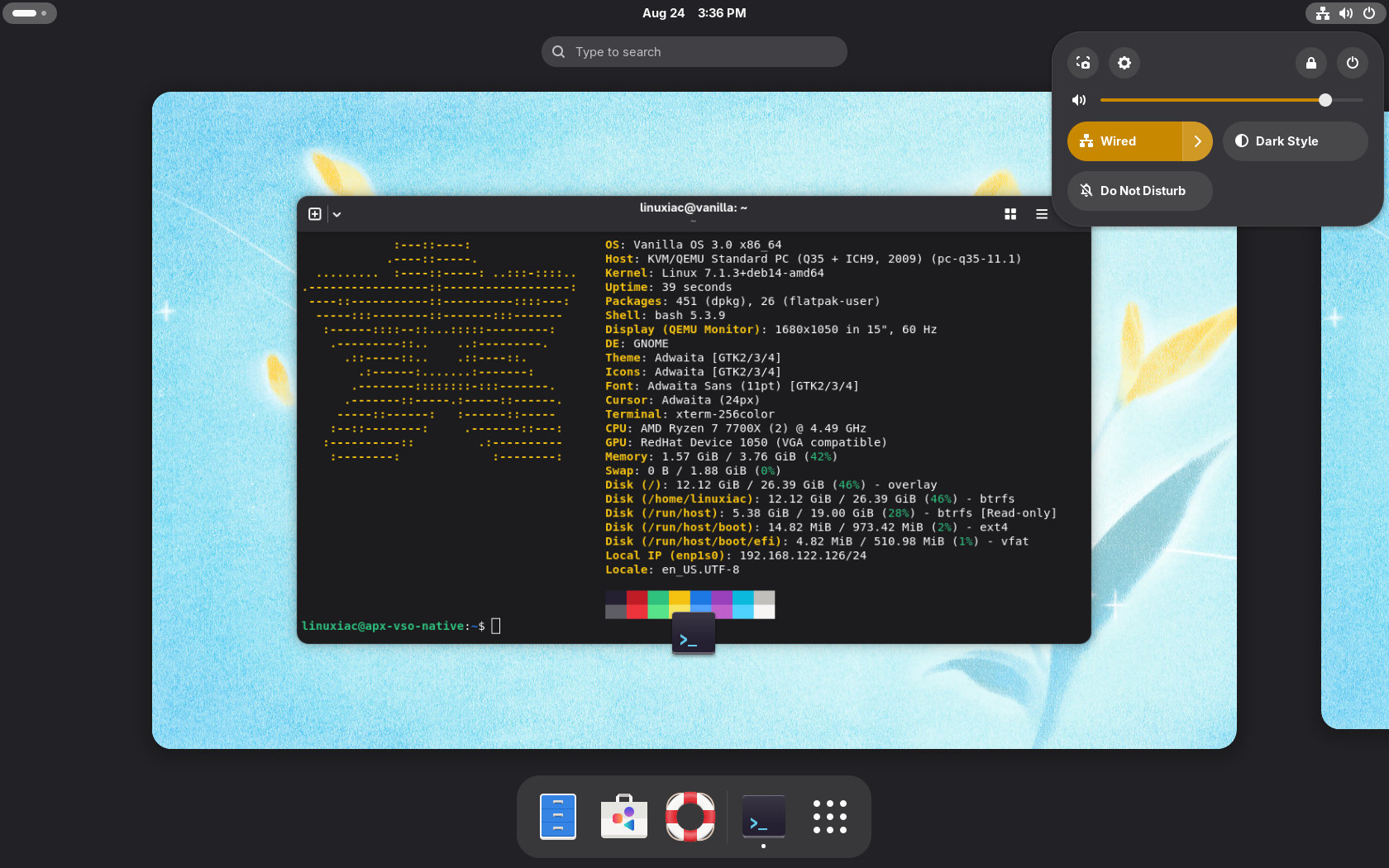
More than two years after Vanilla OS 2 “Orchid” launched in July 2024, the project has released a major update. Vanilla OS 3, codenamed “Reunion,” is now officially available, bringing ARM64 support, GNOME 50, Linux kernel 7.1.3, a new backup solution, and substantial changes to the distro’s underlying tooling.
If you haven’t used Vanilla OS before, it’s a Debian-based Linux distribution that uses an immutable, atomic system management style, protecting the core system and updating it atomically with its ABRoot feature. Or, more simply, the system keeps two versions of itself, makes changes to the inactive one, then switches to it after a reboot.
A major new feature in Vanilla OS 3 “Reunion” is official ARM64 support. Vanilla OS now offers images for both x86_64 and ARM64 systems. Right now, ARM64 support targets UEFI-compatible devices, and the project’s packages are also built for ARM64.
The desktop has been updated too. Reunion comes with GNOME 50 “Tokyo” and uses only the Wayland GNOME session, powered by Linux kernel 7.1.3.
Another key update is Vanilla Continuity, a new in-house-made backup and restore tool that uses snapshots. Continuity can back up your home folders, your list of installed Flatpak apps, and ABRoot metadata. You can then save backups locally, on an external LUKS2-encrypted drive, or send them to remote storage using SFTP, FTP, or NFS.
The team has also worked on making builds reproducible. Developers say most Vanilla OS system images can now be rebuilt from the same source and settings, improving transparency and build reliability. The main exception is NVIDIA images, due to how NVIDIA kernel modules are managed.
Apx, Vanilla OS’s container-based package management layer, has been overhauled again. Version 3 is now rewritten with the new Vanilla OS SDK and includes updates to its command-line interface and core design.
Moreover, Debian and openSUSE Leap are now part of the default Apx stacks, so you can access packages from more distributions using containers.
Vanilla System Operator has also been rewritten using the new SDK. Its container image now uses Debian Testing instead of Debian Sid. Distrobox has been updated too to version 2.0.0-rc.4, which has been rewritten in Go.
The default desktop apps also change. Ptyxis is now the terminal emulator instead of Black Box, Papers replaces Evince as the document viewer, and Resources replaces GNOME System Monitor. File Roller and GNOME Photos are no longer included by default.
Finally, if you’re using Vanilla OS 2 “Orchid,” you don’t need to do a clean install. The developers offer a supported upgrade path from Orchid 1.4.0 to Reunion.
For more details, refer to the official Vanilla OS 3 “Reunion” release announcement.
Users upgrading manually with abroot upgrade should ensure they are running ABRoot 2.4 or newer because of changes related to the new multi-architecture system images.