
Over five months after its last 6.4 release, and just in time for Christmas, Parrot OS, a versatile Debian-based Linux distro designed for ethical hackers and cybersecurity pros, announced version 7.0, codenamed Echo, marking the most substantial release in the project’s history.
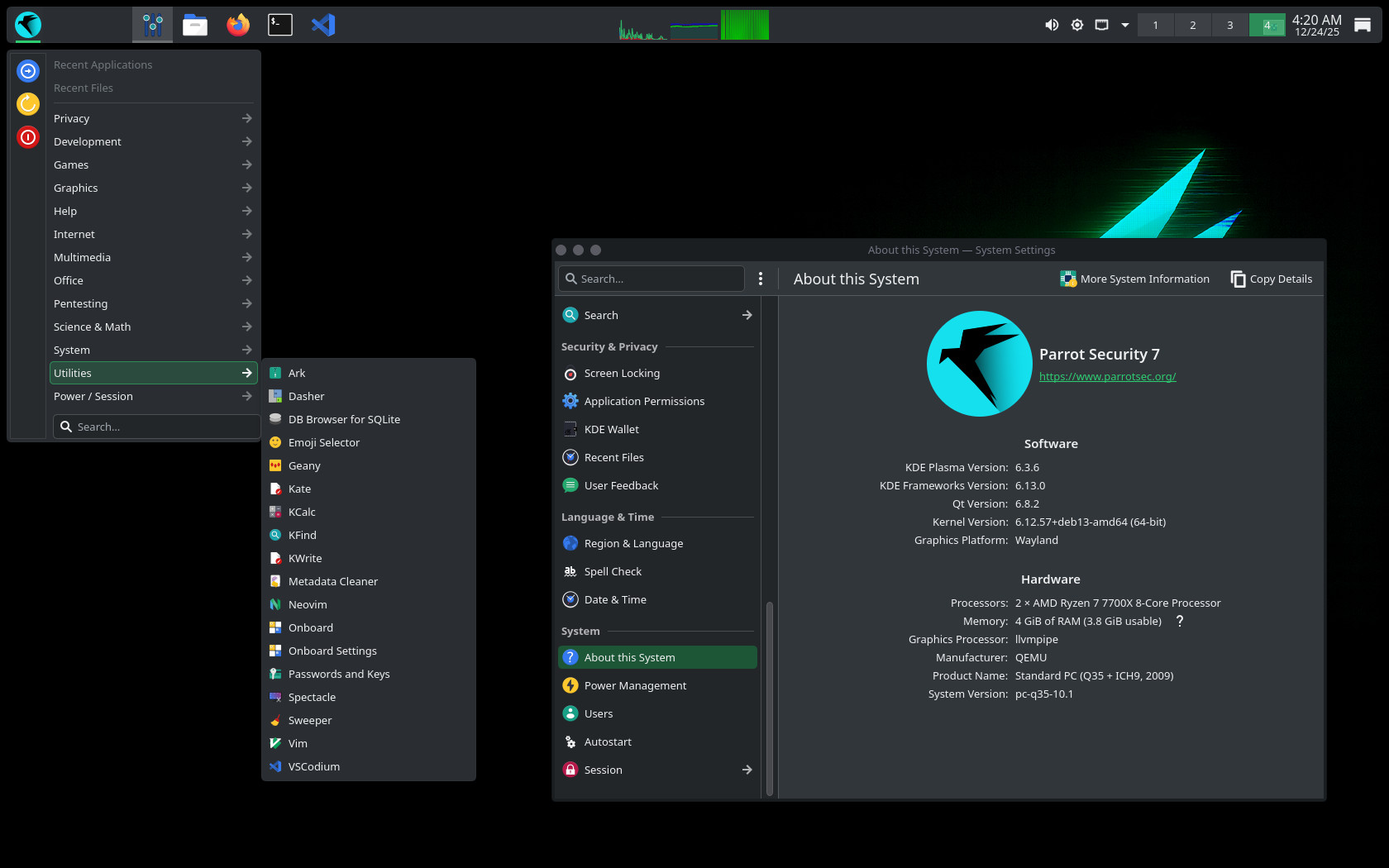
One of the most visible changes is the move to KDE Plasma 6 (6.3.6) as the default desktop environment. The system now runs on Wayland by default and is built on a Debian 13 base. Despite the desktop transition, the distro maintains a lightweight profile through extensive customization and theming.
Powered by Linux kernel 6.12 LTS, the new Parrot OS 7.0 visual identity revises icons, colors, and wallpapers, drawing inspiration from Flat Remix and Sweet Mars, and is delivered through a dedicated echo-themes package included in the distribution.
Under the hood, Parrot OS 7 introduces a reworked build system. ISO images are still generated with live-build, while virtual machine images are produced via a custom pipeline designed to deliver clean, optimized builds. Images are provided for QEMU, VirtualBox, VMware, and UTM in formats including qcow2, vmdk, ova, vdi, and utm.
Docker images have also been rebuilt for this release, with updated Core and Security editions joined by images dedicated to specific tool groups such as nmap, sqlmap, metasploit, and others. Plus, all builds are now automated through GitLab-based CI/CD runners.
Several core system components have been heavily refactored. The parrot-core package, which received the largest set of changes, has been redesigned to work with KDE’s plain text configuration files rather than the dconf database previously used with MATE.
The menu system has also been updated, with revised icons and desktop entries, while a Go-based launcher updater checks for duplicates and configuration issues and provides clearer diagnostics when errors occur. Other updated components include desktop meta-packages, display manager configuration, Firefox profiles, and Calamares installer settings.
Parrot OS 7 ships with an expanded and updated set of penetration testing and security tools. New additions include convoC2, goshs, evil-winrm-py, hexstrike-ai, bpf-linker, pkinit-tools, chisel, bloodhound.py, autorecon, and trufflehog, alongside updates to established tools such as Burp Suite, Maltego, airgeddon, sqlsus, and jadx.
The release also introduces a new AI-focused category, starting with Hexstrike AI. Rather than general-purpose automation, the project emphasizes tools for assessing and securing large language model prompts and related technologies.
Moreover, the parrot-tools meta-package has been expanded to preinstall a broader selection of utilities. Development toolsets now include gdb and cgdb, while additional information-gathering, reversing, and cloud-focused tools have been added across relevant categories. Seahorse replaces GPA for cryptographic key management, aligning the toolset with the updated desktop stack.
Parrot OS 7 also adds official support for RISC-V, making it the first penetration-testing distribution to do so. The project provides a pre-assembled root filesystem tarball, and its repositories include native Debian package builds and, where possible, Parrot-specific tools.
System updating has been addressed through a complete rewrite of the Parrot updater. The tool is now written in Rust and includes a graphical interface built with gtk4-rs. It performs weekly update checks and displays desktop notifications when updates are available, replacing earlier implementations that were considered inconvenient by some users.
Images for Docker and WSL have been updated to the Echo release, and the CI/CD pipeline has been refined to trigger automated rebuilds and pushes when repository changes occur. Rocket, the Parrot application manager, has been updated to version 1.3.0, bringing performance improvements alongside the broader system changes.
It’s important to note that Parrot OS 7 repositories can now be used with Debian 13 through a conversion script that supports any desktop environment or window manager. While compatible, the project recommends backing up and starting with the Core edition before gradually installing additional components, given the wide range of possible Debian configurations.
As you might expect, switching to KDE on Raspberry Pi systems changes the hardware requirements. The Core edition is recommended for Raspberry Pi 3B devices, while systems with at least 2 GB of RAM can run other editions. Alternative desktops such as MATE or XFCE may be reconsidered in future releases.
Given the scale of the changes, a clean installation is recommended for most users. Parrot OS 6.x will continue to receive security updates, and an automated migration path is planned once the transition to Parrot OS 7 is considered fully stable.
Systems upgraded from Parrot OS 6.4 will retain the MATE desktop by default, with migration to KDE Plasma 6 requiring manual configuration of the configuration files.
For more information, see the announcement.
Parrot OS 7.0 Echo is now available for download from the project’s website, offering two main editions. The Security edition is intended for penetration testing and red team work and comes with a full set of preinstalled security tools. The Home edition is a general-purpose system designed for daily use, development, and privacy, without the heavy-duty pentesting toolset.




Debian and KDE Plasma are the best choices, so congratulations to them!
But moving the task bar (panel) from its bottom default location to the top is a very bad choice as you cannot quickly go to the top right corner and click to close the maximized windows.
Which for sure it will have the close button exactly in that corner as the window’s title bars are at the top and the close button is always right aligned on them.
An action that can be done even with the eyes closed or looking away from the screen.
They should read about Fitt’s law to understand why the default bottom location is better.