OpenRGB, the popular open-source application for controlling RGB lighting hardware from different manufacturers through a single interface, has reached version 1.0 after nearly three years of development since the stable 0.9 release.
One of the biggest user-facing changes is an overhauled profile system. Profiles are redesigned around JSON and can now store more than the state of RGB controllers. Plugins can participate in profile saving and loading, while users get more control over what information a profile contains.
Moreover, the new system supports profiles linked to events like starting or closing OpenRGB, as well as suspend and resume. Plus, OpenRGB 1.0 also brings major improvements to running the software as a background service.
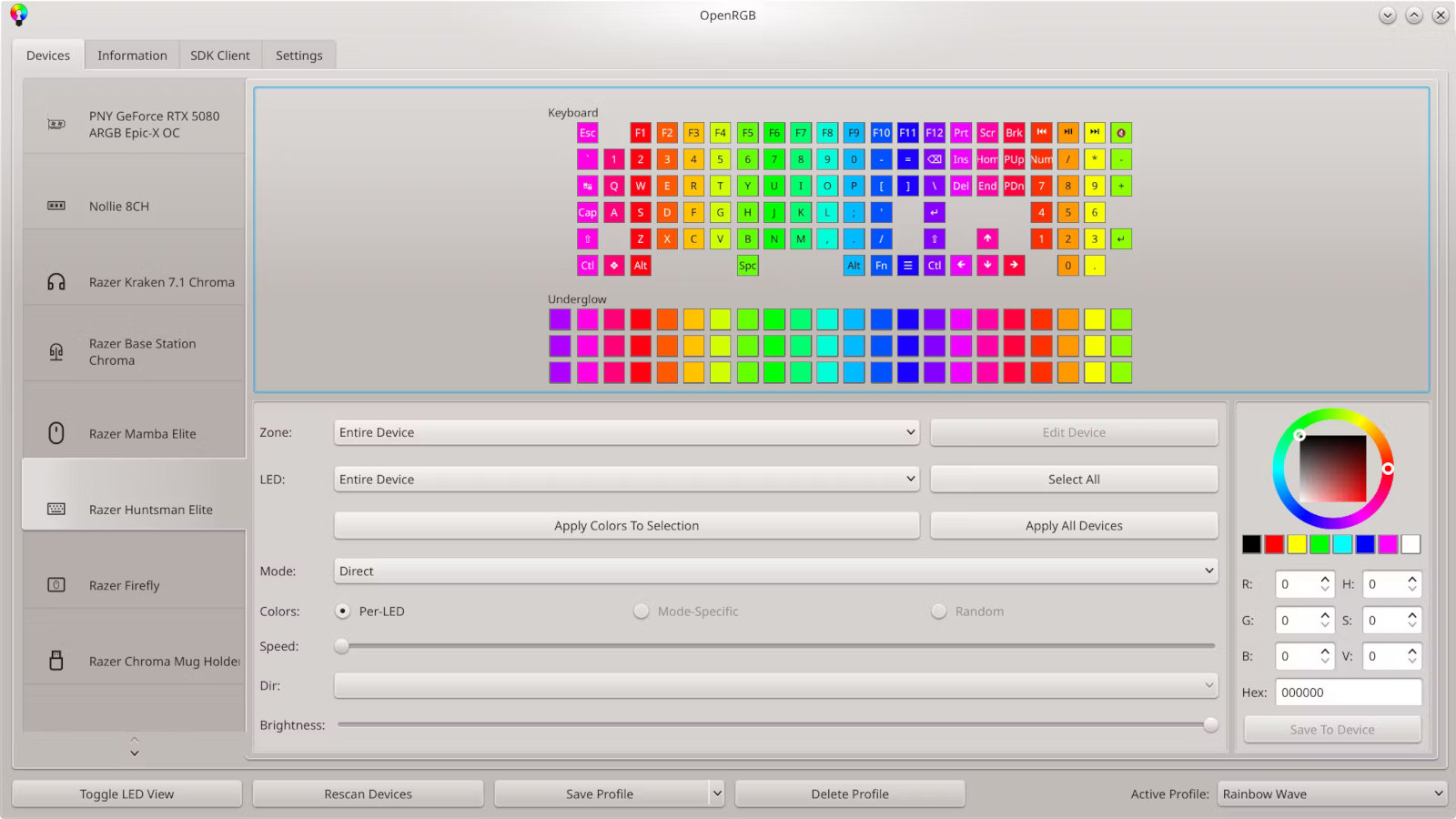
Linux installations can now include an OpenRGB systemd service directly, with the project also providing the associated configuration needed to initialize its /etc/openrgb environment.
Another important addition is HID hotplug support. Instead of assuming that the set of connected RGB devices remains unchanged while OpenRGB is running, the application can now react when supported HID devices are connected or removed.
That change goes hand in hand with OpenRGB SDK Protocol 6. Controllers are now identified using unique 32-bit IDs rather than their position in a device list. Protocol 6 also introduces a server name and other improvements to communication between OpenRGB clients and servers.
The RGB controller system has also undergone substantial work, including support for per-zone modes.
Under the hood, the plugin interface moves to API version 5, and plugins also gain hooks to save and restore their state as part of the new profile system.
Another notable milestone is the move to Qt 6 for the project’s primary builds. Linux AppImages, Debian and Fedora packages, Windows builds, the MSI installer, and macOS builds have all moved to Qt 6 as part of the 1.0 rework.
Additionally, for Linux users, OpenRGB also now considers its Flatpak package an officially supported distribution method.
On Windows, OpenRGB 1.0 also incorporates PawnIO, which replaces the older approach for low-level SMBus hardware access.
Finally, hardware support has expanded considerably throughout the lengthy development cycle. The project describes the release as adding “tons” of new device support. To see the full list of supported devices, check here.
For additional details, visit the project’s website or check the release README.
Image credits: OpenRGB