

Linux has crossed a major milestone in North America, with the open-source operating system now accounting for 10.65% of desktop usage in the region, according to Statcounter’s latest figures for July 2026.
The result places Linux firmly in double-digit territory for the first time in Statcounter’s North American desktop operating system statistics.
For comparison, Statcounter recorded Linux at 5.52% in June 2026, so the share nearly doubled in one month. As expected, Windows remained the dominant desktop operating system, while Apple’s OS X and macOS categories continued to hold a substantial market share.
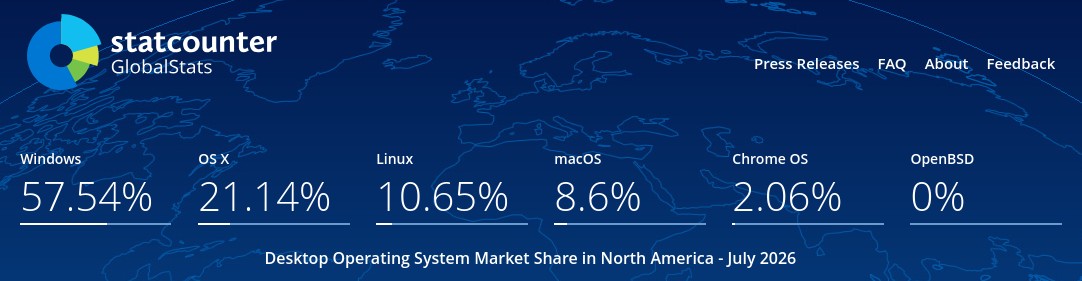
However, the sharp monthly increase needs context. Statcounter’s June figures included an “Unknown” category that accounted for 9.24% of North American desktop usage. Its reduction seems to have coincided with Linux’s rise, possibly indicating better identification of previously unclassified traffic.
That does not invalidate the 10.65% result, but the increase should not be seen as millions switching from Windows or macOS to Linux in July alone. Part of the jump may reflect changes in detection, classification, or Statcounter’s sample composition.
Still, Statcounter is not the only major web measurement platform showing Linux with a substantial presence on North American desktops. Cloudflare Radar data, filtered to desktop HTTP traffic from North America over the previous 28 days, also places Linux at a notably high level.
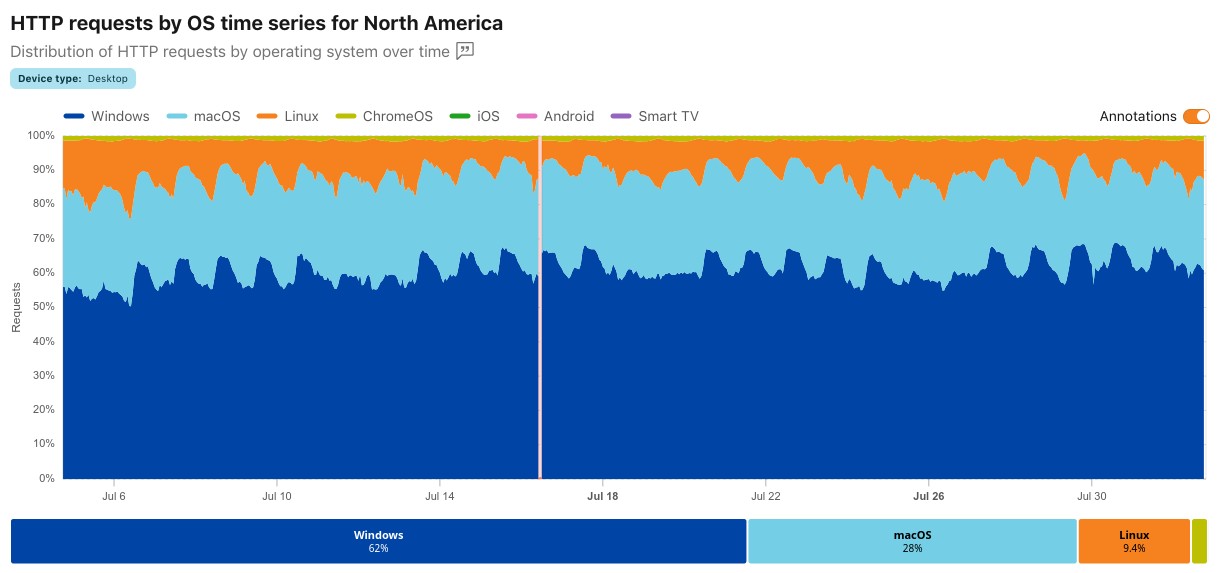
Importantly, the two services use different datasets. Statcounter bases its statistics on page views from its analytics network, which covers over one million websites and processes more than three billion page views monthly.
The company measures usage by page views rather than counting unique users or installed systems. Its figures update daily and may be revised during a 45-day quality-assurance period.
Cloudflare Radar, meanwhile, derives its operating system distribution from HTTP requests observed across Cloudflare’s global network.
Consequently, neither source should be seen as a literal census showing exactly one in ten North American desktops run Linux. They just measure the relative share of observable web activity linked to different operating systems.
Cloudflare’s unfiltered figures may include automated requests unless human traffic is classified. This is especially relevant to Linux, widely used for servers, automation, development environments, and headless browser workloads. Still, two large independent datasets pointing to a stronger Linux desktop presence make the Statcounter result harder to dismiss as an anomaly.
The milestone comes after years of steady improvements in the Linux desktop ecosystem. Hardware compatibility has advanced, installation has become simpler, and mainstream distributions now offer polished desktop experiences requiring little command-line knowledge for everyday use.
Linux gaming has transformed through Valve’s Proton compatibility layer, the Steam Deck, improved graphics drivers, and broader Vulkan support. Meanwhile, growing frustration with Windows hardware requirements, advertising, account integration, telemetry, and forced interface changes has pushed some users to explore alternatives.
However, none of these factors alone proves the cause of the latest increase, and Statcounter does not provide demographic or motivational data to explain the change. Still, they are part of a broader environment in which moving to Linux is more practical than it was a few years ago.
The Steam Deck may have also contributed indirectly. Although primarily a handheld gaming device, its Linux-based SteamOS has introduced a larger audience to Linux gaming and shown that the operating system can deliver a polished consumer experience without requiring users to understand technical details.
There is also growing influence from developers, privacy-conscious users, educational institutions, and organizations seeking greater control over computing environments. Plus, Linux distributions increasingly provide mature support for productivity workloads, web applications, communication platforms, creative software, and development tools.
For now, the safest conclusion is that Linux has surpassed 10% of measured desktop web usage in North America according to Statcounter, not necessarily 10% of the region’s installed desktop computer base.
But even with that distinction, crossing the double-digit threshold remains notable. Linux has spent decades described as perpetually close to a desktop breakthrough. So, maybe, just maybe, we’re really approaching a famous running joke and long-standing prediction: “Year of Linux on the Desktop.”





I Deleted all traces of Windows from all my computers … I installed Linux MintOS on my old Desktop, DeepinOS on my laptop and Harmony on my big screen NEW desktop.
I am as happy as a lark !!!… Content beyond words … I am at the gates of heaven !!
These figures have already been debunked. StatCounter even published a correction. A lot of site were presenting these figures as evidence that Windows has taken a massive hit – problem is, the numbers don’t add up.
After StatCounter’s correction, Windows was back up around 71%.
https://www.windowslatest.com/2026/07/12/no-windows-did-not-fall-below-60-market-share-or-lose-15-points-to-linux/
Still, Linux market share has been rising sharply for months, even after the correction.
That’s not a surprise, given that governments in the majority of developed countries have announced a shift away from American proprietary software, including cloud services and, of course, MS Windows and MS Office.
Proprietary software is coming to an end anyway, as it is inherently unreliable and untrustworthy. You could say that this is becoming a Stallman world (but we would be nothing without men) 🙃
Is there anyone still using 4GB RAM with mint😅 Because I’m
Is there anyone still using 4GB RAM with mint😅
I was just waiting for someone to say that they use Arch..
I use Artix. It’s like Arch but better. I init with OpenRC BTW.
BTW, I use Arch.
Dear sir,
3 comments.
1- HTTP requests are overall more reliable than parsing the userAgent string of a web browser. But then again, why would anyone with a Linux desktop PC want to modify the OS string of the userAgent string of his browser? I see no obvious reason for such hack.
2- I spent 2 hours going over and viewing several countries Linux usage percentages on Statcounter website. The reliability of Linux usage percentage (desktop platform) of heavily militarized countries and countries currently (or recently) at war should not be (perfectly) trusted, should be debattable.
3- One factor or reason (among many factors and reasons) that may explain the sudden rise of Linux usage percentage on the desktop platform is the recent rising cost of RAM memory sticks and CPU units due to the AI and data center development frenzies. When an ordinary Windows 10 PC user is told that (s)he must buy a new computer because his(her) PC can not upgrade to Windows 11 and when (s)he realizes that the such purchase is going to cost a lot more, then such person will definitely be more opened, receptive to friends and other community groups telling them that Linux is free (as in beer), has overall (and generally acknowledged) better security and privacy and can extend the lifetime usage of his(her) PC.
I just had #3 with a retired non-technical friend who told me he was shopping for a new laptop because his wouldn’t run Windows 11. I told him that we could just install Zorin on it and he’s loved it ever since. Another retired guy just had me do 2 Zorin installs for him. These are both retired guys at my Bible Study group. Both have been using it for months with no problems.
“But then again, why would anyone with a Linux desktop PC want to modify the OS string of the userAgent string of his browser? I see no obvious reason for such hack.”
Not sure if this is sarcasm, or just naïvety, but as a malware analyst, I do this rather often. A lot of landing pages for payloads have user agent checking in place to make sure only their intended targets actually make it to the page. They’re pretty easy to trick with browser extensions, though.
How many average user of any OS are malware analyst, that do this rather often?
What a silly statement.,
Joomzie,
It was not sarcasm nor naïvety. I just did not see why modifying userAgent string could serve any useful purpose.
In some websites, you find problems (that are avoided if your browser “says” that it’s running Windows…).
Sys,
> In some websites, you find problems (that are avoided if your browser “says” that it’s running Windows…).
Yes, I understand. But very rare in my case.
Back in 2012, I stumbled on 1 website which was “refusing” to comply with my requests (upload photos) because of the Linux OS I was using. But I managed anyway or worked around this – *_without having to modify the navigator.userAgent string of my web browser_* .
Also, back in 2012, I stumbled on 1 government website which was stating that the particular service of a webpage of the government website has not has not been tested with my Linux operating system and warned me that the service I was requesting might not succeed and, if so, that I would get an error message specific about the failure. It was both a warning and an invitation to use Windows OS of Mac OS.
I made a screenshot of both of these 2012 websites and of their refusal and warning. I still have them.
Gérard
Also, to avoid being “fingerprinted”, you can use the most common of user agents.
I’m assuming that most, if not nearly all, of those Linux desktop machines is a former Windows desktop machine. Conservation is a HUGE benefit to the environment, not to even mention consumer pocketbooks. Linux helps us to reclaim our time, our money, and our environment!
This is encouraging NEWS, particularly as it shows growing sensibilities amoung North American PC users, while such trend is significantly ahead in European Union (EU) – with which I was directly connected, Asian nations – particularly China and India and elsewhere.
In my 25 plus years as a Linux professional, I was constantly aware that the “actual” full time Linux desktop use was probably a lot higher in North American region, since many organizations, small business and areas of academia had switch for a period of time through non-official Linux implementation. Even Tech behemoths like Google, Oracle and IBM, as well as Boeing, Cisco, telecommunications giants have long standardized on Linux desktop in many sectors of their operations
Another contributing factor is the insistent breakage, weak reliability and very poor security functionality in Microsoft Windows – to a degree that is inexplicable in any other jurisdiction, other than 20 plus year fealty of much of populace to visual of Bill Gates as super wealthy, futuristic thinking technologist making USA the “greatest nation on Earth”.
I’ve written for decades that it is inevitable that the Linux Desktop will (almost entirely) replace MS Windows. The market share will rise with increasing speed, as it will become common, general knowledge of Linux will rise sharply, and much more Windows-only software will become available for Linux, even MS software; and many more computer shops will offer Linux as the default option with a high price for MS Windows, as it is already with many shops.
In the end, maintaining MS Windows will become too costly for MS, and that’ll be the end of this train wreck that haunted the world for so long.
After all, MS Windows was nothing but a cancer!
And yeah, 2027 will be the year of the Linux Desktop!
Hip hip Hooray!