KaOS has released its March 2026 ISO, marking one of the most significant internal overhauls in the distribution’s history. This release builds on changes introduced earlier this year, when the project began moving away from tightly integrated systemd components and KDE Plasma.
The initial shift brought a new default desktop based on Niri and Noctalia as part of a broader effort to decouple core system elements. KaOS 2026.03 extends this effort further into the system.
The most significant changes affect the boot and initramfs infrastructure. KaOS no longer uses systemd-boot as the default bootloader, replacing it with Limine. Additionally, mkinitcpio, which is closely tied to systemd workflows, has been replaced by Dracut for initramfs generation and ISO creation.
This transition removes systemd from key early-boot processes and introduces a custom Dracut module designed for the KaOS live environment.
According to the project, these changes are part of a long-term plan. The KaOS team has been evaluating alternatives in response to upstream systemd changes, especially regarding support for split /usr layouts, which the distribution continues to use. Although the system currently runs on systemd, groundwork is underway for a possible transition to Dinit.
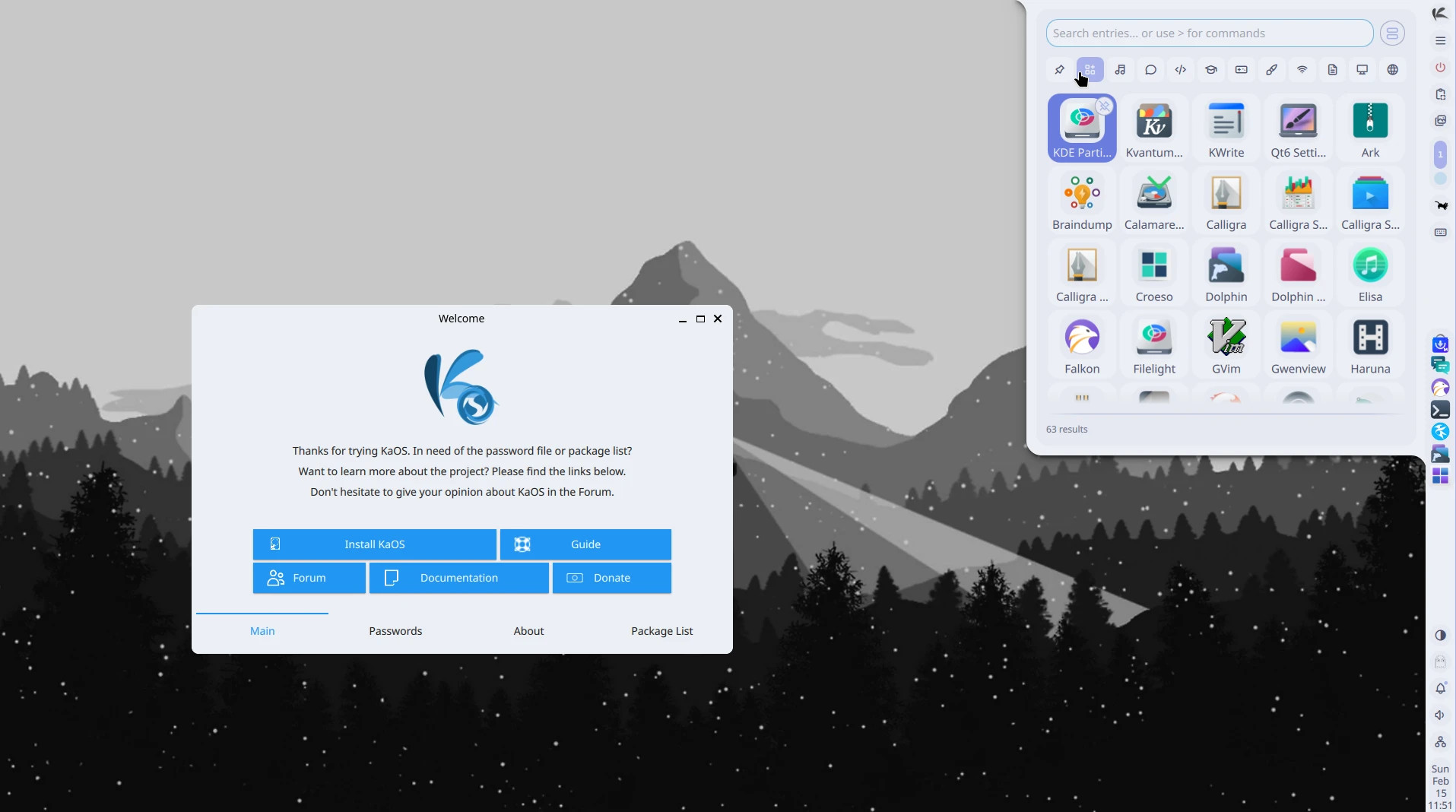
On desktops, KaOS 2026.03 does not anymore include KDE Plasma in the default ISO. Instead, it features the Niri Wayland compositor with the Noctalia shell, both built on Qt. Plasma remains available in the repositories, but its removal from the default environment reflects the project’s effort to avoid systemd-dependent components.
But just to mention that, even with those changes, the system remains focused on Qt and avoids GTK entirely, maintaining one of KaOS’ long-standing design principles.
Core components have been updated throughout the stack. The release includes Linux kernel 6.19 LTS, Wayland 1.25, Qt 6.11, GStreamer 1.28, ZFS 2.4.1, and OpenCV 4.13. The toolchain and libraries have been rebuilt to reflect the Qt update and other dependency changes.
The Calamares installer now operates fully under Wayland, resolving previous limitations in QML input handling. The default filesystem remains XFS with CRC and finobt features enabled, improving metadata integrity and long-term performance.
Several user-facing changes accompany the new environment. The ISO now uses the Kitty terminal instead of Konsole and Yakuake, introduces Btop as the system monitor, and adopts the Starship prompt. A new Phonon backend based on MPV replaces VLC, as there is no Qt6-compatible VLC version.
Wayland is now the default throughout the system, including for the SDDM display manager. This change introduces limitations in virtualized environments, as tools like VirtualBox still lack full Wayland support without specific configuration.
Additional utilities have been added to support the new desktop stack, including cliphist, brightnessctl, seatd, and xwayland-satellite. Kjournald, a graphical log viewer, is now included by default, reducing reliance on manual journalctl usage.
For more details, see the announcement. The ISO image is available on the project’s Download page.
Some limitations remain. RAID installations are currently unsupported, and XFS cannot be used for BIOS installations due to GRUB compatibility issues. VirtualBox requires 3D acceleration and specific display settings to boot the system.
Image credits: KaOS