Sixteen months after the previous 0.10.1 release, git-bug, the distributed, offline-first bug tracker that stores issue-tracking data directly in Git repositories, released version 0.11, bringing a completely rewritten web interface, a built-in code browser, improved search indexing, and many fixes.
If you are unfamiliar with git-bug, the idea is simple. Instead of keeping bug reports on centralized services like GitHub or GitLab, git-bug stores them in Git and lets users push and pull them through regular Git remotes. It works completely offline and offers CLI, terminal, and web interfaces.
The biggest visible change in version 0.11 is the new Web UI, which, according to the devs, has been rewritten from scratch.
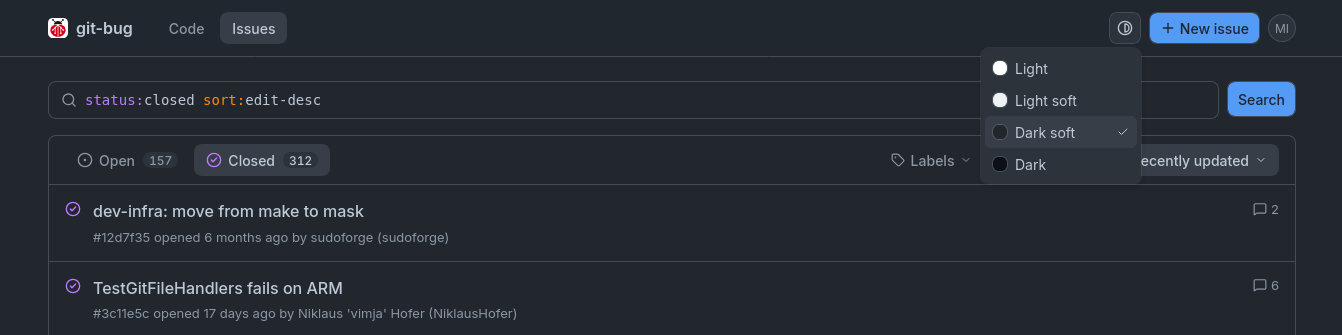
While the previous interface was mainly for viewing issues, the new one lets users manage them. You can browse, search, filter, and paginate issues, create new ones, add and edit comments, change titles, labels, and issue status, and view user profiles with their reported issues.
Filters are stored directly in the URL, so you can share a filtered issue view as a link. The interface includes four themes, light and dark variants with soft and hard styles, and supports switching between multiple repositories when the server hosts more than one.
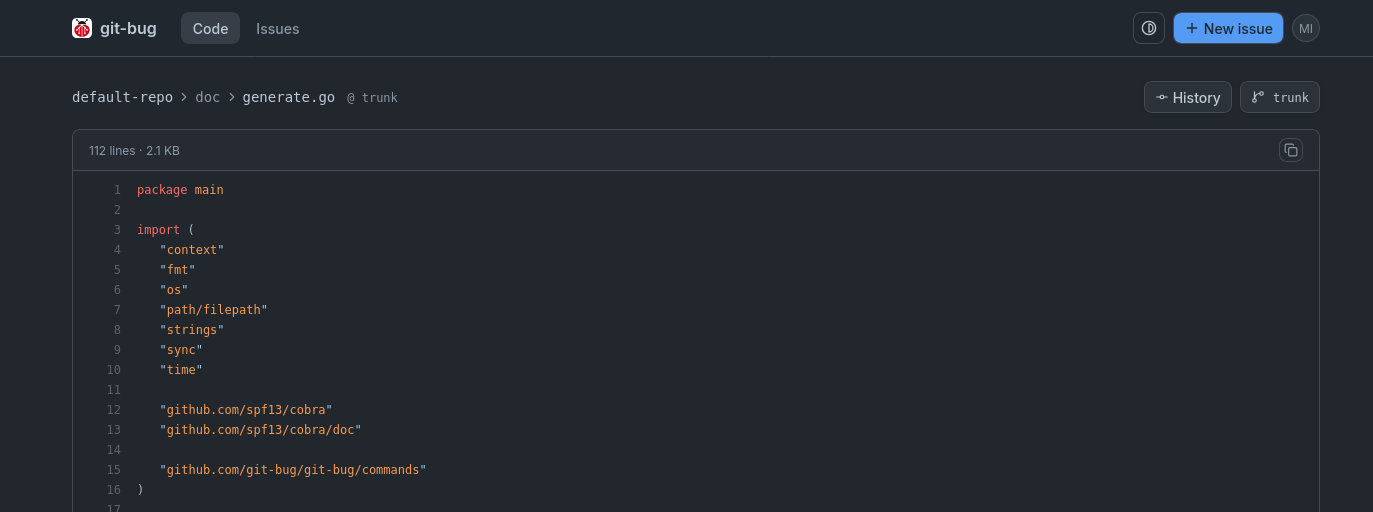
Just as importantly, there is a significant addition beyond issue tracking. The Web UI now also works as a repository code browser.
Users can navigate a repository file tree, view files with syntax highlighting and line numbers, link directly to specific line ranges, and render Markdown files directly in the browser. It can also display commit history for individual files and directories, show commit details and collapsible diffs, and switch between branches and tags.
These capabilities are not limited to the frontend. git-bug’s backend can now browse Git references, trees, blobs, commit history, and diffs, with the functionality exposed through the project’s GraphQL API. A new HTTP endpoint is also available for retrieving raw repository files.
Under the hood, version 0.11 includes a substantial correctness pass. Developers fixed problems involving cache races, stale metadata, non-atomic commits, search indexes not refreshing after merges, and labels shared between different representations of the same bug.
Forward compatibility has improved as well. Unknown operations are now preserved rather than discarded. This means if a newer git-bug release or another implementation writes an operation an older version does not understand, the data remains intact instead of being lost when the bug is rewritten.
Another notable improvement concerns the search index. git-bug has moved from Bleve v1 to Bleve v2, and the developers say that on the project’s own repository, the index size dropped from around 51 MiB to less than 4 MiB. Existing indexes are rebuilt automatically during an upgrade.
Last but not least, a few breaking changes are worth keeping in mind. Installing git-bug with go install no longer includes the Web UI, the git bug commands command has been removed, and the git bug webui --host option has been renamed to --bind. Support for some less commonly tested platforms, including Linux on 386 and s390x, has also been dropped.
For additional details and downloads, see the project’s GitHub release page.
Image credits: git-bug.