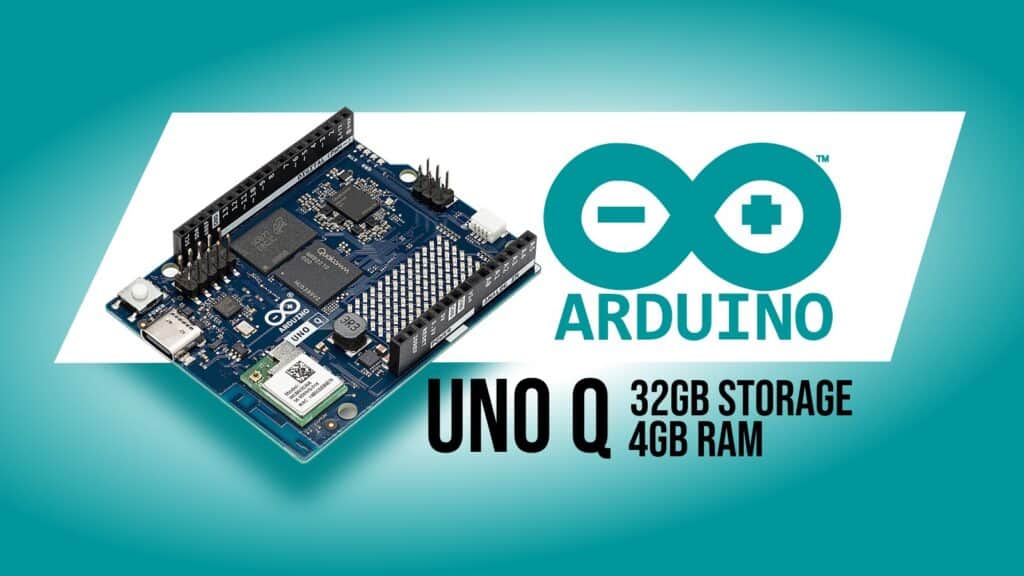
Arduino has expanded its Arduino UNO Q lineup with a new configuration featuring 4 GB of LPDDR4 RAM and 32 GB of onboard eMMC storage, as a hybrid Linux single-board computer rather than a traditional microcontroller-based Arduino.
Unlike classic Arduino boards, the UNO Q is built around what Arduino describes as a “dual-brain” architecture design. It combines a quad-core Qualcomm Dragonwing QRB2210 application processor, capable of running Debian, with a dedicated STM32U585 microcontroller responsible for real-time, deterministic hardware control.
This separation allows Linux to handle multitasking workloads, such as networking, user interfaces, and application logic, while time-critical tasks, such as GPIO access, PWM, and sensor handling, are offloaded to the MCU.
The newly introduced 4 GB RAM and 32 GB storage variant is explicitly aimed at standalone operation. The additional memory improves Linux multitasking and responsiveness when running resource-intensive applications, while the integrated eMMC eliminates the need for external storage.
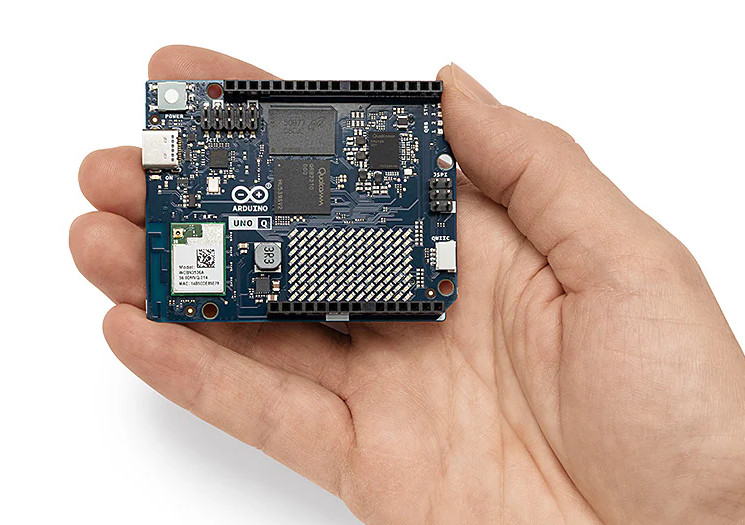
According to Arduino, this configuration is better suited for edge computing, robotics, embedded Linux development, and AI-assisted workloads that exceed the practical limits of lower-memory models.
Regarding connectivity and expansion, the UNO Q 4 GB model includes dual-band Wi-Fi 5 and Bluetooth 5.1, USB-C with display output support, standard UNO headers for shield compatibility, and a Qwiic connector for rapid peripheral integration. Development is supported through Arduino’s tooling stack, including Arduino App Lab, enabling sketches, Python applications, and AI workflows to coexist on the same device.
Finally, for readers who may be less technically inclined, let me explain how this device differs from more familiar SBCs, such as the Raspberry Pi. In very short, a Raspberry Pi is a general-purpose Linux computer, with hardware access mediated by the operating system, while classic Arduino boards are microcontrollers designed for direct, real-time control of electronics.
The UNO Q bridges these two approaches by combining both capabilities on a single board. The new 4 GB model is priced at $59. The 2 GB UNO Q model is also available for $44. For more information, visit the manufacturer’s website.