Ardour 9.0 has been released as one of the most substantial updates to this open-source digital audio workstation. A central change is the expansion of clip-based workflows. The Cue page now allows direct editing of both MIDI and audio cues, with MIDI clips opening a full pianoroll editor that mirrors the capabilities of the main timeline.
Users can also record directly into cue slots, effectively turning Ardour into a live-looping environment similar in concept to other contemporary DAWs. Recordings can be constrained to fixed musical lengths or stopped manually, then launched in sync with the project’s quantization grid.
On top of that, MIDI editing receives a major overhaul. Dedicated pianoroll windows can be opened either in a separate window or docked at the bottom of the editor, providing focused editing without the distractions of the full timeline.
New tools such as note brushing make it faster to create rhythmic and melodic patterns, while improvements to the step editor, note range handling, and region extension behavior address long-standing usability issues. Plus, Ardour now also supports MIDI regions that extend beyond their last note.
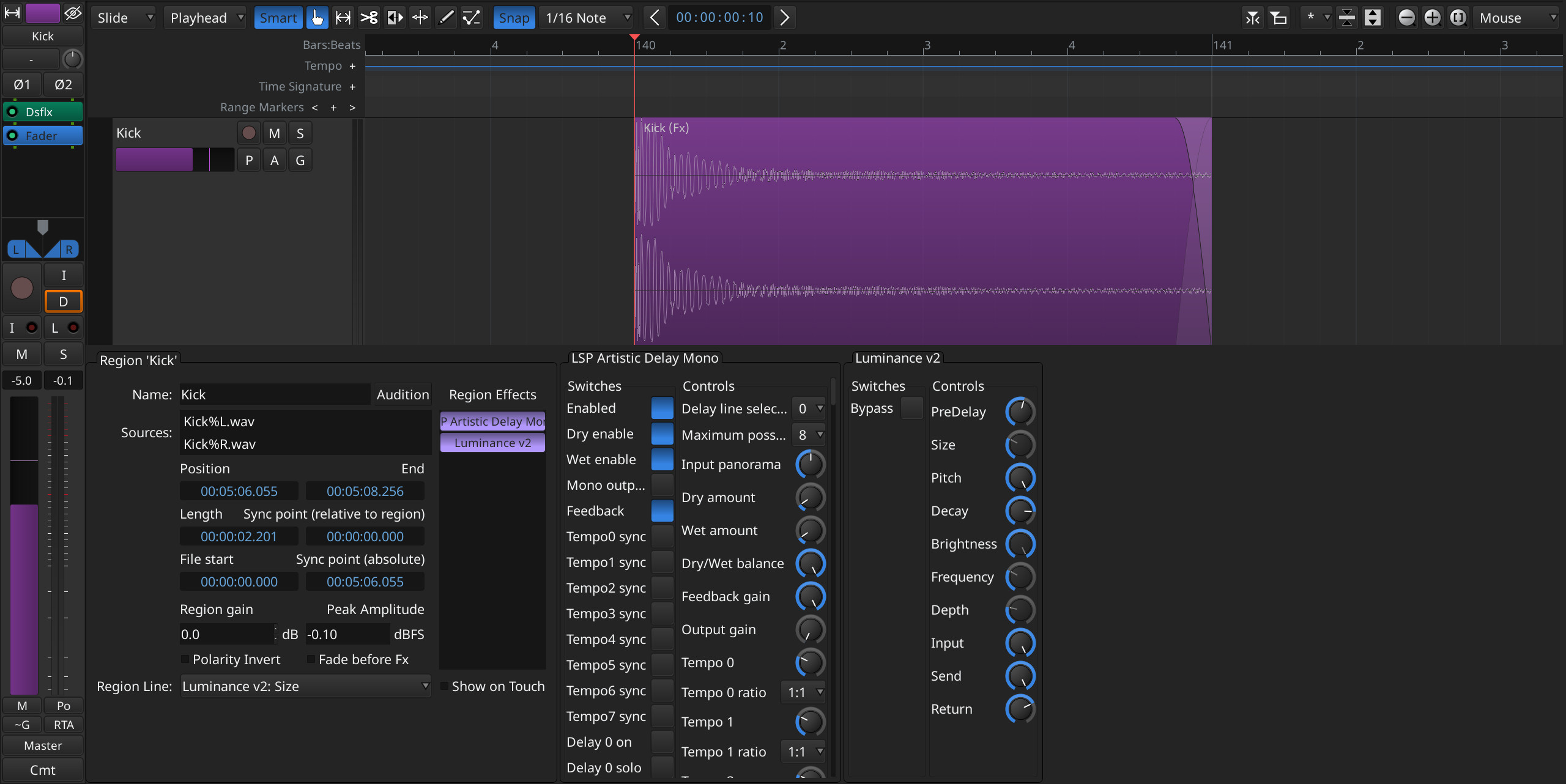
Another headline feature is the introduction of region FX. Effects can now be applied directly to individual audio regions rather than entire tracks. These effects and their automation remain attached to the region when it is moved or edited, and are processed offline when the region is read from disk, thereby avoiding additional real-time DSP load.
Ardour 9.0 also adds a real-time perceptual spectrum analyzer. The new analyzer window can display and overlay the frequency content of multiple tracks and busses simultaneously, making it easier to identify frequency conflicts or gaps within a mix.
As you would expect from a major release, the user interface has been extensively revised. The application bar has been reorganized to surface context-specific controls while hiding less frequently used options by default.
Pane visibility can now be toggled directly from the toolbar; the editor list has been redesigned; and the new session dialog now uses a tabbed layout for faster navigation. Ruler controls have been consolidated and enhanced with quicker marker navigation and editing.
Platform-specific improvements are particularly notable on macOS, where Ardour 9.0 introduces faster GUI drawing in dense views such as the mixer, improved Retina scaling, and better behavior on recent macOS releases. On Linux and Windows, multi-touch interaction is now supported when the operating system provides it.
Under the hood, the release includes many technical changes. The default recording format is now RF64, a WAV-compatible format that automatically handles very large files.
Plugin handling has been improved across LV2 and VST3, Lua scripting gains new bindings and example scripts, and extensive fixes address crashes, timing accuracy, MIDI handling, and session compatibility going back to older Ardour versions. The codebase has been updated to C++17 and now supports macOS 10.13 and later.
Finally, Ardour 9.0 also updates hardware and controller support with new MIDI binding maps, expanded Mackie Control Protocol functionality, and refreshed MIDNAM files for popular devices. Translation updates are included for several languages, and some legacy components, such as Frontier Tranzport support, have been formally dropped.
For more information, see the announcement.
Image credits: Ardour