Phosh, the GNOME-based mobile shell for Linux smartphones and other touch-enabled devices, has released version 0.59.
One of the most interesting additions is initial speech input support in Stevia, Phosh’s on-screen keyboard. The feature uses Vosk, an offline speech recognition toolkit, enabling voice-based text entry. However, the implementation is still in its early stages.
The quick settings panel gains two new controls. The first lets users capture screenshots directly without external tools, while the second provides a way to start or stop the SSH daemon. Moreover, the location quick setting is now enabled by default.
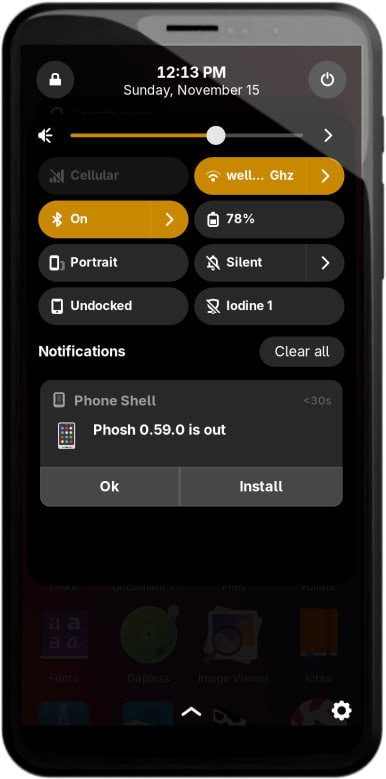
On the privacy side, Phosh 0.59 features a new status bar plugin that indicates when the device’s camera is in use. Users can also configure top-bar plugins through the updated Phosh Mobile Settings application.
Another improvement concerns unlocking devices. Phosh can now retrieve the required PIN length from systemd-homed, making unlocking more convenient. A new phosh-pin-tool utility also lets users configure the PIN length manually.
Performance improvements are included as well. Thumbnail overlay composition has been optimized by moving most rendering work to Phoc, Phosh’s Wayland compositor. Phoc 0.59 adds support for the phoc-foreign-toplevel-identifier-v1 protocol, allows adjusting the number of workspaces at runtime, and fixes several bugs, including crashes.
On top of that, the file selection portal improves handling of mounted storage, including USB devices and network shares, and adds keyboard shortcuts for easier file sorting.
The release also updates Phosh Session Services to version 0.3, introducing an initial UnifiedPush distributor based on ntfy. The operating system update service has also been adjusted to avoid displaying update notifications when using metered connections.
Finally, the first-boot assistant gains a new device-naming screen, checks for duplicate usernames, and locks the root account during setup. On the hardware side, the accompanying gmobile 0.7.5 release adds display panel and wake-up key support for the SHIFT8 and Motorola Moto G10 smartphones.
For more information, see the release announcement.