Fastfetch, the popular command-line system information tool that displays hardware and software details alongside a distribution logo, has released version 2.68.1.
The headline addition is a new Top module that shows processes consuming the most CPU, memory, or disk I/O, giving users a way to include live system activity directly in their Fastfetch output instead of relying on separate monitoring utilities.
Linux users running standalone window managers get improved GTK configuration detection. Fastfetch can now more reliably identify GTK themes, icon themes, and fonts in environments like Hyprland, Sway, niri, and i3.
The Login Manager module has received several improvements. On Linux, it can now report a login manager’s human-readable name. Detection has also expanded to macOS, Windows, and POSIX systems without systemd by examining the process list.
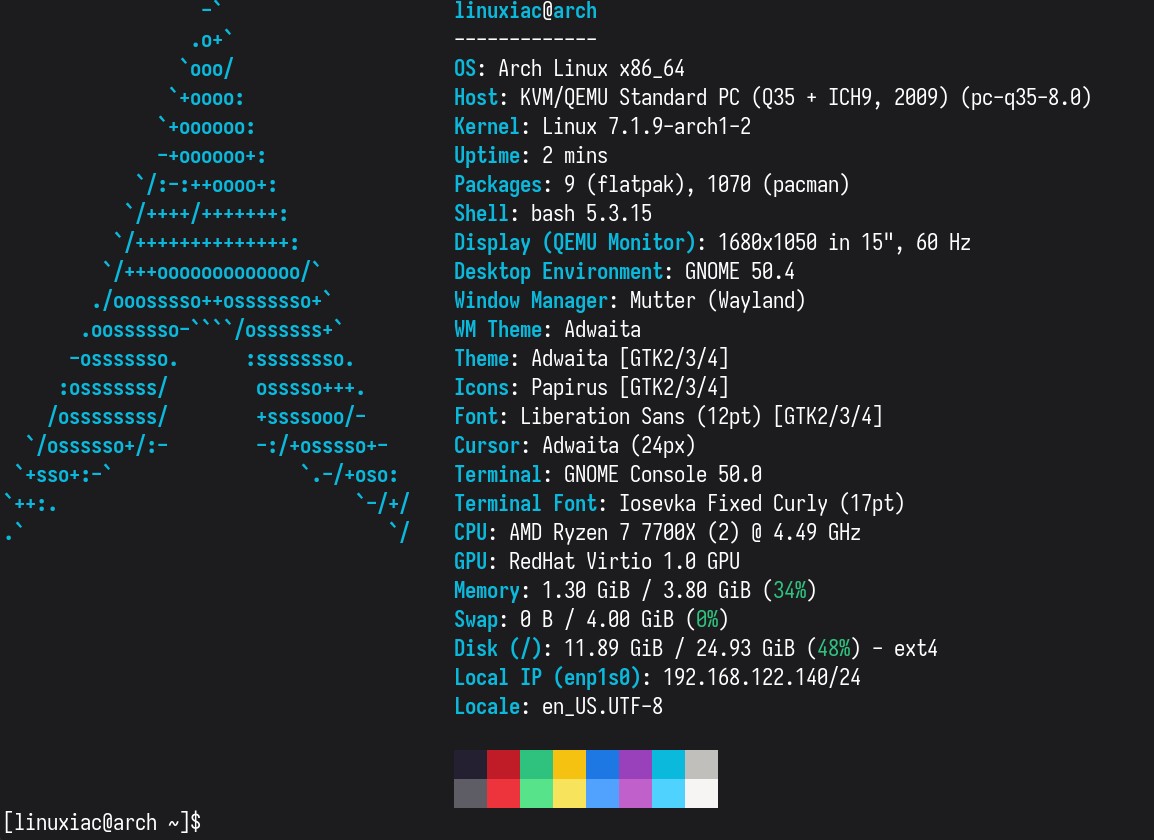
Another notable addition is support for localized module keys. A new --key-language option lets Fastfetch display module labels in a selected language. Leaving the option unset makes it follow the system locale automatically. The localized module name is also available to custom output formats through the new {module-name} placeholder.
Fastfetch 2.68.1 also improves its Wi-Fi module. It can now detect wireless channel width and expose it through the {channel-width} formatting variable. Channel-frequency reporting is more accurate, with additional detection improvements for Windows and macOS. Wi-Fi detection support has been added for SunOS and Haiku.
Moreover, the release adds battery detection on SunOS, terminal font-size detection in Termux, Wayland support on Android, and desktop environment detection for ASUS Zenfone devices. It also includes support for additional ARM system-on-chips.
There are several smaller usability changes. Fastfetch now spells out “Desktop Environment,” “Window Manager,” and “Login Manager” instead of using the shorter DE, WM, and LM labels. Fish shell completion scripts have been improved to display descriptions for supported enum values.
On the bug-fix side, developers addressed precision problems in DiskIO and NetIO rate calculations and added protection against division-by-zero errors. The release also fixes ash shell version detection, memory usage reporting on 32-bit FreeBSD systems, and includes internal cleanups and optimizations.
Finally, Fastfetch’s growing collection of distribution and operating system logos now includes entries for Omarchy, Omarchy2, and an older macOS logo.
For additional details, see the changelog. Fastfetch 2.68.1 is now available from the project’s GitHub releases page, with prebuilt packages for Linux, FreeBSD, DragonFly BSD, Haiku, macOS, and Windows.