
Bazzite, the immutable Linux distro built on Fedora Atomic Desktop technology and developed as part of the Universal Blue project with a focus exclusively on gaming, has completed its transition to Fedora 44 with the release of Bazzite Deck 44, which the project calls the biggest update in Bazzite’s history.
More importantly, the release ends the temporary split between Bazzite’s desktop and Deck images, so future updates will roll out across the entire lineup at the same time.
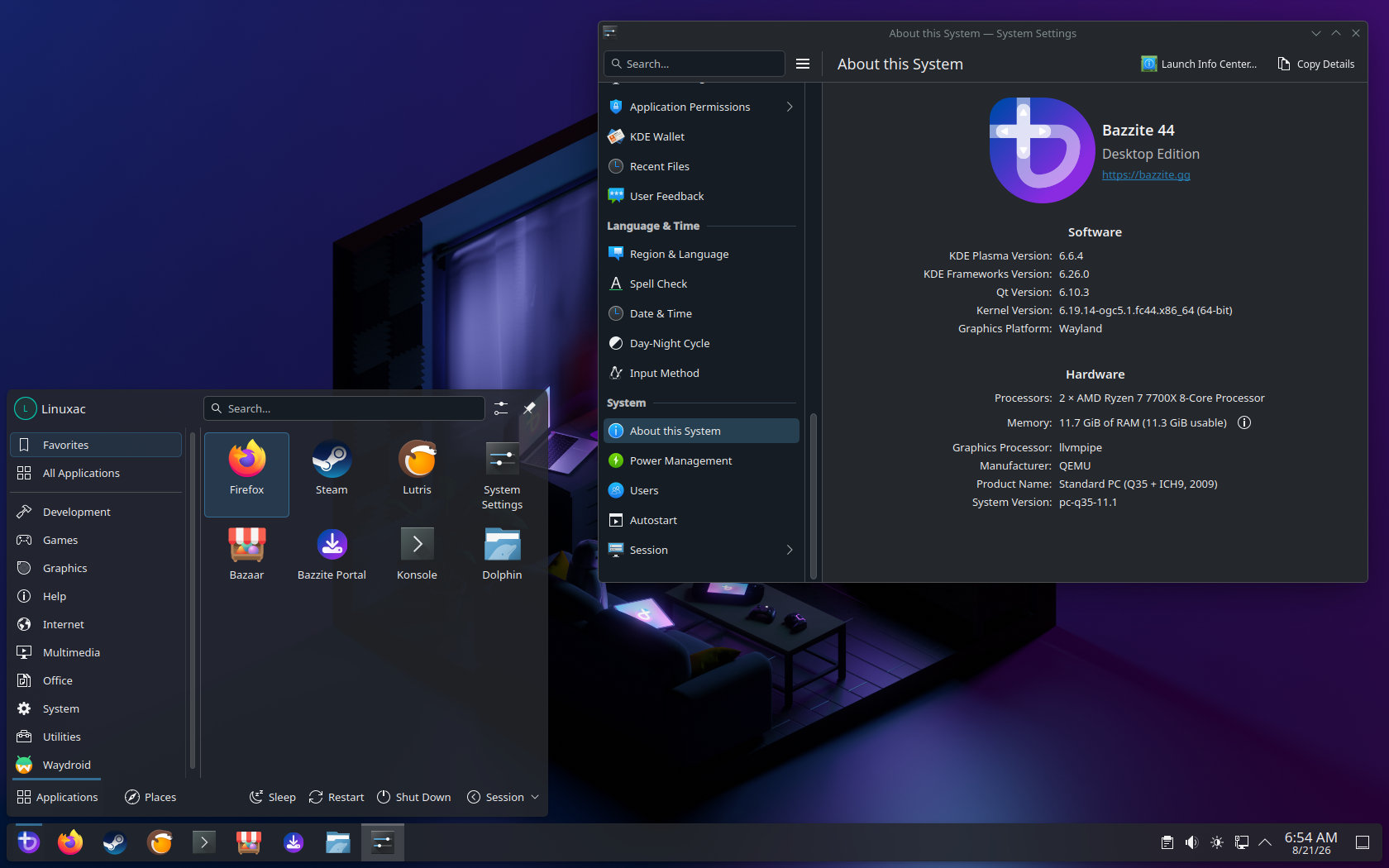
Bazzite’s regular desktop images had already moved to KDE Plasma 6.6 and GNOME 50 along with broader system changes. The August release now brings the Deck images onto the same base and delivers another set of improvements shared across all Bazzite editions.
One of the largest changes is a complete overhaul of the software stack for Bazzite’s handheld images. The old setup is replaced by a SteamOS-aligned stack built around InputPlumber for controller handling, emulation, and remapping; SteamOS-Manager for session switching and TDP management; PowerStation for power controls on hardware not fully supported by SteamOS-Manager; and OpenGamepadUI for additional controls Steam does not expose.
Moreover, TDP control is now handled through Steam’s Quick Access Menu, making the experience closer to Valve’s SteamOS, with OpenGamepadUI remaining available for additional hardware-specific functions and enabled by default on non-Valve handhelds.
Another major addition is the new Bazzite Updater, a graphical utility for applying system updates and browsing changelogs. It can be added directly to Steam Game Mode and controlled entirely with a gamepad, removing the need to switch to the desktop environment to manage updates.
Bazzite Portal has received a complete redesign. It now exposes many tasks that previously required ujust commands, including GRUB timeout configuration, HDMI-CEC settings, AMD VRR controls, NVIDIA Flatpak runtime updates, ProtonPlus actions, and an option to add Bazzite Updater to Steam’s Big Picture Mode.
New installations launch Bazzite Portal automatically on first login, making it the central configuration utility for many Bazzite-specific features.
For laptops and systems with multiple GPUs, Cardwire replaces switcheroo and supergfxctl/MUX switching. It provides a graphical interface for selecting GPU modes and defaults, while automatically using the discrete GPU when applications request it. ASUS systems are supported too.
Under the hood, Bazzite has changed its kernel strategy. The custom kernel has been retired, and every image now uses the kernel maintained by the Open Gaming Collective. The current release ships with the latest and greatest Linux kernel 7.2.
On the graphics side, Bazzite 44 ships Mesa 26.2.1 together with the kernel’s VRAM overcommit and dmem cgroup functionality. The team also backported scheduler improvements from the Linux kernel 7.3 development cycle.
AMD users can experiment with HDMI 2.1 FRL, ALLM, and VRR support. For now, the functionality is optional and can be enabled through a ujust command or Bazzite Portal to reduce possible regressions.
Greenboot now handles failed-boot detection and automatic update rollbacks, while bpftune provides automatic kernel network tuning. The Vulkan Low Latency layer is included, along with MakeMKV and libmmbd for Blu-ray playback and several kernel modules for gaming peripherals and capture devices.
Desktop users get several environment-specific changes. On KDE Plasma, Konsole replaces Ptyxis as the default terminal since Konsole provides comparable container functionality. The Oxygen theme and icon set are included by default, along with Bazzite Portal integration with KDE’s search interface.
GNOME receives its own Bazzite Portal search provider and out-of-the-box support for rounded blur through Blur My Shell. Both desktop options also get three new wallpapers.
It is worth noting that Bazzite itself is not offered as one single image. Instead, the project maintains several editions depending on the target hardware and intended usage. For conventional desktops and laptops, users can choose the standard Desktop edition with KDE Plasma or GNOME.
There are also separate images for AMD and Intel graphics, plus dedicated NVIDIA variants. For newer NVIDIA hardware, additional nvidia-open images use NVIDIA’s open kernel modules.
Bazzite-Deck images are for handheld PCs and controller-focused living-room systems. They boot automatically into Steam Gaming Mode, providing a console-like interface similar to SteamOS, while allowing users to switch to a full desktop session when needed.
Finally, Bazzite-DX, short for Developer eXperience, targets developers who want Bazzite’s gaming-focused base along with additional development and workstation tooling. Software such as QEMU and ROCm, which has now been removed from the standard images, remains available there.
For additional details, see the release announcement.
Existing Bazzite Deck 43 users can upgrade through the normal update mechanism. However, because the transition crosses both a Fedora major version and an entirely new handheld software stack, the developers recommend pinning the current deployment beforehand so users have an easy rollback path if something does not work correctly.