
Chatto, a group chat application designed for teams and online communities, is now open source and available for anyone to host on their own infrastructure.
The application has been under development for approximately a year and offers a familiar channel-based communication experience similar to platforms such as Slack, Microsoft Teams, and Discord. However, Chatto places greater emphasis on self-hosting, privacy, modest resource requirements, and ease of deployment.
Instead of requiring administrators to configure several separate components, Chatto can be launched as a single executable that includes both the server and the web frontend. A separate database is not required for a basic installation, although more advanced deployments can use Docker Compose or other infrastructure tools.
The project provides ready-made binaries for Linux systems running on x86_64 and ARM64 hardware, as well as builds for macOS and Windows. Once initialized, the server hosts its own web interface, allowing users to access it through a browser.
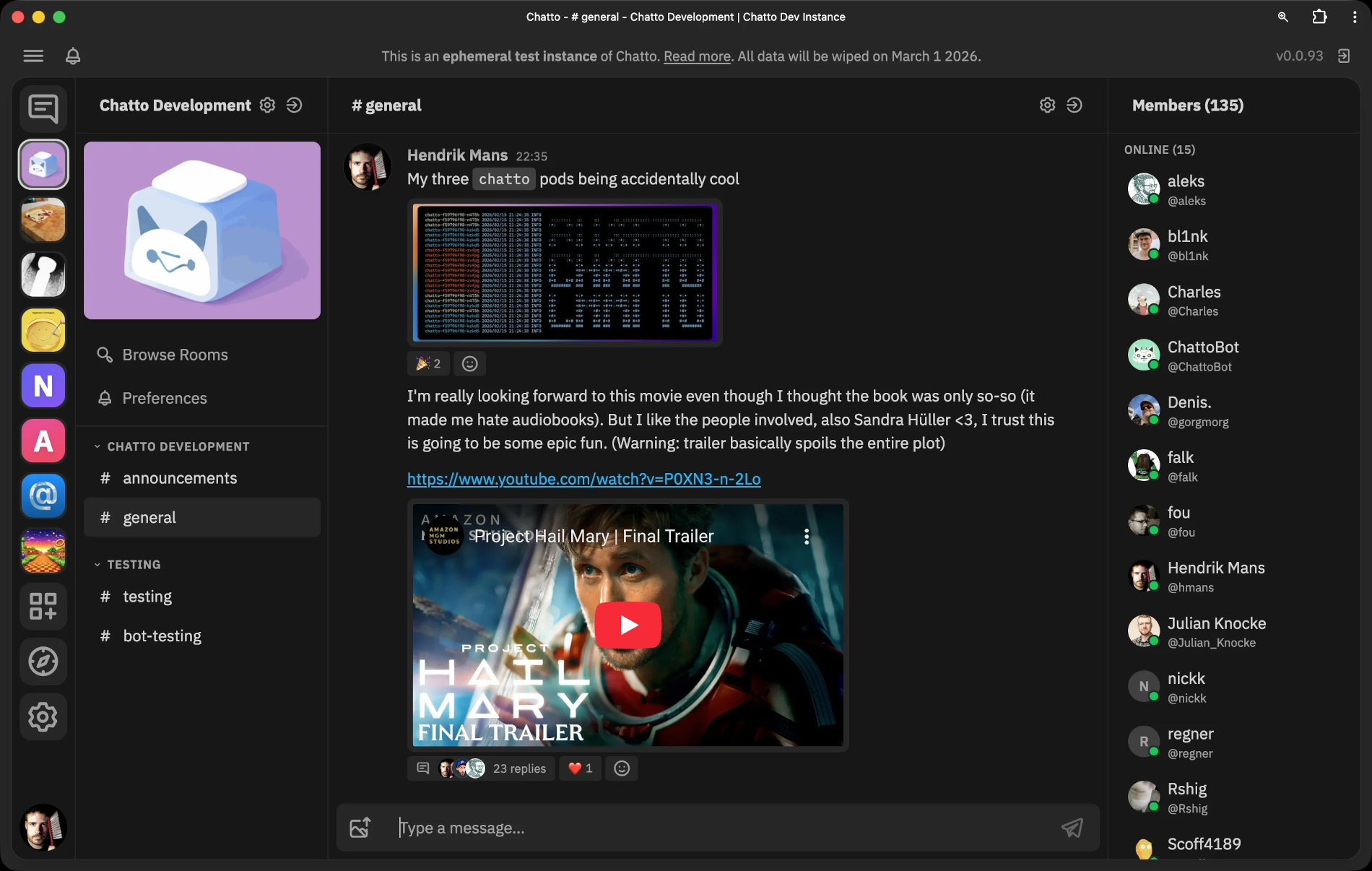
Despite its compact deployment, Chatto offers features typical of modern communication platforms, including text rooms, file sharing, reactions, embedded videos, configurable roles and permissions, voice and video calls, and screen sharing.
Importantly, voice and video calls are end-to-end encrypted. The number of participants depends on server capacity, not application-imposed limits.
Chatto also encrypts personal information and chat data stored on the server. Each user’s information is protected with individual encryption keys, which can be destroyed when the account is deleted, making the remaining encrypted data unreadable.
Each Chatto server functions as an independent community. The platform does not support federation, so instances do not exchange or synchronize data with one another.
Users can join multiple communities by connecting directly to each server. Administrators can run multiple Chatto processes to manage separate communities.
The project also states that Chatto contains no third-party tracking or analytics. Since messages and personal data remain on the administrator’s server, organizations retain control over where their communication data is stored.
Currently, Chatto is at version 0.4. The developer considers it stable for production use but notes that breaking changes may occur before version 1.0, expected in six to twelve months. The upcoming 0.5 release will focus on safety and moderation features, such as content reporting, and enhancements to multi-server functionality.
Alongside the self-hosted edition, a managed service called Chatto Cloud is preparing to enter public beta. It will provide paid hosting without placing additional application features behind a premium subscription.
The hosted service will initially operate entirely on European-owned infrastructure and will include automatic scaling, nightly backups, and upgrades without service interruptions. Additional regions are planned for early 2027.
For additional details, see the announcement. Chatto source code is available on the project’s GitHub repository. However, external code contributions are not currently accepted. For installation instructions and further details, see the official Chatto self-hosting documentation.
Image credits: Chatto Project





It looks a lot like Microsoft teams from picture so it should be easy for people to use. I work for a corporation that gives me no say on what I use at work so I will never be using it there. I think the only way I could get people I know to use this is with mobile apps for android and ios otherwise I doubt anyone I know would use it or want to use it.