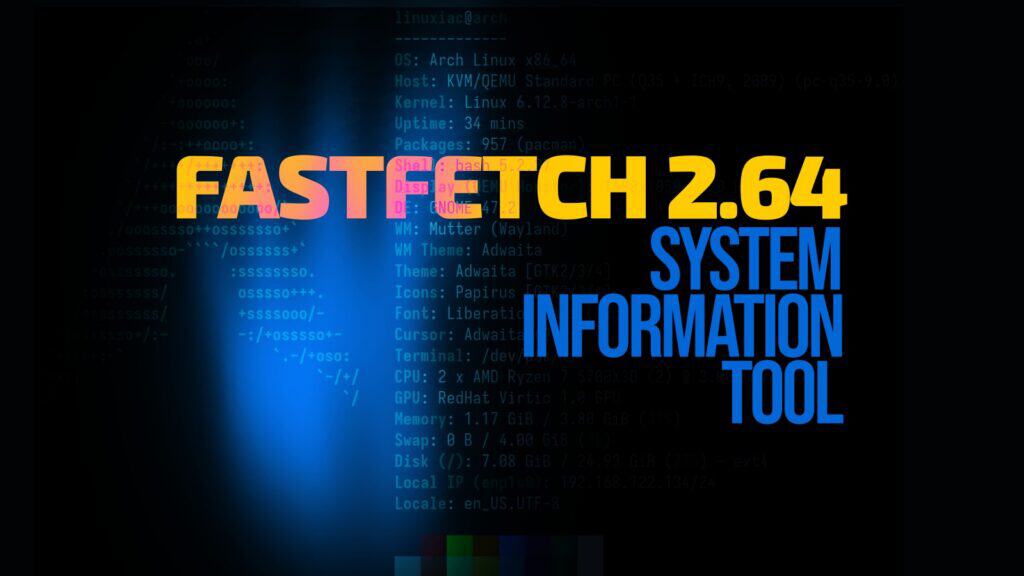
Fastfetch, a popular tool among Linux users for displaying a sleek summary of system information in the terminal alongside an OS’s ASCII logo, has just launched version 2.64.
The primary feature in this release is the Codec module, which reports hardware-accelerated video codec support. On Linux and BSD, Fastfetch uses VA-API by default and VDPAU as a fallback for NVIDIA hardware. Both require building Fastfetch with libva and libvdpau support.
The Codec module is available on additional platforms. Windows support uses D3D12VA on Windows 11 and D3D11VA with MFT on Windows 10 or earlier. macOS uses VideoToolbox, and Android uses AMediaCodec. Vulkan Video is also supported as a backend but is disabled by default and must be enabled manually using the useVulkan option.
By default, the Codec module reports both encoders and decoders. If no codec is detected for a type, Fastfetch displays “None.” Users can configure the output to show only encoders or only decoders using the showType option.
Fastfetch 2.64 also adds experimental scripting support for custom formats. Lua scripting is now available for greater control over module output, supporting Lua 5.3 through 5.5. Lua 5.1 and LuaJIT are not supported.
QuickJS support is now available as a JavaScript-based alternative for custom formats. It requires quickjs-ng 0.15 or newer and uses the qjs prefix in Fastfetch format strings.
Custom format handling has been enhanced, as will string handling specifiers now recognize ANSI escape sequences, ensuring correct operation with colored output. A new center-alignment specifier allows formatting within a defined field width.
Desktop and platform detection have been updated. Fastfetch 2.64 adds Wallpaper and WMTheme detection for the COSMIC desktop environment on Linux, improves terminal name detection for Nix packages, and adds DDC/CI brightness detection on FreeBSD.
On top of that, Haiku support now includes preliminary Bootmgr, Brightness, and WMTheme detection. Terminal font detection for the Muxy terminal on macOS and improved BusyBox ash version detection on Linux have also been added.
Importantly, the logo printing logic has been reworked. ASCII logos and modules are now printed line by line to resolve previous layout issues. The new --logo-padding-bottom option controls spacing between a top-positioned logo and the first module.
This release also includes several bug fixes, addressing SwayFX version detection on Linux, fallback font detection for Ghostty on macOS, stat output alignment, and incorrect boot manager reporting on macOS 26.
Finally, the logo set now includes new entries for Quasar, Origami, Origami_small, BerserkArch, and NixOS2. The NixOS_small logo received minor color and layout updates, and the NurOS logo has been revised.
For additional details, see the changelog.