Zed, the Rust-based code editor from Atom’s original creators, has reached version 1.0, marking its first stable milestone after years of pre-1.0 development. The release is available for Linux, macOS, and Windows.
Some of you probably remember that Atom was one of the most influential open-source code editors of the 2010s and helped popularize the Electron-based desktop app model.
Unfortunately, GitHub officially sunsetted Atom in 2022, years after Microsoft acquired the company. In light of this, it is most accurate to say that Zed is not a continuation of Atom’s codebase but comes from Atom’s original creators and is widely seen as its spiritual successor.
Because this time the architecture is different. Zed was rebuilt from scratch in Rust and uses GPUI, its own hardware-accelerated UI framework, rather than Electron. The project focuses on native performance, low latency, and direct control over the editor’s rendering stack.
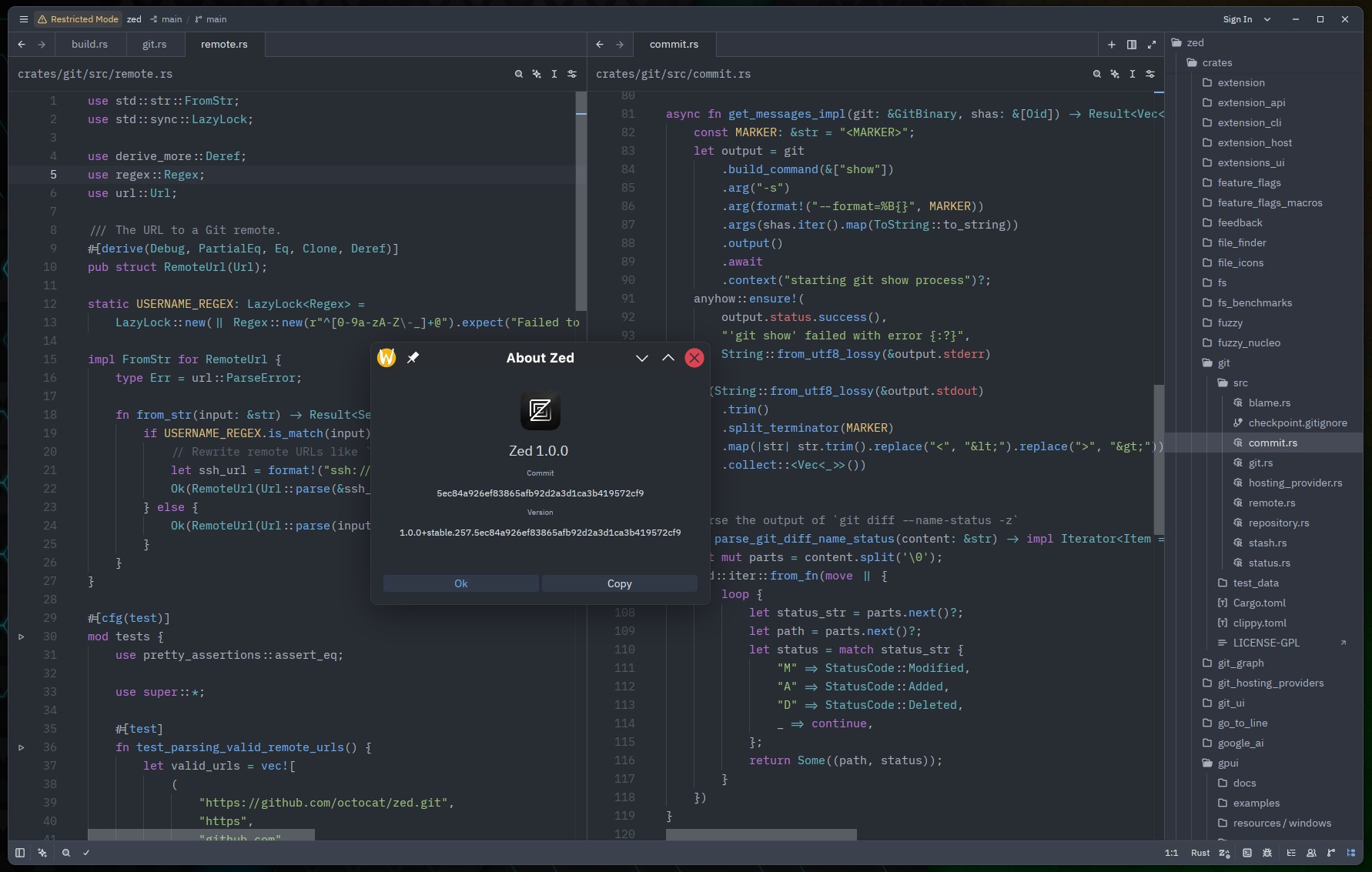
Zed 1.0 also builds on what Atom offered. Alongside standard editor features, the project now includes Git integration, SSH remoting, debugging, language tooling, and built-in AI workflows. The editor supports AI agents, edit predictions, and the Agent Client Protocol, allowing external coding agents to work inside the editor.
This week’s 1.0 release also includes several smaller improvements, secondary to the milestone itself. Notable additions include bookmark support, a new command palette action to view Git commits, animated GIF support in the Markdown preview, improved fuzzy matching, better SSH session reuse, and support for the DeepSeek-V4-Pro and DeepSeek-V4-Flash AI models.
The release also brings many fixes across Git, Vim mode, terminals, dev containers, remote development, Windows path handling, Markdown preview, Python workspaces, and Linux X11 input handling. One breaking change is included: the old "soft_wrap": "preferred_line_length" setting has been removed in favor of "soft_wrap": "bounded".
Alongside the 1.0 milestone, Zed is introducing Zed for Business, designed for teams that need centralized billing, role-based access controls, and organization management, positioning Zed into the broader developer tooling market, where it competes with established options such as Visual Studio Code, JetBrains IDEs, and other modern code editors.
For more details, see the official announcement. The list of changes in Zed 1.0 is here.