Shotcut, a popular open-source video editor, has released version 25.12, introducing one of its most significant image-quality upgrades to date with full 10-bit CPU video processing and expanded linear color handling.
Until now, 10-bit video support was limited when working outside GPU effects, forcing users to avoid transitions, blending, or many CPU-based filters to prevent a fallback to 8-bit processing. With this release, many CPU video effects have been ported to support both 10-bit and 12-bit sources, including transitions and track compositing.
In addition, CPU filters tagged for 10-bit operation now function correctly when combined with experimental GPU processing, allowing more flexible workflows without sacrificing bit depth.
Shotcut 25.12 also expands linear color processing beyond GPU-only use. Linear color avoids gamma-based pixel mixing, which can introduce subtle color distortions during scaling, blurring, interpolation, and compositing.
Previously restricted to GPU effects, linear processing is now available as a broader project option. When GPU acceleration is enabled, video frames transferred back to the CPU remain in linear color space, preserving accuracy across the pipeline.
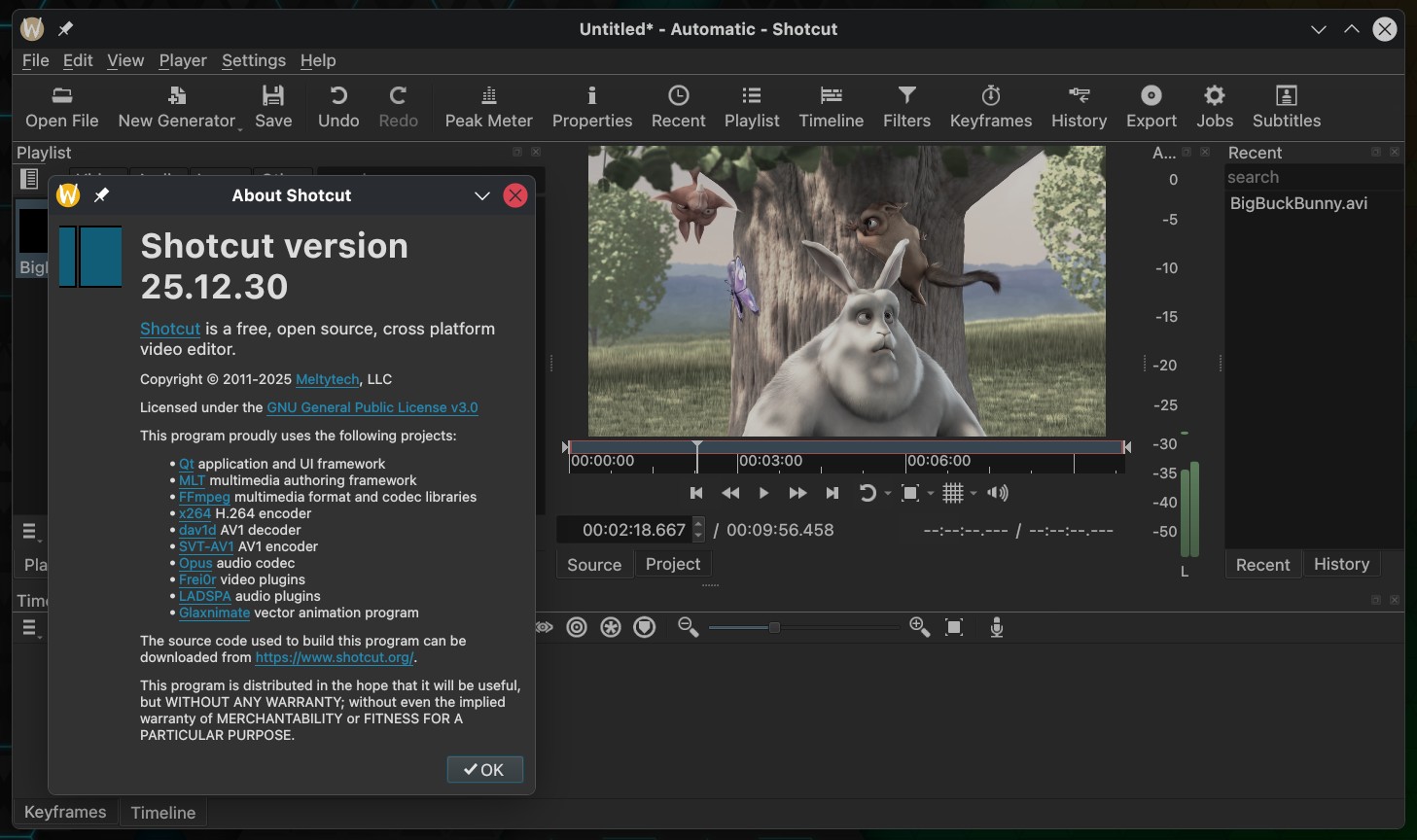
To clearly expose these changes, Shotcut adds a new Settings > Processing Mode submenu with four options: Native 8-bit CPU, Native 10-bit CPU, Linear 10-bit CPU, and an experimental Linear 10-bit GPU/CPU mode.
Non-linear modes remain available due to the significant performance cost of linear processing, while 8-bit mode is retained for compatibility with a wider range of filters. Shotcut developers note that performance improvements for linear workflows are planned for a future release.
Beyond color and bit depth, Shotcut 25.12 introduces several workflow enhancements. The Filters menu now includes a drop-down to browse filters appropriate to the current processing mode, and it defaults intelligently to Color or Audio filters depending on the active workspace.
A visual preset browser has also been added for the HTML image and video generator, with support for custom WebP thumbnails. Screen Snapshot and Screen Recording gain options to minimize Shotcut and record audio, while Linux users benefit from NVIDIA’s new dedicated hardware video encoder support for screen recording on X11 systems.
Finally, the release also delivers a long list of refinements and fixes. Hardware encoding compatibility via VA-API has been improved on Linux AppImage, Portable, and Snap builds. Subtitle extraction now supports mov_text and SSA formats, and the bundled zimg library has been upgraded to version 3.0.6 for better HDR-to-SDR and linear color conversions.
Numerous regressions introduced in earlier 25.x releases have been addressed, including color damage in dissolve transitions, broken audio filters, 10-bit encoder issues on AMD and Windows on Arm, and multiple stability and memory-leak fixes.
For more information, see the changelog.
You can download the application in the universal AppImage format, ready for use on any Linux distribution. Additionally, installation files for Windows and macOS are also available.