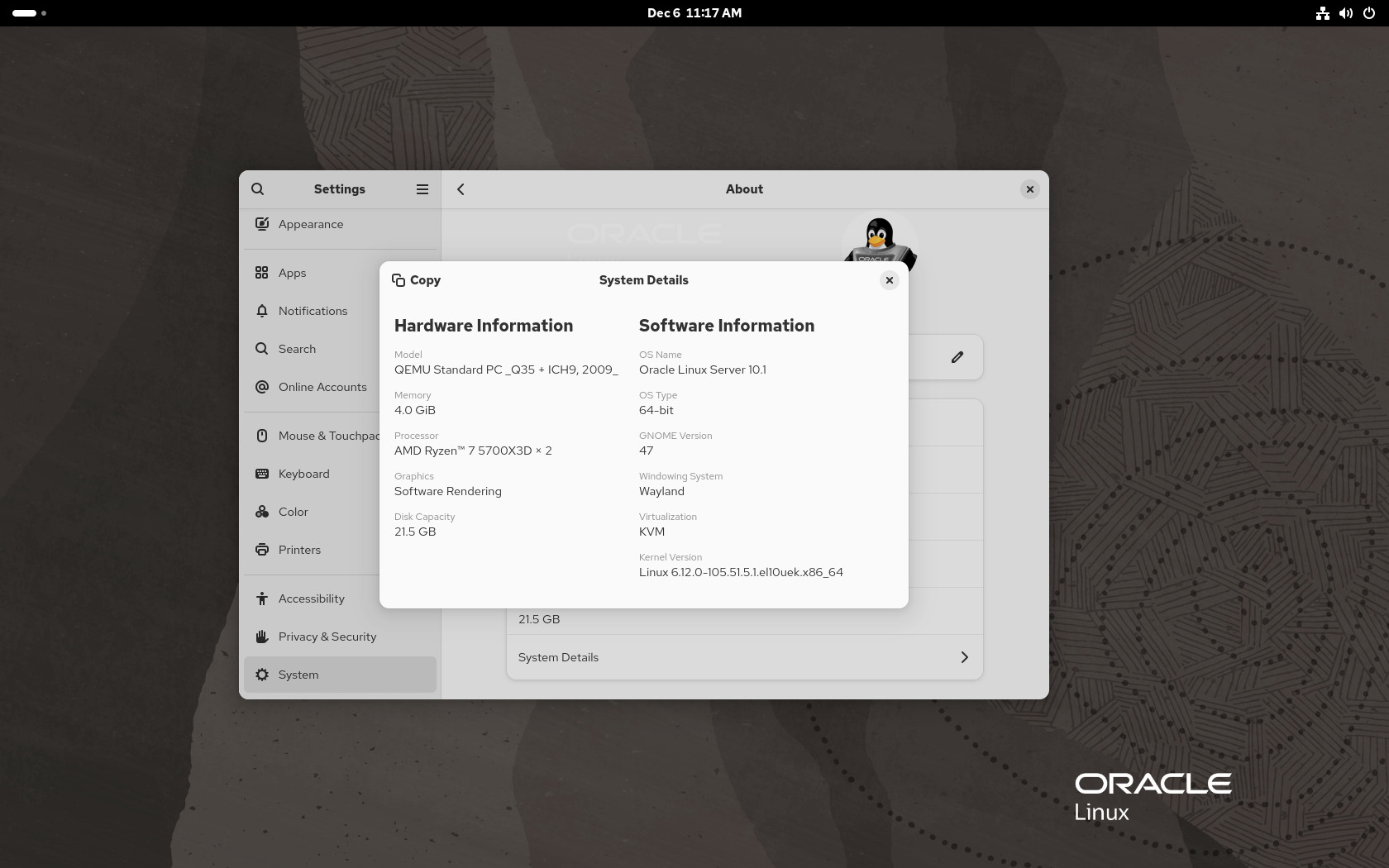
Over five months after the major 10 release, Oracle announced the global availability of the first update in the series, Oracle Linux 10.1 for x86_64 and aarch64 systems.
The release ships two kernel options: the Unbreakable Enterprise Kernel 8.1, based on Linux 6.12 for both architectures, and the Red Hat Compatible Kernel 6.12 for x86_64.
On the security side, Oracle Linux 10.1 activates post-quantum cryptography algorithms across system-wide crypto policies by default. OpenSSL 3.5 introduces ML-KEM, ML-DSA, SLH-DSA, and QUIC transport support, while NSS and GnuTLS add expanded ML-DSA coverage and certificate compression.
In addition, Sequoia gains OpenPGP v6 capabilities, enabling quantum-resistant signatures and RPM package verification using ML-DSA keys. For compatibility, the AD-SUPPORT-LEGACY subpolicy is restored for environments that still require RC4 encryption.
Container workflows receive improvements with updated Podman (v5.6), Buildah (v1.41), Skopeo (v1.20), crun, and runc, delivering new build features, expanded Quadlet support, and improved volume and secret handling. Storage-focused environments benefit from multipathd’s new file-based socket interface, allowing containers to communicate with the host daemon without additional network configuration.
Developers see broad updates across the toolchain with GCC Toolset 15, LLVM 20, updated binutils, and GDB 16.3. Rust 1.88.0 introduces the Rust 2024 Edition and enhancements for async programming. OpenJDK 25 is included as the long-term support Java platform. Valgrind moves to a modular packaging model, enabling installations that focus on only the required components.
Kernel-level tooling also receives upgrades. The perf subsystem is updated to version 6.15 with expanded hardware support and improved Python integration. The eBPF implementation moves to kernel version 6.14, while the crash utility reaches version 9.0 with support for updated GDB internals and cross-compilation workflows.
Regarding storage and networking improvements, iproute2 is updated to 6.14, and multipathd enhancements support more consistent device management across container and host boundaries.
On top of that, SELinux policies have been updated to version 42.1, confining previously permissive services such as switcheroo-control and tuned-ppd. Plus, the SCAP Security Guide updates to version 0.1.78, aligning Oracle Linux 9 STIG profiles with DISA requirements.
Lastly, the Cockpit web-based system management UI was bumped to version 344, introducing a PatternFly 6-based interface, enhanced VNC and serial consoles, WireGuard IPv6 VPN support, and branding customization. A dedicated SELinux subpackage for cockpit-ws ensures consistent behavior on systems regardless of SELinux configuration.
For more information, see the annoucement ot refer to the release notes.
Upgrades to Oracle Linux 10.1 are available through standard system updates. Systems running Oracle Linux 10 can update using DNF, while Leapp supports in-place upgrades from Oracle Linux 8 to 9 and from Oracle Linux 9 to 10.1.