
Linux 6.18, released a few days ago, has been officially added to Kernel.org’s long-term support lineup, confirming it as the next LTS kernel in the upstream series. Now, let me explain what this actually means for those who are less familiar with it.
The Linux kernel follows a predictable development rhythm. A new mainline release occurs every 9 to 10 weeks, forming what is commonly referred to as a “regular” or “stable” kernel. These kernels receive updates only for a short period, typically a few months, before developers move on to the next version.
At the same time, Long Term Support (LTS) kernels are selected versions that receive fixes and are supported for years, becoming a stable foundation for distributions, hardware vendors, and embedded systems that prioritize predictable updates over rapid feature changes.
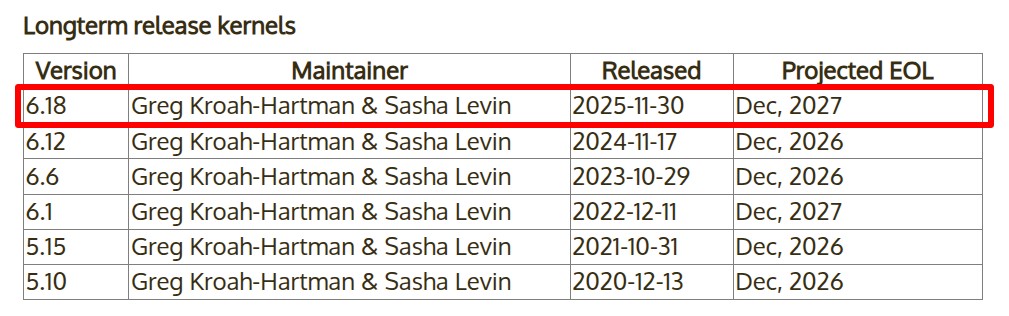
With that said, Linux 6.18 now joins the long-term support line as the sixth active LTS kernel, with an EOL projected for December 2027. It appears alongside the other five maintained LTS branches: 6.12 (EOL December 2026), 6.6 (EOL December 2026), 6.1 (EOL December 2027), 5.15 (EOL December 2026), and 5.10 (EOL December 2026).
Finally, it is worth mentioning that the new Linux 6.18 LTS brings a wide set of architectural, core kernel, and subsystem updates carried over from its initial release cycle. These include improvements in CPU architecture handling, expanded BPF features, updates to memory management, enhancements in scheduler behavior, and updates to various drivers.