
There’s no doubt that 2026 will bring plenty of new Linux releases, with Ubuntu 26.04 LTS likely being the most anticipated, set to arrive at the end of April. But this article isn’t about the usual names that tend to dominate the conversation year after year.
Instead, I want to focus on two relatively new projects that left a strong impression on me in 2025. What sets them apart is their originality: they aren’t built on top of existing distributions, and they take genuinely fresh approaches to how a Linux system can be designed and function.
And no, this isn’t about the wave of immutability that defined much of 2025, nor about distributions overloaded with tools in an attempt to be everything to everyone.
What we’re looking at here is something different. These projects have something rarer: a strong sense of identity, true originality, and a clear spirit of innovation. Both are rolling-release distributions, both are still in alpha or beta, and both feel full of promise.
I strongly believe that 2026 will be the year we see their first stable releases, and that they’ll bring something meaningful to the wider Linux family. With that, let me introduce them.
AerynOS
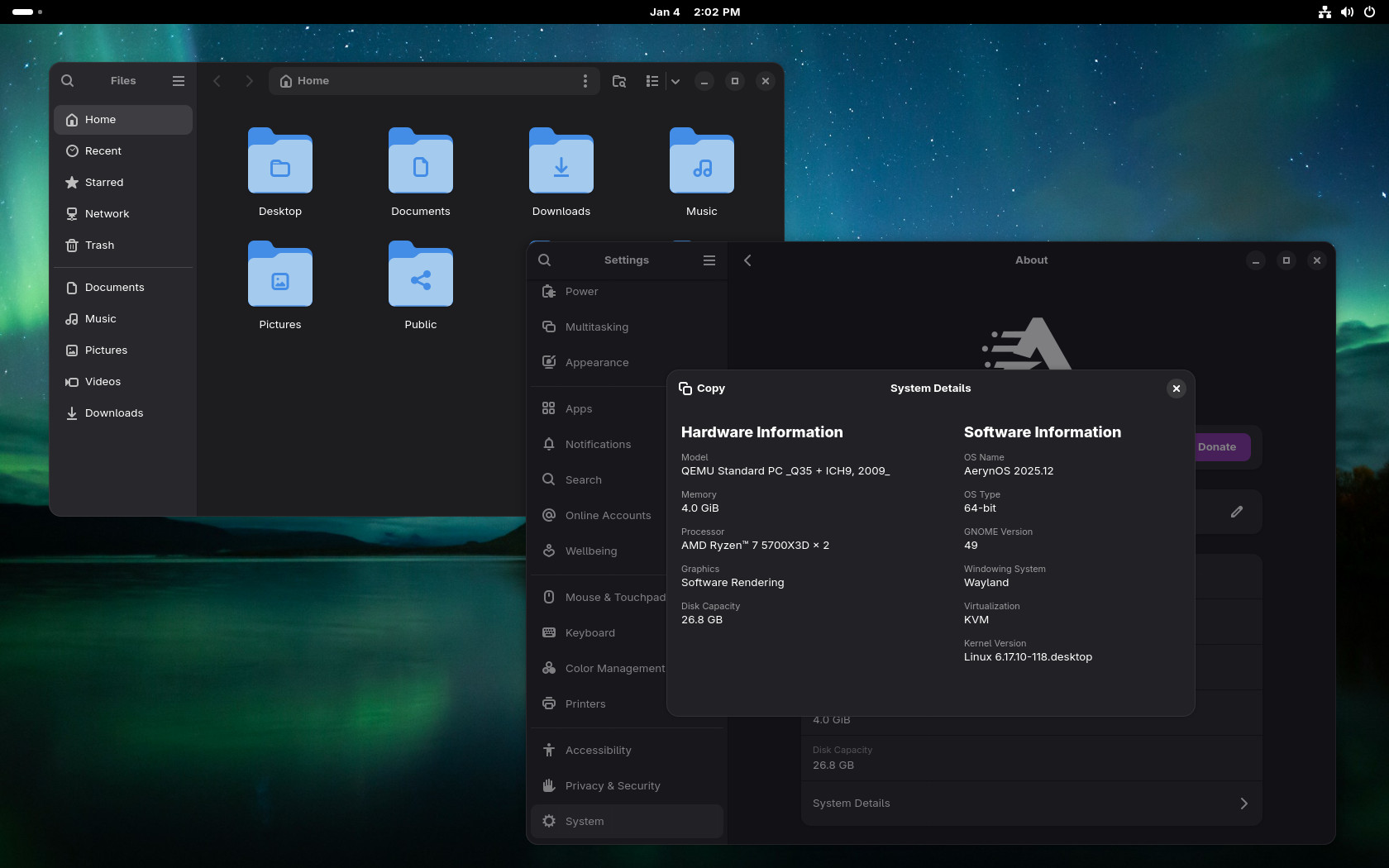
First and foremost, it’s time this project stopped being associated with one of its founders, Ikey Doherty. He has not been part of it since last spring. Ownership has since moved to the other co-founder and co-architect, Rune Morling (ermo), and development appears to be moving ahead at full speed. With that finally put to rest, let’s turn to the distribution itself.
AerynOS (previously known as Serpent OS) is an atomic-update-based rolling-release Linux distro (not to be confused with immutability) currently in alpha. Rather than performing traditional in-place package upgrades, AerynOS treats updates as atomic transactions. If any part of an update fails, the entire transaction is rolled back, preventing partial updates and preserving system integrity.
The beauty of this approach is that it does not rely on read-only filesystems or A/B partitioning schemes common in some immutable distributions, allowing the use of standard filesystems like ext4, XFS, etc., while still achieving atomicity and rollback. Every transaction creates a new boot entry tied to that system state, and retained states can be rolled back quickly if needed.
And honestly, I find this approach brilliant. It feels far more human and user-friendly than rpm-ostree, bootc, or the A/B root filesystem models commonly used for immutability and rollback. That said, this is entirely my personal opinion, and I’m not trying to speak for anyone else.
Yes, while Btrfs paired with Snapper and transactional-update is also among my favorites, the approach taken by AerynOS is the one I personally like the most. But enough about that. Let’s turn to the other foundation the distribution is built on: its in-house-developed moss package manager, written in Rust.
Above all, the moss package and system manager look and feel like a traditional package manager. Every file in every package is deduplicated using hashes, enabling efficient storage and rapid construction of new system states. Packages are distributed in a type-safe .stone binary format compressed with zstd and indexed for content-addressed retrieval.
As I said, moss thus manages not just individual packages but the entire operating system state, enforcing that packages contain only /usr-scoped files to maintain statelessness between the system and configuration, treating the entire OS state as a managed object rather than disjoint packages. This separation simplifies transaction logic, reduces conflicts, and supports a reproducible system layout.
With this set of features, AerynOS has everything it needs to earn a place in the relatively small but highly respected group of truly original Linux distributions. Projects that build not only the system itself, but also the tooling around it, from the ground up. Which, believe me, is an enormous amount of work.
Hopefully, if things go well, 2026 could be the year the project reaches beta, and why not even a stable release before the year’s end. If that happens, it’s likely to attract a following among more technically inclined users, especially those who already gravitate toward distributions like Arch or Void. And speaking of Void, that brings me to the second project I have high hopes for in 2026.
Chimera Linux
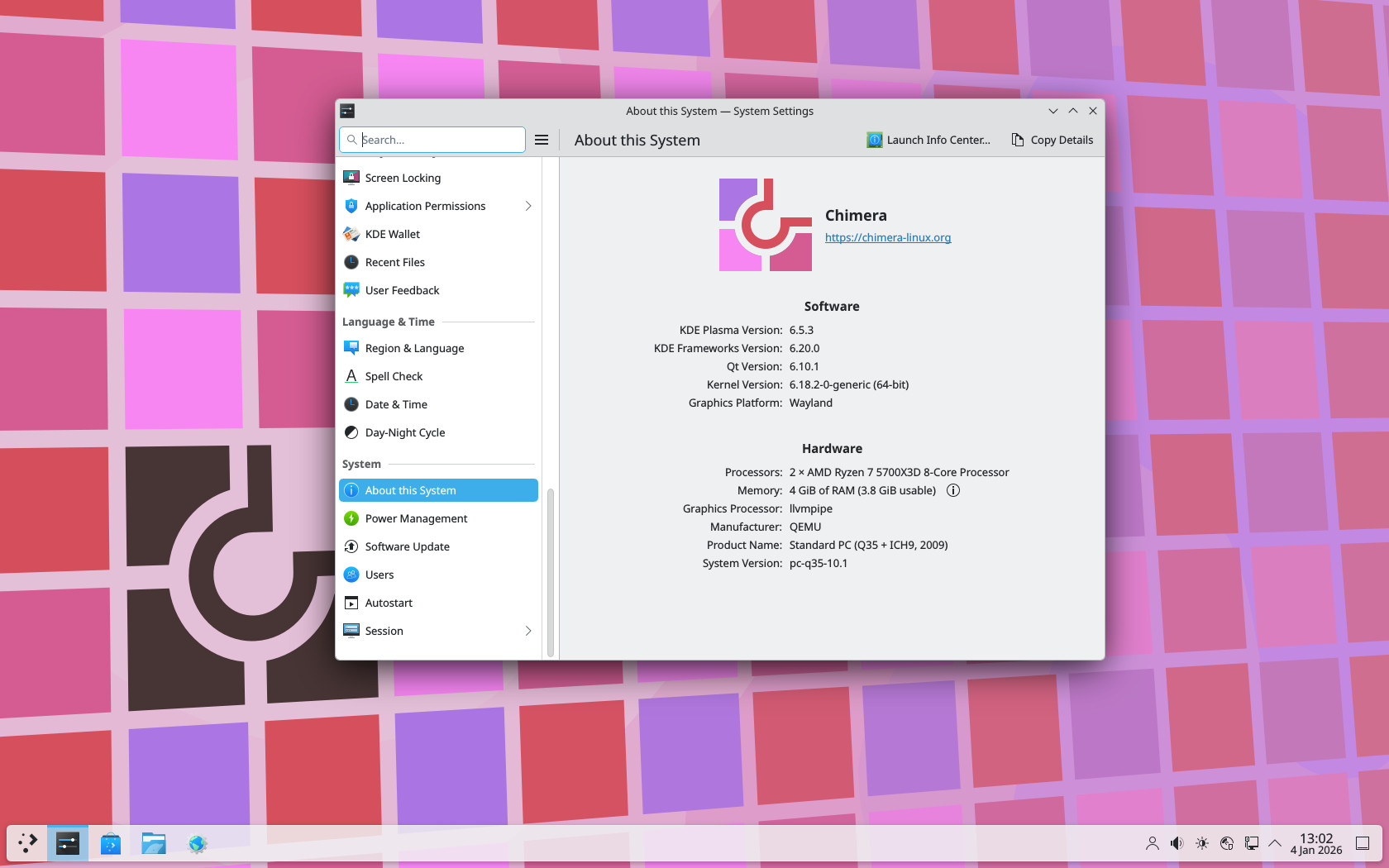
It’s no coincidence that I mentioned Void, since the distribution is often described as UNIX-oriented because many of its core design choices align more closely with traditional UNIX philosophy than with modern Linux distribution trends. Well, Chimera goes even further in that direction.
The project isn’t as new as AerynOS. Chimera Linux first launched more than four years ago, in mid-2021, and is still officially in beta (hitting alpha in mid-2023). Here’s a little more about the distribution itself and why I have high hopes for it in 2026.
As with AerynOS, Chimera is also an original rolling-release Linux distribution. But what’s more interesting, however, is that it can’t really be called GNU/Linux. Instead, it would be more accurate to describe it as non-GNU, and there’s a very good reason for that. It deliberately does not use the GNU userland as its core system environment.
As you know, the term GNU/Linux refers to systems that combine the Linux kernel with the GNU toolchain and core userland, most notably glibc, GNU coreutils, GNU binutils, Bash, and other GNU Project components. But Chimera Linux explicitly departs from this model.
It uses musl libc instead of glibc and replaces large parts of the GNU userland with BSD-derived and LLVM-based tools, including LLVM/Clang as the primary compiler and non-GNU implementations of standard utilities wherever possible. More importantly, this is not a partial or incidental difference; it is a design goal.
Chimera aims to build a clean, modern system that resembles a BSD-style userland running on the Linux kernel, rather than a GNU system with Linux underneath. It’s also worth noting that Chimera is a systemd-free distribution. It uses Dinit, an init system strongly influenced by the UNIX philosophy of doing one thing but doing it well.
For package management, Chimera relies on APK (Alpine Package Keeper), a tool well-known to Alpine Linux users, known for its simplicity, speed, and minimal overhead. The installation is done entirely from the terminal and follows a process very similar to installing Arch Linux.
Here, you won’t find features like atomic updates in AerynOS. Instead, the distribution follows the more common Linux approach, using a traditional package manager and regular package updates. That said, its choice of underlying components makes it exceptionally lightweight, fast, and flexible. Much like Arch, it gives you the freedom to build the system entirely around your own preferences and needs.
With that in mind, if you are an Arch or Void user and haven’t tried Chimera yet, it’s more than worth your time. I genuinely hope that 2026 will be the year it finally leaves beta and delivers its first stable release, which I am sure will not be missed by more advanced technical users. Needless to say, if you’re drawn to the BSD’s philosophy, Chimera Linux is simply a must-try.
Bottom Line
So, AerynOS and Chimera Linux are two projects I have high hopes for in 2026. Both sit a bit outside the spotlight, which usually focuses on the big names in the Linux world. Still, each has the qualities needed to reach a broader audience. Before that can happen, though, there’s one essential step: both need to move beyond their current alpha and beta phases and deliver stable releases.
Another important factor right now is their relatively small package ecosystems. Compared to the vast software collections available, for example, in Arch or Debian repositories, both AerynOS and Chimera Linux are still quite limited. That’s understandable given the smaller number of developers behind them, and it ties back to an earlier point: once stable versions are available, it’s reasonable to expect more developers to get involved and help expand their ecosystems.
I’m hopeful that this progress will happen in 2026. As always, I’ll be following both projects closely and reporting on any notable developments as they unfold.


Interesting but it will be a few more years before I even consider another distro since I have everything setup and working the way I want it. I have tried many distros in past only to either be burned by eol or annoying bugs only to migrate back to the bigger projects.
I’ve used Solus for a long time (excellent distro!), and have therefore been aware of Ikey Doherty and AerynOs. While I follow AerynOS’s development only sporadically, I’ve been interested in it for years. Strange and sad that Ikey no longer seems to be part of it, but I’m hoping that the distro reaches maturity soon. Also interesting to hear about that Chimera Linux, it’s new to me.
Can you try Fluff Linux?
Having btrfs for your root partition with Limine gives you the same rollback capability as AerynOS
I’ve been daily driving AerynOs for a couple of months. I’m not recommending that to anyone else given the alpha status and limited package base currently but it serves all my needs currently (with perhaps a little more reliance on Flatpaks than I would like in the long run) and it’s absolutely solid.
Although it feels like a ‘technical’ distro, the manifestation of that technology is something that is very reliable and easy to use for the end user.