
The Open Source Initiative, a nonprofit organization that promotes and protects open source software, has published its annual ranking of the most viewed open source licenses in 2025, reflecting the preferences and priorities of developers, organizations, and open source communities worldwide.
At the top of the 2025 rankings is the MIT License, maintaining its long-standing position as the most sought-after open-source license. With approximately 1.53 million pageviews and 925,000 unique visitors, the MIT License’s permissive terms and minimal restrictions remain highly attractive for projects ranging from personal open source repositories to large-scale commercial products.
Following the MIT License, the Apache License 2.0 ranks second in interest, drawing 344,000 pageviews and 245,000 unique visitors. Its strong patent grant and clear terms for contributions make it a preferred choice for many enterprise and cloud-native projects seeking compatibility with broader software ecosystems.
The BSD family of licenses, specifically the BSD 3-Clause and BSD 2-Clause variants, also feature prominently. The BSD 3-Clause garnered 214,000 pageviews with 173,000 visitors, while the simpler BSD 2-Clause license registered 128,000 pageviews and 104,000 visitors.
Traditional GNU General Public Licenses remain in high demand in 2025. The GPL-2.0 and GPL-3.0 versions together account for over 130,000 pageviews.
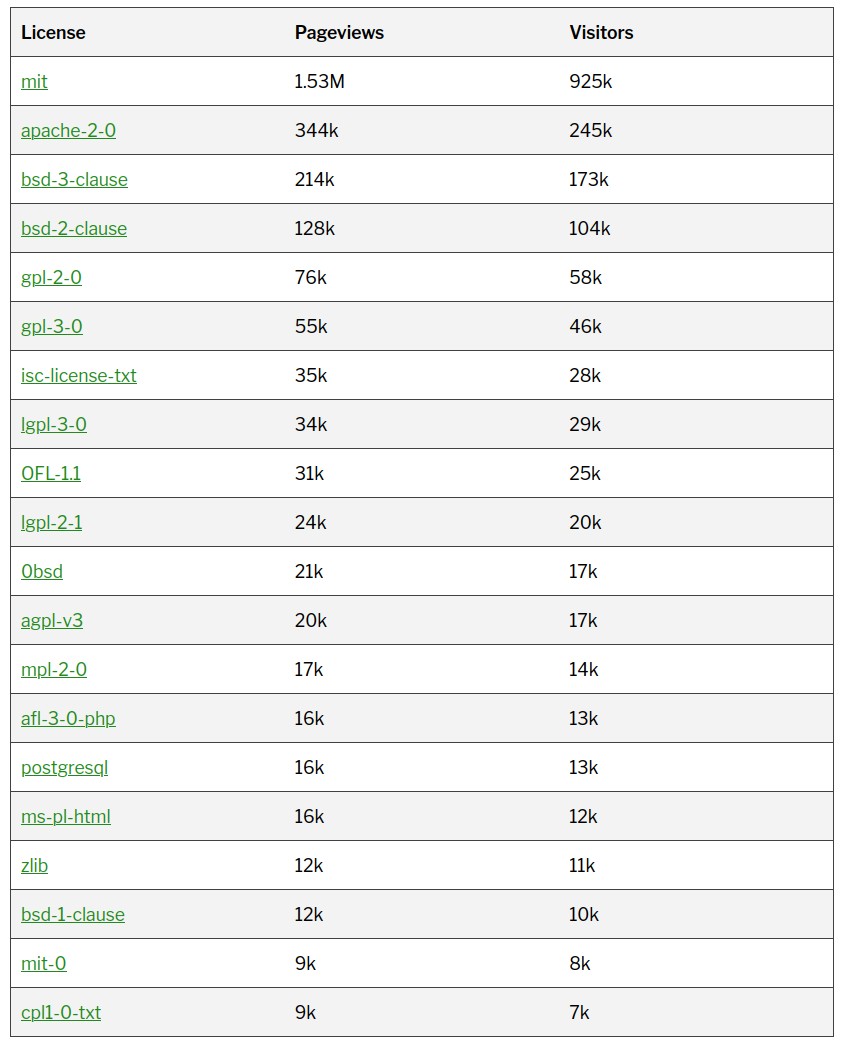
Beyond these leading entries, several other licenses appear in the top 20 list based on community engagement. These include the ISC License, LGPL 3.0, Open Font License (OFL 1.1), and the Mozilla Public License 2.0 (MPL-2.0). Permissive, weak copyleft, and non-software licenses, such as the 0BSD and AGPL-v3, round out the broader landscape of developer interest.
OSI’s ranking is based on the number of human-driven pageviews of enriched license pages across the calendar year 2025. This methodology accounts for multiple entry points to license content and attempts to filter out bot or crawler traffic, although actual usage figures may be higher due to ad blockers and other tracking limitations.
For those curious, here is a brief comparison of the most popular open-source licenses in 2025.
| License | Type | Copyleft | Patent Grant | Typical Use Cases |
|---|---|---|---|---|
| MIT | Permissive | No | No | Libraries, startups, commercial software, personal projects |
| Apache License 2.0 | Permissive | No | Yes | Enterprise software, cloud platforms, foundations |
| BSD 3-Clause | Permissive | No | No | Academic projects, infrastructure software |
| BSD 2-Clause | Permissive | No | No | Minimalist libraries, embedded systems |
| GPL-2.0 | Strong copyleft | Yes | Implicit | Kernels, core system software |
| GPL-3.0 | Strong copyleft | Yes | Explicit | Applications, tools needing patent protection |
| LGPL-3.0 | Weak copyleft | Partial | Explicit | Shared libraries |
| MPL-2.0 | File-level copyleft | Partial | Explicit | Mixed proprietary/open projects |
| ISC | Permissive | No | No | Small utilities, replacements for MIT/BSD |
| OFL-1.1 | Specialized | No | N/A | Fonts and typography projects |
So, what is the conclusion from all this? Permissive licenses continue to dominate the open source landscape in 2025, with the MIT License and Apache License 2.0 accounting for the largest share of developer interest. Their minimal restrictions and broad compatibility make them well-suited to modern software development, particularly in commercial, cloud, and infrastructure projects.
At the same time, copyleft licenses, including GPL-2.0 and GPL-3.0, remain significant but are increasingly concentrated in system-level software and projects that prioritise reciprocal sharing. Meanwhile, weak copyleft options such as LGPL-3.0 and MPL-2.0 continue to serve as compromises for projects that balance openness with proprietary integration.
Finally, the 2025 rankings largely mirror patterns seen in previous years, with permissive licenses dominating overall interest and usage. Comparing the 2025 data with the 2024 list shows consistent demand for the same core set of licenses, suggesting stability in how projects balance flexibility, community contribution, and legal clarity.
For more information, see the ranking itself on the Open Source Initiative website.




It’s a shame that there’s seems to be a trend away from viral licensing. That being said, the GPL et al. have so many holes in them that often you’re just alienating companies from using your software without providing much protection in practice.