

KDE Linux, a new, still-in-development KDE initiative to bring its own immutable distro as a Plasma-first Linux OS to the public, continues to move beyond an initial alpha stage, reached in September 2025.
According to the KDE devs, contributor activity has expanded noticeably since then, and at the time of writing, the project estimates it is roughly 62 percent of the way toward beta readiness.
One of the most recent changes is enabling delta updates by default. Instead of downloading full operating system images, KDE Linux now calculates and applies only the differences between builds. For users updating daily, this means reducing typical update sizes from around 7 GB to approximately 1–2 GB.
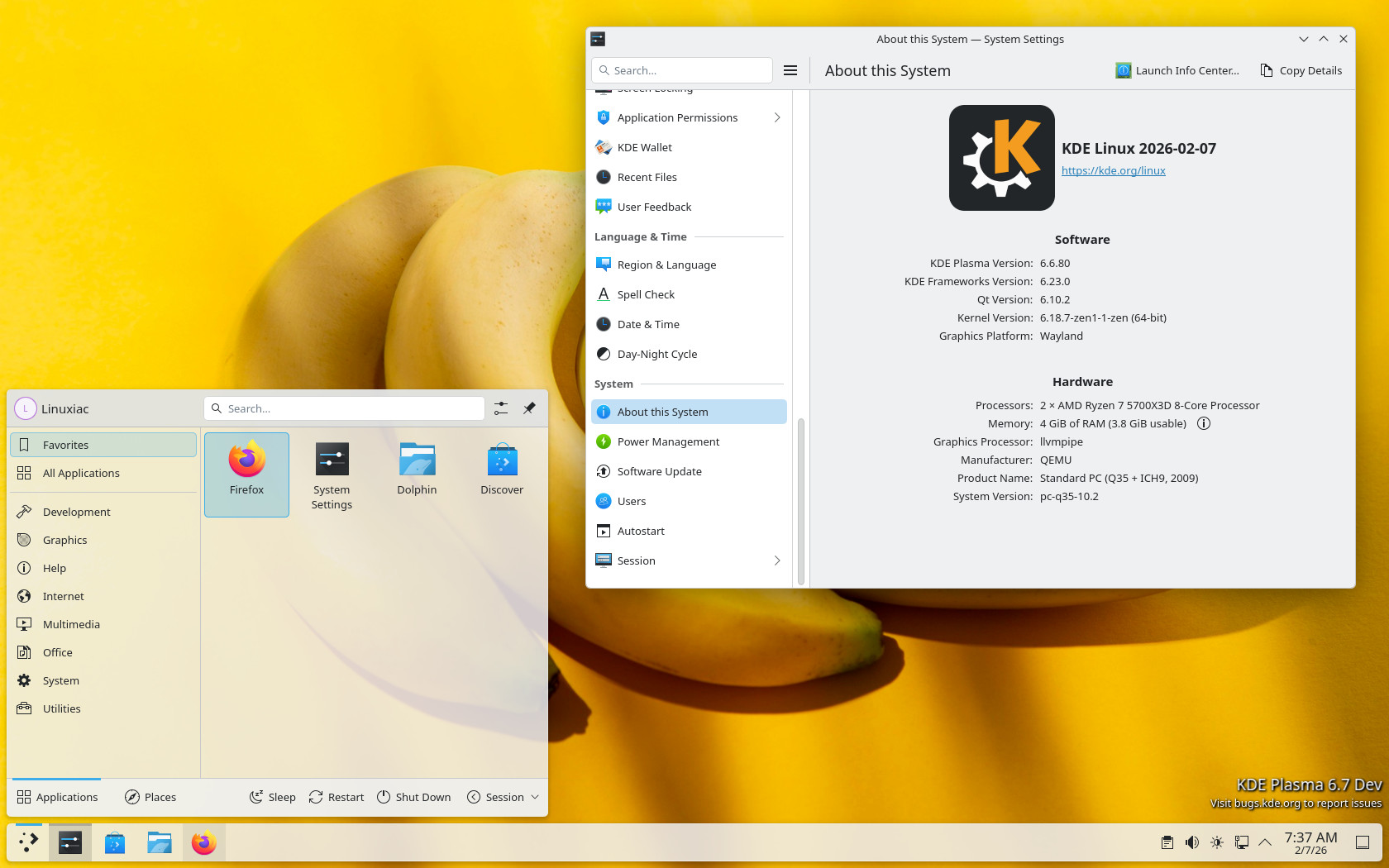
Initial user setup has also been reworked. KDE Linux now relies on plasma-setup to handle first-user configuration, particularly for systems shipped with Plasma preinstalled. At the same time, the distribution has switched from SDDM to Plasma Login Manager, a newer login manager designed for deeper integration with Plasma on systemd-based systems.
Hardware support has expanded, with recent builds including improved support for scanners, drawing tablets, Bluetooth file sharing, Android devices, gaming peripherals, multi-button mice, LVM setups, exFAT and XFS filesystems, audio CDs, security tokens, smart cards, virtual cameras, USB Wi-Fi devices with onboard storage, and Vulkan on selected GPUs.
On the performance side, kernel configuration and middleware components such as PulseAudio and PipeWire have been adjusted to improve responsiveness and efficiency, including optimizations for low-latency audio. Plus, KDE Linux now uses the Zen kernel.
Moreover, the boot menu is now hidden by default to reduce noise during startup, while still appearing automatically after failed or rapid restarts to allow rollbacks. Wireless performance has also been improved by automatically setting the regulatory domain based on the system’s time zone, allowing hardware to operate at legally permitted power levels without manual configuration.
Regarding software, KCalc is now preinstalled as the default calculator, alongside the Qrca QR code scanner. KDE’s Kup backup utility is scheduled for inclusion to promote off-device backups.
It’s worth noting that the distro now ships with a refined default Zsh configuration and a basic “command not found” handler to guide users when they run commands that aren’t available. RAR archive support has also been added to Ark.
Finally, the project has removed several components. Snap support has been dropped due to its reliance on the Arch User Repository and the project’s goal of avoiding AUR dependencies by beta. Homebrew is no longer recommended after reports of system instability caused by user-level library overrides.
Additionally, several applications, including Kate, Elisa, and Icon Explorer, were removed from the base image to reduce overlap or because they are readily available via Flatpak. The iwd wireless daemon was also removed following limited use and uncertainty around its future maintenance.
For more information, see Nate Graham’s post.
If you want to try KDE Linux, you can find the instructions here. Just keep in mind that manual partitioning is currently broken, so avoid it for now.





Removing Kate to allow the Flatpack version? Slower to launch, more storage space, less likely to upgrade to new versions, harder to create shortcuts on the desktop, etc.