
KaOS 2026.02 is now available, marking a major change in the distribution’s history. And if you’re wondering why, here’s the big surprise. While KaOS has traditionally focused on KDE and Plasma, this ISO does not include Plasma or KWin. Instead, it features a desktop based on the Niri Wayland compositor and the Noctalia shell.
According to the project, this change is part of the distro’s ongoing efforts to move away from systemd and evaluate alternatives, such as the Dinit service manager. As Plasma’s reliance on systemd grows and full integration becomes mandatory upstream, KaOS developers are exploring other desktop options to maintain a Qt-focused distribution.
“For those wondering why this change, it has come into play because of a desire to move away from Systemd. Work is ongoing to see if a move to Dinit is viable for this distribution, that also meant, looking for an alternative to Plasma, since Plasma pretty much demands Systemd, and will be fully mandatory soon.”
It’s worth noting, however, that the current ISO still uses systemd and serves as a test platform to assess user response to a possible future transition. At the same time, Plasma 6 remains fully available in the repositories.
The desktop stack features Niri 25.11, Noctalia 4.4, and Quickshell 0.2.1, all built on Qt 6.10.2, delivering a scrollable tiling Wayland experience while maintaining KaOS’ commitment to a Qt-only, GTK-free system.
However, the first step away from systemd has been taken as the ISO introduces Limine as the default bootloader, replacing systemd-boot. Other UEFI boot options are still available through Calamares.
While systemd 254 was the last to fully support KaOS’s split /usr setup, the ISO now ships with systemd 255.22. Installed systems are expected to transition to systemd 257.10, though generating a live ISO with that version is not yet fully resolved.
Core system updates include Linux kernel 6.18, GCC 15.2.1, Glibc 2.42, Binutils 2.45, Mesa 25.3.5, PipeWire 1.4.9, GStreamer 1.28, ZFS 2.4, CMake 4.2, OpenSSH 10.2, Bash 5.3, Protobuf 33.5, OpenCV 4.12.0, and Poppler 26.02.0. The Linux kernel now includes built-in microcode for automated early updates.
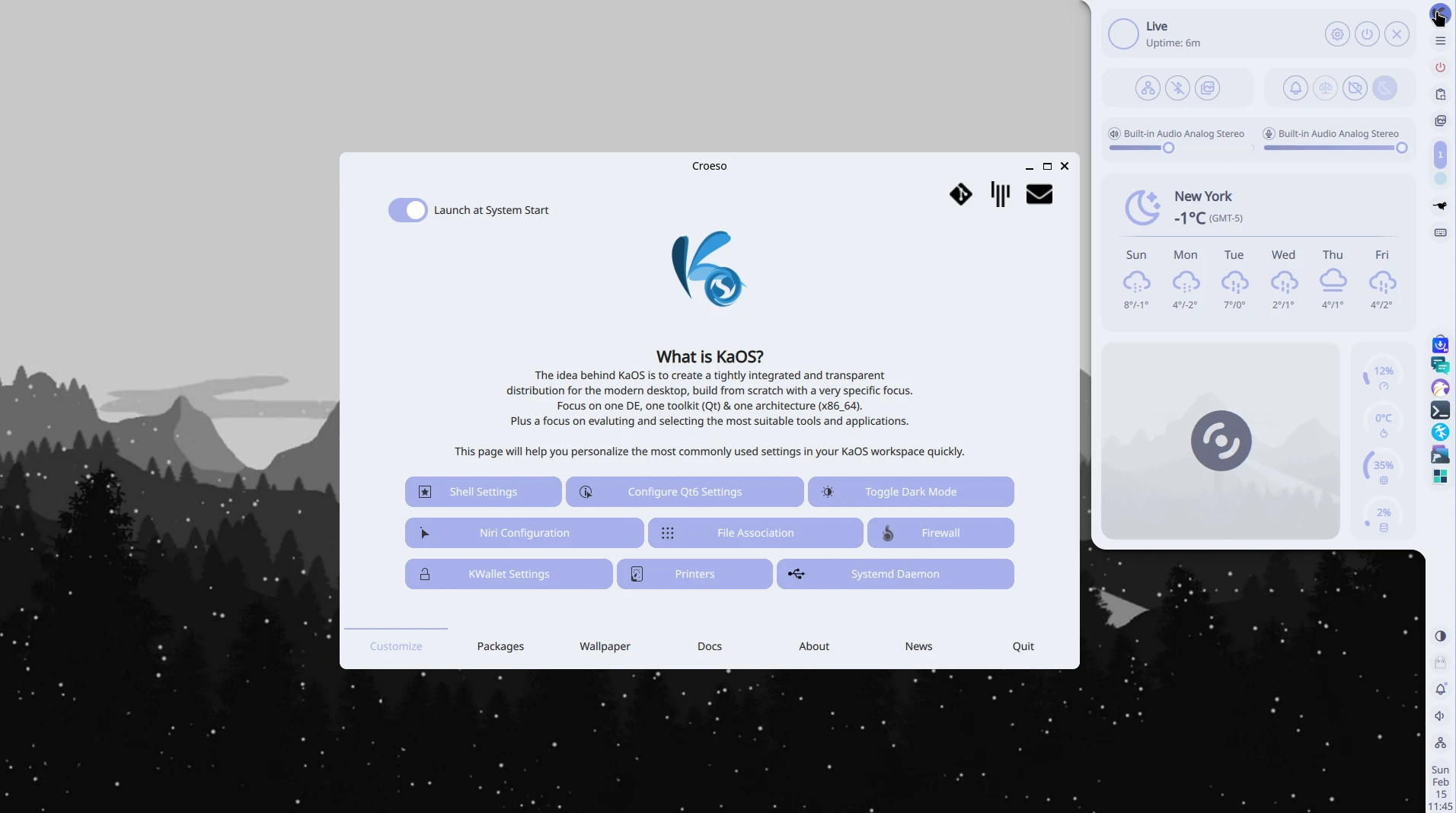
Installer improvements include Calamares no longer opening a web browser as root on the Welcome page. Additional information is now provided through a QML Drawer integrated into the interface. Automated partitioning supports XFS, EXT4, Btrfs, and ZFS without manual setup.
The default filesystem is still XFS with CRC and finobt enabled. However, BIOS installations cannot use XFS due to GRUB compatibility issues with the latest XFS implementation. RAID installations are currently unsupported.
Multimedia updates include a new Phonon backend. Since there is no Qt6 port of VLC, KaOS now defaults to phonon-mpv, ensuring a fully Qt6-ready media stack. SDDM 0.20 runs in Wayland mode, further reducing reliance on X11. System logging is simplified with Kjournald, a graphical log viewer included by default.
Croeso, KaOS’s post-install configuration tool, remains included. Written in QML, it offers options to adjust commonly used settings, select wallpapers, install packages from predefined groups, and access distribution information. The Live environment also includes an installation guide. Artwork updates feature the Midna icon theme.
Known issues include the inability to install on RAID, GRUB failures with XFS on BIOS systems, and the need for 3D acceleration with the VMSVGA adapter to support Wayland in VirtualBox. The project also reiterates that its ISO images do not support tools such as Unetbootin or Rufus.
The release announcement contains detailed information about all changes. The ISO image is available on the project’s Download page.
Image credits: KaOS Project




“…since Plasma pretty much demands Systemd, and will be fully mandatory soon”
WOW, way to completely misunderstand the KDE project.
Just because a single (optional) program requires systemd doesn’t mean the whole desktop will.
It kind of does though, as the easy logical integrated solution can no longer be used for systemd-free distros. They will have to find their way around it, and explore new login managers/greeters options. As if they didn’t have enough work to maintain their distro.
It’s not a blocker either, I understand that. But it just makes things more complicated than they should be.
Uhhh kde plasma literally just did a thing about this in 9 to 5 linux and said thid.
“Only the Plasma Login Manager will be dependent on systemd, but future Plasma releases aren’t dependent on Plasma Login Manager, nor systemd”
Smart move. systemd is paying the price for spreading their tentacles to the point of trying to lock the entire Linux ecosystem around them.
This is not what Linux users want, and it starts to show.
Exactly right Voltaflake.
Sounds like reading comprehension is not your forte.
Sounds like it is my forte, but it definitely isn’t yours.
They clearly don’t like the direction of systemd and how deep systemd/Red Hat spread their tentacles (here with plasma login manager, although it doesn’t prevent from using KDE with another greeter) and are working their way around it to keep a QT environment. This is exactly what I said if you were able to read the big picture.
And, for using a distro using dinit rather than systemd, I could not agree more with their choice.
The momentum is on dinit, it’s been growing of late as the best Linux init and service system.