Cloudflare, which manages about 20 percent of global internet traffic, published its annual Radar Year in Review summarizing internet trends for 2025.
The company operates one of the world’s largest content delivery, DNS, and security infrastructures, with data centers in hundreds of cities and visibility into traffic for millions of websites, applications, and APIs. Here is a summary of the most important points.
Global internet traffic rose by 19 percent in 2025. Much of this increase came from more automated activity, especially AI-related crawling. Cloudflare saw big jumps in traffic from AI bots used for content discovery, training, and real-time data access.

While traditional search crawlers such as Googlebot remained dominant, newer AI-focused crawlers from companies including OpenAI, Anthropic, and Meta expanded rapidly.
In over 100 countries, most web requests came from mobile devices, showing the shift to mobile-first internet use. Cloudflare also reported that Starlink traffic more than doubled in many areas, especially where regular internet is limited or during disruptions.
The data shows that iOS devices accounted for 35% of global mobile traffic in 2025, up 2 points from the previous year. Android still led worldwide, but iOS was most popular in some countries. Monaco had the highest iOS share at 70%, and iOS made up over half of mobile traffic in 30 places, including Denmark (65%), Japan (57%), and Puerto Rico (52%).
By contrast, Android traffic was overwhelmingly dominant in many developing markets, exceeding 90% in 27 countries, led by Papua New Guinea at 97%, with Sudan, Malawi, Bangladesh, and Ethiopia all above 95%. Overall, Android generated 50% or more of mobile device traffic in 175 countries and regions worldwide.
As expected, Chrome remained the top browser in 2025, accounting for about two-thirds of all web traffic, similar to last year. Safari was second with 15.4%, followed by Microsoft Edge at 7.4%, Mozilla Firefox at 3.7%, and Samsung Internet at 2.3%.
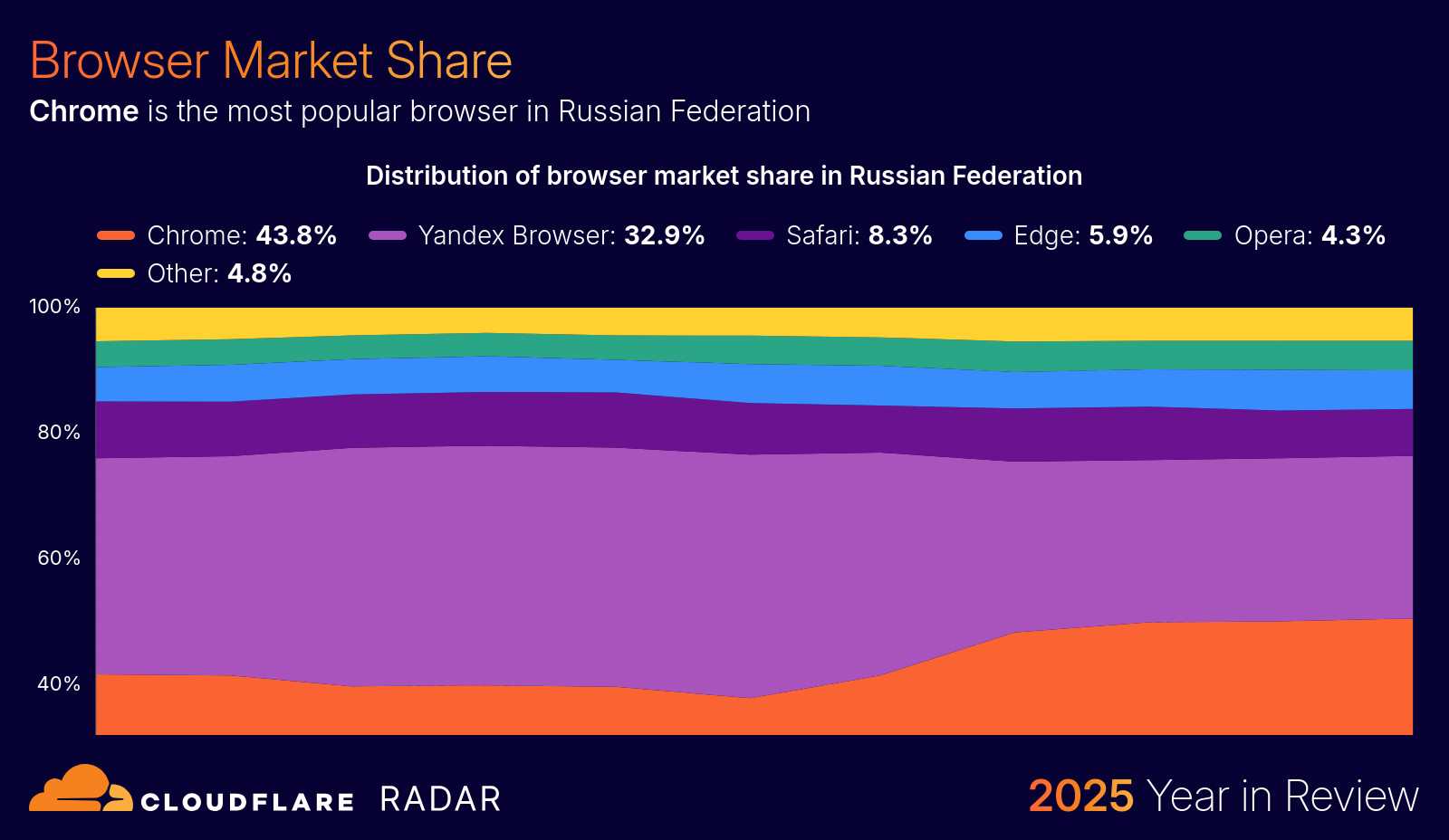
The overall picture shifts notably by operating system: on iOS, where Safari is the default browser, it generated 79% of request traffic, far ahead of Chrome’s 19%, while all other browsers combined accounted for less than 1%. On Android, Chrome was even more dominant, responsible for 85% of requests, with Samsung Internet a distant second at 6.6%.
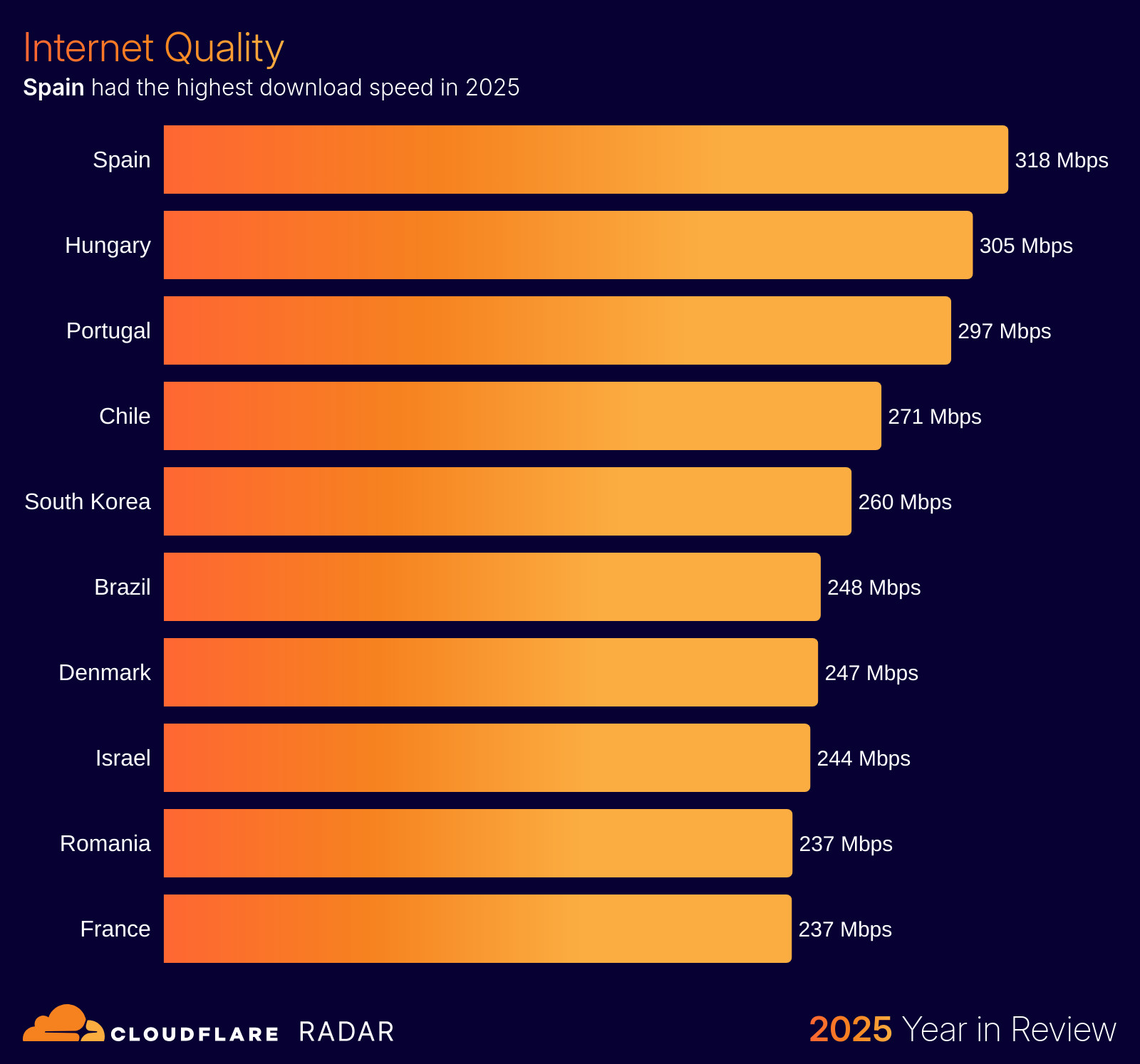
When it comes to internet speed, European countries led the world, with all top performers averaging over 200 Mbps downloads. Spain stood out in several categories.
Based on aggregated results from tests run on speed.cloudflare.com, Spain, Hungary, Portugal, Denmark, Romania, and France ranked among the world’s fastest, with Spain and Hungary exceeding 300 Mbps on average for downloads, posting year-over-year gains of 25 Mbps and 46 Mbps, respectively.
Regarding security and resilience trends in 2025, Cloudflare reported continued growth in the scale and frequency of large distributed denial-of-service attacks, including hyper-volumetric events that set new records. At the same time, adoption of post-quantum cryptography accelerated significantly, with more than half of observed HTTPS traffic (52%) now using quantum-resistant encryption mechanisms.
Network reliability remained uneven across regions. Nearly half of the major internet outages tracked by Cloudflare in 2025 were linked to government-mandated shutdowns or restrictions. Other outages were attributed to power failures, cable damage, and natural disasters.
Finally, newer protocols like HTTP/3 and HTTP/2 continued to grow, while older HTTP/1 traffic continued to decline.
For a detailed overview, refer to the 2025 Cloudflare Radar announcement.